India retains world's fastest-growing economy tag at 6.4% in 2025: UN
Synopsis
Even as the Iran war rattles global energy markets and the UN cuts its world growth forecast to 2.5 per cent, India holds its ground as the planet's fastest-growing major economy at 6.4 per cent — with the UN flagging that its diversified energy sourcing, foreign exchange reserves, and fiscal buffers give it more room to absorb the shock than most.
Key Takeaways
The United Nations projects India's GDP growth at 6.4 per cent in 2025 — the fastest among major economies.
This is a 0.2 percentage point downgrade from the 6.6 per cent January forecast; the UN expects a recovery to 6.6 per cent in 2026 .
Growth drivers — consumer demand, public investment, and services exports — are expected to remain intact, according to UN senior economist Ingo Pitterle .
India's refining infrastructure, foreign exchange reserves, and fiscal buffers may limit the crude price pass-through from the Strait of Hormuz closure.
Global growth was cut to 2.5 per cent for 2025; China follows India at 4.6 per cent , the US at 2 per cent .
Rising import costs for industrial inputs could pressure producer prices and export competitiveness if buffers are exhausted, the UN warned.
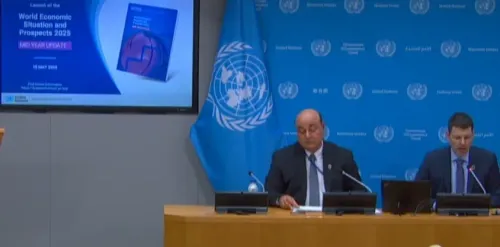
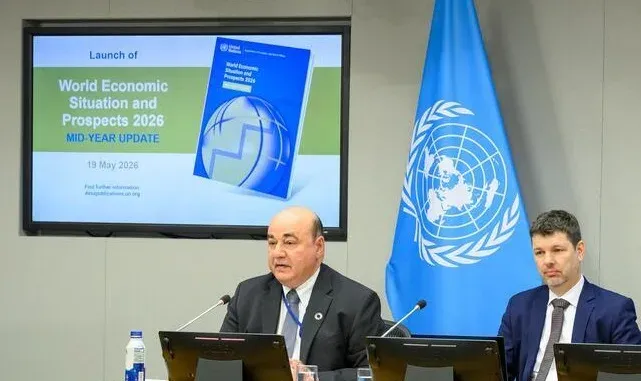
India will retain its position as the world's fastest-growing major economy in 2025, expanding at 6.4 per cent, even as the fallout from the Iran war and the closure of the Strait of Hormuz weigh on global trade and energy markets, according to the United Nations mid-year update to its World Economic Situation and Prospects report released on 20 May.
The projection marks a 0.2 percentage point downgrade from the 6.6 per cent forecast made in January, but the UN expects India to recover to that figure in 2026.
What Is Driving India's Growth
'We have seen structurally very robust growth in India, which has been driven by consumer demand, by public investment, but also by strong performance in services exports,' said Ingo Pitterle, the UN's senior economist heading its Global Economic Monitoring Branch, briefing reporters on Tuesday. 'These main drivers will largely remain intact,' he added.
Shantanu Mukherjee, director of the UN's Economic Analysis and Policy Division, acknowledged the downgrade but noted that 'India is a large economy well diversified,' pointing to structural reforms and improvements in tax revenues as stabilising factors.
How India Is Buffered Against the Iran War Shock
The closure of the Strait of Hormuz by Iran has disrupted global energy flows, stoking inflationary pressures worldwide. However, the report assessed that 'India's diversified energy sourcing and structural buffers, including its refining infrastructure, ample foreign exchange reserves, and fiscal space to manage fuel prices, may limit the direct pass-through of higher crude prices.'
Pitterle flagged residual vulnerabilities: remittance flows face pressure, and any tightening in global financial conditions could complicate India's monetary policy calculus. He nonetheless characterised India's baseline outlook as 'solid growth of around 6.4-6.5 per cent.'
Global Growth Downgraded to 2.5 Per Cent
The UN cut its world growth forecast by 0.2 percentage points to 2.5 per cent for 2025, attributing the revision primarily to the Middle East crisis. 'The crisis in the Middle East has delivered another major shock to the world economy, testing the resilience of global growth, stoking inflationary pressures and further challenging the prospects for sustainable development,' the report stated.
Despite the headline drag, the report noted that aggregate projections are supported 'by the performance of large economies, most notably China and India.' China is projected to grow at 4.6 per cent in 2025, slipping to 4.5 per cent in 2026. Among developed economies, the United States leads with a projected 2 per cent growth in both years, while the European Union is forecast at 1.1 per cent this year and 1.4 per cent next year.
Risks India Must Watch
Mukherjee cautioned that rising import costs — particularly for industrial petrochemicals such as naphtha, diesel fuel, and logistics inputs — could eventually filter through to producer prices and erode export competitiveness. 'When import costs go up, if these are going into producing your exports, into your manufacturing, your exports could also suffer,' he said.
He stressed the importance of tracking the producer price index alongside the consumer price index to gauge the true inflationary impact on businesses. India's ability to absorb these shocks, he said, depends on how long existing fiscal buffers and foreign exchange reserves hold out before they are drawn down.
The overall South Asia growth projection stands at 4.6 per cent for 2025 and 5.6 per cent for 2026, pulled below India's individual rate by weaker performances elsewhere in the region. With global headwinds persisting, the UN's next quarterly assessment will be closely watched for any further revision to India's trajectory.
Point of View
But the 0.2-point downgrade is a quiet signal that even structurally resilient economies are not insulated from geopolitical shocks. The more telling detail is the warning on producer prices: if freight, logistics, and petrochemical input costs keep climbing, India's export competitiveness — not just its inflation print — comes under threat. The government's fiscal space is real, but finite; how it is deployed in the next two quarters will determine whether the 6.6 per cent recovery forecast for 2026 holds or becomes the next number to be revised downward.
NationPress
21 Sept 2026
Frequently Asked Questions
What is India's GDP growth forecast for 2025 according to the UN?
The United Nations projects India's GDP growth at 6.4 per cent in 2025, making it the world's fastest-growing major economy. This is a 0.2 percentage point downgrade from the 6.6 per cent forecast issued in January, with the UN expecting India to recover to that figure in 2026.
Why has the UN downgraded India's growth forecast?
The downgrade reflects the global economic disruption caused by the Iran war and the closure of the Strait of Hormuz, which has pushed up energy prices and stoked inflationary pressures worldwide. The UN still characterises India's baseline as 'solid growth of around 6.4-6.5 per cent.'
How is India protected from the Iran war's economic fallout?
According to the UN report, India's diversified energy sourcing, refining infrastructure, ample foreign exchange reserves, and fiscal space to manage fuel prices may limit the direct pass-through of higher crude prices. However, the UN flagged vulnerabilities in remittance flows and potential monetary policy complications from global financial tightening.
How does India's growth compare with China and the US in 2025?
India leads at 6.4 per cent, followed by China at 4.6 per cent and the United States at 2 per cent, according to the UN mid-year update. The European Union is projected at 1.1 per cent for 2025.
What risks could slow India's growth in the coming months?
The UN warned that rising import costs — including freight, logistics, and industrial petrochemicals like naphtha and diesel — could push up producer prices and eventually hurt export competitiveness. India's resilience depends on how long its fiscal buffers and foreign exchange reserves can absorb these pressures before they run out.