Will India Maintain Its Status as the Fastest Growing Major Economy at 6.6% Amid Trade Challenges?
Synopsis
A recent UN report reveals that India is set to retain its title as the fastest growing major economy at 6.6% this year, despite the challenges posed by US tariffs and global trade upheavals. Discover how India's private consumption and public investment are key factors in this economic resilience.
Key Takeaways
India is set to maintain its status as the fastest growing major economy at 6.6% this year.
US tariffs have been significant, yet India's economy remains resilient.
Tax reforms and monetary easing play crucial roles in India's growth.
The global economy is expected to grow at a slower rate of 2.7% this year.
South Asia's economic outlook is also positive, with growth projected at 5.6%.
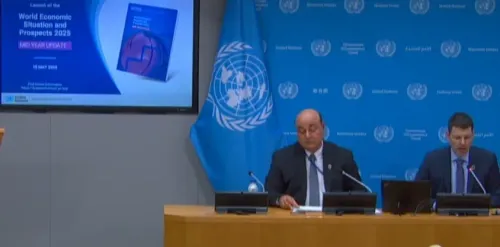
According to a recent report from the United Nations dated January 8, India is projected to remain the fastest growing major economy this year with an impressive growth rate of 6.6%. This growth showcases India's remarkable resilience against challenges posed by trade disruptions and tariffs imposed by the United States.
The UN's flagship economic analysis credits this performance to ongoing tax reforms and monetary easing.
The report highlights that India's robust private consumption and significant public investment are likely to significantly counterbalance the negative impacts of higher tariffs on Indian exports.
Despite facing a total of 50% tariffs from US President Donald Trump, India has successfully maintained its position in the growth rankings.
The World Economic Situation and Prospects 2026 (WESP) report estimates India's growth rate at 7.4% last year, projecting a slight moderation this year before rising again to 6.7% next year.
In comparison, the global economy is expected to grow at 2.7% this year, a slight decline from last year's 2.8%, with an anticipated increase to 2.9% next year.
This growth remains below the pre-pandemic average of 3.2%.
For China, a growth rate of 4.6% is expected this year, decreasing to 4.5% next year, down from an estimated 4.9% last year.
The United States is projected to achieve the highest growth rate among developing nations, improving slightly from 1.9% last year to 2% this year and 2.2% the following year.
The European Union saw an estimated growth of 1.5% last year, with forecasts of 1.3% this year and 1.6% next year.
Overall, the world economy has proven to be more resilient against trade disputes than anticipated.
The report notes that in 2025, unexpected strength against significant increases in US tariffs, buoyed by strong consumer spending and easing inflation, has helped sustain growth.
An easing of trade tensions has also contributed to limiting disruptions in international trade.
Nevertheless, the report cautions that underlying weaknesses remain, such as subdued investment and limited fiscal space, which could lead the world economy to settle into a slower growth trajectory compared to the pre-pandemic era.
The impact of increased tariffs is expected to become more evident this year.
Introducing the report, Secretary-General António Guterres stated, "A mix of economic, geopolitical, and technological tensions is reshaping the global landscape, resulting in new economic uncertainties and social vulnerabilities."
The outlook for South Asia remains relatively strong, projected at 5.6% for this year and increasing to 5.9% next year, recovering to the 5.9% level estimated for the previous year.
However, the report warns that uncertainty in trade policy could impact economic prospects, and the high public debt in several nations limits fiscal space and increases vulnerability to shocks.
Here are this year's growth forecasts for other South Asian nations:
Bangladesh: 5.1%; Bhutan: 6%; Maldives: 4%; Sri Lanka: 4.3%; Pakistan: 3.6%.
Point of View
It is evident that India's economic resilience amid challenging international trade dynamics is commendable. The proactive measures taken through tax reforms and increased public investment are crucial in sustaining growth. As we monitor these developments closely, it is clear that India's trajectory will significantly impact not only its economy but also the broader South Asian region.
NationPress
6 Oct 2026
Frequently Asked Questions
What is the projected growth rate for India this year?
India is projected to grow at a rate of 6.6% this year, according to the latest UN report.
How have US tariffs affected India’s economy?
While US tariffs have been challenging, India's resilient private consumption and public investment are expected to counteract their negative impact.
What other countries are mentioned in the report?
The report also provides growth projections for countries like China, the US, and various South Asian nations.
What factors contribute to India’s economic resilience?
Key factors include recent tax reforms, monetary easing, strong consumer spending, and significant public investment.
What is the overall outlook for the global economy?
The global economy is projected to grow by 2.7% this year, slightly below last year's 2.8%, with ongoing uncertainties.