India-New Zealand elevate ties to Strategic Partnership: PM Luxon
Synopsis
For the first time in 40 years, an Indian Prime Minister has visited New Zealand — and the outcome is a formal Strategic Partnership that reframes a relationship long defined almost entirely by trade. With an FTA already eliminating tariffs on 57% of NZ exports to India from day one, the upgrade signals both nations are betting on the Indo-Pacific's emerging strategic geometry.
Key Takeaways
India and New Zealand elevated bilateral ties to a Strategic Partnership on 11 July in Auckland .
This is the first visit by an Indian Prime Minister to New Zealand in 40 years .
The Free Trade Agreement (FTA) will eliminate tariffs on 57 per cent of New Zealand's exports to India from day one.
Several MoUs were signed across multiple sectors following delegation-level talks.
PM Modi's Auckland stop was the final leg of a three-nation visit .
New Zealand PM Christopher Luxon announced the partnership, crediting Modi's personal commitment to advancing ties.
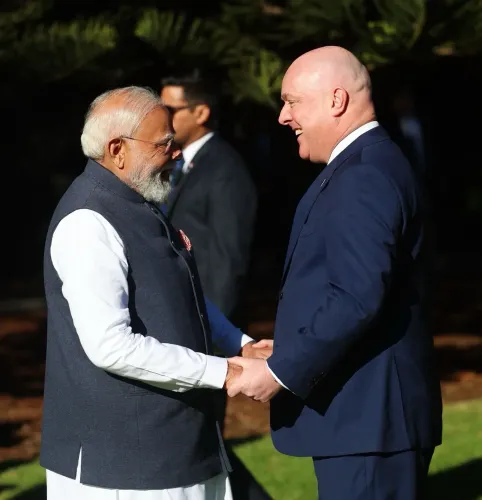
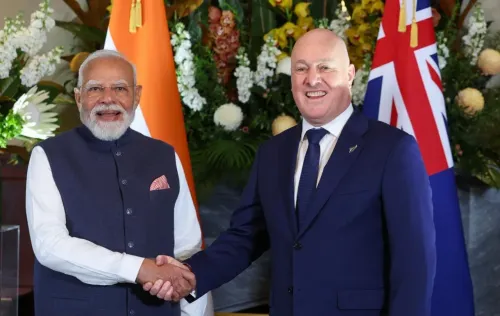
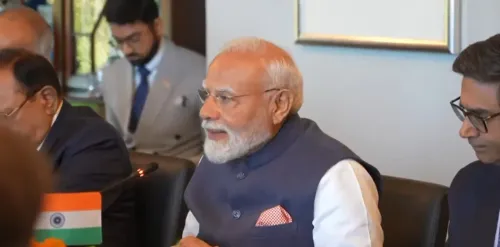
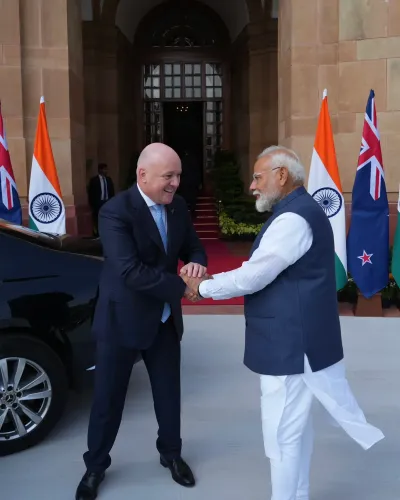
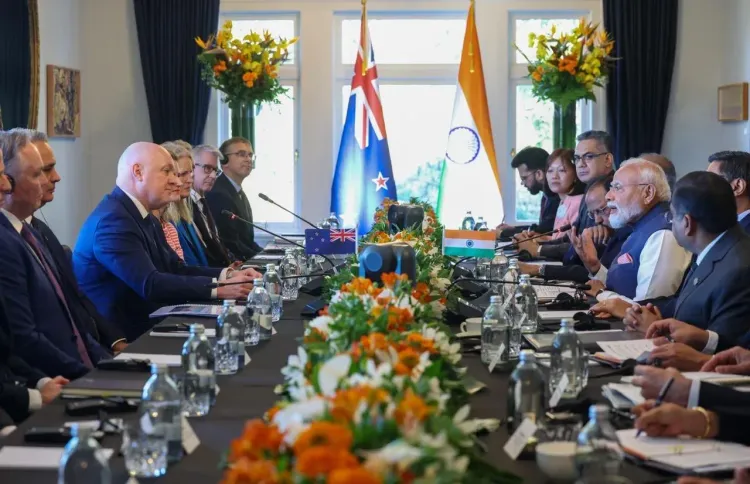
New Zealand Prime Minister Christopher Luxon on Saturday, 11 July announced that India and New Zealand have agreed to elevate their bilateral relationship to a Strategic Partnership, establishing a broader framework for deepening cooperation across trade, diplomacy, and other sectors. The announcement came during delegation-level talks with Prime Minister Narendra Modi in Auckland, marking a significant shift in how the two nations formally structure their engagement.
A Historic First in Four Decades
Luxon described Modi's visit as a defining moment, noting it was the first visit by an Indian Prime Minister to New Zealand in 40 years. Addressing the talks directly, Luxon said, 'It's a truly historic event... marking the first visit by an Indian Prime Minister to New Zealand in 40 years. This visit is also a significant milestone in the New Zealand-India relationship.'
Modi had previously hosted Luxon in India, and the New Zealand PM acknowledged the personal commitment Modi has invested in advancing bilateral ties. 'Thank you for the relationship, and thank you for what you have put into it personally,' Luxon said.
Beyond the FTA: What the Strategic Partnership Means
While the Free Trade Agreement (FTA) has been a centrepiece of recent bilateral engagement, Luxon emphasised that the new Strategic Partnership is designed to go further. 'Today's focus is about more than just the FTA. It's about where we go to next in this relationship and how we broaden that out,' he said, adding that the partnership would give the relationship 'more framework and breadth' going forward.
In a post on X, Luxon highlighted the trade dimension, noting that the FTA would 'eliminate tariffs on 57 per cent of everything we sell to India on day one.' He framed the two nations as bookending the Indo-Pacific, with geographic distance no barrier to economic collaboration.
MoUs Signed Across Key Sectors
Following the delegation-level talks, the two leaders witnessed the exchange of several Memoranda of Understanding (MoUs) spanning multiple sectors. Specific sectors covered by the MoUs were not immediately detailed, but officials indicated the agreements are aimed at expanding practical cooperation beyond trade.
Modi's Three-Nation Tour Concludes in Auckland
Prime Minister Modi arrived in New Zealand on Friday as the final leg of a three-nation visit. The Auckland stop is seen as the diplomatic highlight of the tour, given the rarity of an Indian Prime Ministerial visit to New Zealand and the significance of the Strategic Partnership announcement. The elevation of ties reflects a broader Indian diplomatic push to deepen partnerships across the Indo-Pacific region. Both governments are expected to operationalise the new framework through follow-up ministerial engagements in the months ahead.
Point of View
Many of which remain largely ceremonial. The real test here is whether the FTA's tariff commitments translate into actual trade growth — and whether the MoUs signed in Auckland produce verifiable outcomes or gather dust. Modi's visit ending in New Zealand is also a deliberate Indo-Pacific signal: as India deepens ties from the Gulf to the Pacific, Wellington is being drawn into a web of partnerships that serve New Delhi's strategic geometry as much as bilateral commerce. Luxon's enthusiasm is genuine, but New Zealand's leverage in this relationship is modest — India is the larger economy, the larger market, and the more consequential geopolitical actor.
NationPress
11 Jul 2026
Frequently Asked Questions
What is the India-New Zealand Strategic Partnership announced in Auckland?
It is a formal elevation of bilateral ties between India and New Zealand, announced on 11 July in Auckland during delegation-level talks between PM Modi and PM Luxon. The partnership provides a broader framework for expanding cooperation across trade, diplomacy, and other sectors beyond the existing Free Trade Agreement.
When was the last time an Indian Prime Minister visited New Zealand?
PM Modi's visit on 11 July 2025 is the first by an Indian Prime Minister to New Zealand in 40 years, making it a rare and diplomatically significant occasion that both governments have described as a historic milestone.
What does the India-New Zealand Free Trade Agreement cover?
The FTA will eliminate tariffs on 57 per cent of everything New Zealand sells to India from day one of its implementation, according to PM Luxon. The agreement has been a central pillar of the bilateral relationship in recent years.
What MoUs were signed during PM Modi's Auckland visit?
Several Memoranda of Understanding covering multiple sectors were exchanged following the delegation-level talks in Auckland. Specific details of each MoU were not immediately disclosed, but they are aimed at broadening practical cooperation between the two countries.
Why is the India-New Zealand Strategic Partnership significant for the Indo-Pacific?
The upgrade reflects India's broader diplomatic push to deepen structured partnerships across the Indo-Pacific. PM Luxon noted that despite geographic distance — the two nations 'bookend the Indo-Pacific' — both countries are committed to growing economic and strategic ties, signalling alignment on the region's emerging geopolitical architecture.