Is India Set to Launch a Voice-Based LLM Before the Delhi AI Summit?

Synopsis
India is poised to reveal a new voice-based LLM before the global AI summit in Delhi. This initiative aims to bolster the nation’s AI capabilities, as highlighted by key government official Abhishek Singh in a discussion in Silicon Valley. Discover how this development could transform India's technological landscape!
Key Takeaways
India is launching a voice-enabled LLM before the AI summit in New Delhi.
AI will enhance accessibility to government services across various Indian languages.
The AI Impact Summit 2026 will focus on democratizing AI globally.
India is investing in AI talent development through research funding and educational support.
A national datasets platform called AI Coach is being developed to support innovation.
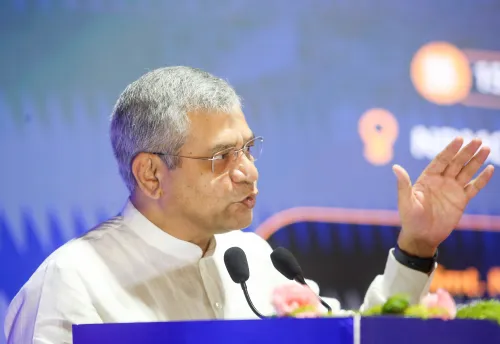
Washington, Dec 6 (NationPress) India is gearing up to introduce a new voice-enabled Large Language Model prior to next year's global Artificial Intelligence (AI) summit in New Delhi, as stated by a leading government official, Abhishek Singh, during a recent engagement with the Silicon Valley community. He presented an extensive strategy aimed at enhancing the nation’s AI capabilities.
Singh, who is the Director General of the National Informatics Centre and Additional Secretary at the Ministry of Electronics and IT, emphasized that India's position as the world's fastest-growing major economy is closely linked to its digital infrastructure.
"We are recognized as the world's largest, fastest-growing economy… expanding at a rate of 8.2 percent," he remarked, designating digital public infrastructure as the core foundation for India's AI aspirations.
He projected that India aims to elevate its economy from approximately $4 trillion to $30 trillion by 2047, asserting that AI will serve as a crucial enabler in this transformation.
The foundation, according to Singh, consists of India's digital public infrastructure, including Aadhaar, UPI, DigiLocker, and India Stack, which he qualified as mind-boggling in scope.
He highlighted that "around 27 countries are developing Aadhaar-based solutions," and nations like the UK are exploring systems similar to DigiLocker.
AI, he stated, will accelerate our digital public infrastructure by facilitating services in every Indian language, enabling millions to access government programs, healthcare information, and agricultural support through natural speech.
"We have the capability to connect the remaining 500 million people," Singh noted as he pointed out significant gaps that led to the initiation of the India AI Mission last year.
Currently, he explained that India possesses "only about 600 GPUs" within its ecosystem and much lower R&D investment in comparison to the U.S. and China. In response, the government has collaborated with the industry to provide 40,000 GPUs at subsidized rates.
Singh acknowledged that India also lacked homegrown AI models, stating, "India did not have its own LLM." The government is now financing nearly 12 initiatives aimed at developing Indian LLMs and SLMs, which include sector-specific models for healthcare and materials science.
Two of these projects, one led by IIT Madras and the other by IIT Bombay, are nearing completion. "Before the summit, we should be able to unveil an Indian LLM, which will primarily be a voice-based model," Singh stated.
On the data front, Singh mentioned that India is establishing a national datasets platform, known as AI Coach, which already hosts "3,500 datasets from public and private sectors" to bolster training and innovation. He added that India is working on 30 scalable AI applications, such as an AI assistant for farmers and diagnostic tools for tuberculosis, cataracts, and diabetic retinopathy.
Such systems, he noted, could bridge gaps in rural healthcare where machines exist but specialists are absent. "That issue can be effectively addressed with a high degree of accuracy by AI machines," he asserted.
A critical aspect of the mission is talent development. "If we do not invest adequately in talent, we risk losing that advantage," Singh warned.
India is sponsoring AI research, establishing data labs in ITIs and polytechnics, and supporting students at various educational levels. Safety is also a key concern; India has launched an AI Safety Institute and is developing tools for bias mitigation, ethical AI certification, privacy preservation, and detecting deep fakes.
Singh remarked that the AI Impact Summit 2026 will be the first global AI gathering held in the developing world. India aims to democratize access to AI so that countries outside the West do not merely become users of AI technology.
More than 100 countries, 15 heads of government, and 50 CEOs are anticipated in Delhi. Seven international working groups, co-led by India, are negotiating outcomes focused on inclusion, safety, economic growth, sustainability, and science.
The summit's results will include a charter for democratizing AI resources, an AI commons repository, principles for workplace transition, an AI-for-science network, and AI Safety Commons. Additionally, India seeks commitments from frontier model developers to share "usage data… with sovereign governments."
India received over 15,000 entries from 136 countries for its global innovation challenges, which Singh described as truly global.
"The entire summit is about people, planet, and progress," Singh emphasized. "Innovative ideas will be highly encouraged."
Participants at the event included leaders from Anthropic, Zoom, Lightspeed Venture Partners, Microsoft, Salesforce, OpenAI, Equinix, and NVIDIA, all of whom reiterated India's growing importance in the global tech landscape.
Michael Sellitto from Anthropic mentioned that the company opened an office in Bangalore due to the "massive opportunities in India."
Zoom's Velchamy Sankarlingam noted the company’s expanding footprint in India for engineering and operations.
Dev Khare from Lightspeed highlighted that India's data resources are a critical aspect of national security, emphasizing the necessity for the country to develop its own models.
A panel of global investors, including General Catalyst, WestBridge Capital, Celesta Capital, and Prosperity7 Ventures, underscored India’s role in promoting responsible global AI usage.
Sumir Chadha from WestBridge pointed out that "India now has the second-largest number of AI users in the world, second only to the U.S.," suggesting that Indian consumers may soon be "more AI adept than users anywhere else globally."
Arun Kumar from Celesta remarked that AI regulation and standards are increasingly becoming significant issues in the India–US relationship.
"There exists an opportunity for alignment in the age of AI and to establish that trusted corridor often discussed," he noted.
UN Special Envoy Amandeep Singh Gill, in a recorded address, stated that the Delhi summit — AI Impact Summit 2026 — emerges at a time when both AI and multilateralism have accelerated, highlighting the need for inclusive representation in the AI evolution.
Closing remarks by Google executive Ben Gomes acknowledged India's vast potential and scale, referencing Google’s recent investments in data centers, educational tools, and sustainable technology. "We firmly believe in the role of educators… and aim to strengthen that connection rather than replace it," he concluded.
Point of View
It is imperative to recognize the significance of India's strides in AI development. The government's proactive approach in establishing a voice-based LLM showcases a commitment to innovation and inclusivity. This initiative not only positions India as a leader in AI but also emphasizes the importance of equitable access to technology for all citizens. Such advancements could reshape the global technology landscape and foster a more interconnected world.
NationPress
2 Oct 2026
Frequently Asked Questions
What is the purpose of the new voice-enabled LLM?
The new voice-enabled LLM aims to enhance accessibility to government services and information, allowing users to interact in their native languages through natural speech, thereby bridging the digital divide.
When will the Indian LLM be unveiled?
The Indian LLM is expected to be announced before the AI Impact Summit scheduled for 2026.
How does India plan to support AI research?
India is funding numerous initiatives, establishing data labs, and supporting educational institutions to foster AI research and talent development.
What is the AI Coach platform?
AI Coach is a national datasets platform being developed by India, designed to host thousands of datasets from both the public and private sectors to support AI training and innovation.
How is India addressing the need for indigenous AI models?
India is funding initiatives to develop homegrown LLMs and SLMs, focusing on sector-specific applications in areas like healthcare and materials science.