Will India and UAE Achieve Their Goal of Doubling Bilateral Trade to $200 Billion by 2032?
Click to start listening
Synopsis
In a landmark meeting, Prime Minister Narendra Modi and UAE President Sheikh Mohamed bin Zayed Al Nahyan have pledged to double trade between India and the UAE to $200 billion by 2032. This ambitious goal reflects the robust economic ties and mutual commitment for future growth.
Key Takeaways
- Target to double trade to $200 billion by 2032.
- Focus on MSME integration through key initiatives.
- Strengthening energy security with LNG agreements.
- Enhancing cooperation in technology and space sectors.
- Public-private partnerships emphasized for sustainable agriculture.
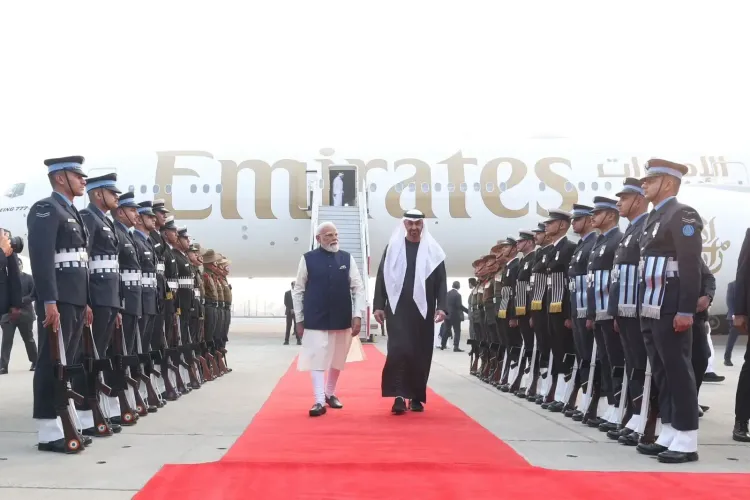
New Delhi, Jan 19 (NationPress) Prime Minister Narendra Modi and UAE President Sheikh Mohamed bin Zayed Al Nahyan have set an ambitious target to double the bilateral trade between India and the UAE to $200 billion by 2032. This decision was announced in a joint statement following a meeting held in the Indian capital.
The leaders acknowledged the significant growth in trade and economic collaboration since the establishment of the Comprehensive Economic Partnership Agreement (CEPA) in 2022. They highlighted the swift increase in bilateral trade, which had reached $100 billion in the fiscal year 2024-25, as stated in their communication.
The outcomes of the 13th High-Level Task Force on Investments, which took place in September 2025, along with the 16th India-UAE Joint Commission Meeting and 5th Strategic Dialogue held in December 2025, were endorsed by the two leaders.
They called for efforts to connect Micro, Small and Medium Enterprises (MSMEs) from both nations, emphasizing the importance of swiftly implementing key initiatives such as 'Bharat Mart', 'Virtual Trade Corridor', and 'Bharat-Africa Setu' to enhance the visibility of MSME products across the Middle East, West Asia, Africa, and the Eurasia region.
Both leaders expressed their contentment regarding the Bilateral Investment Treaty signed in 2024, which has significantly bolstered investment flows in various sectors between the two countries.
The discussions also covered a possible UAE partnership in developing the Special Investment Region in Dholera, Gujarat, which would include constructing vital infrastructure such as an international airport, pilot training school, maintenance, repair, and overhaul (MRO) facility, greenfield port, smart urban township, railway connectivity, and energy infrastructure.
Prime Minister Modi highlighted the success of the inaugural National Investment and Infrastructure Fund (NIIF) and invited UAE sovereign wealth funds to participate in the upcoming second fund set to launch in 2026.
The establishment of branches of DP World and First Abu Dhabi Bank (FAB) in GIFT City (Gujarat International Finance Tec-City) was welcomed, reinforcing its position as a leading international financial hub.
FAB's branch in GIFT City will serve as a vital link, connecting Indian corporations and investors with its extensive expertise and global network across the Gulf Cooperation Council and the MENA region.
Both nations reaffirmed their commitment to enhancing cooperation in food security, recognizing its crucial role in ensuring sustainable supply chains and long-term resilience.
The importance of public-private partnerships, innovation, and knowledge exchange in promoting sustainable agriculture and strengthening food resilience, aligned with national priorities, was emphasized.
The leaders expressed satisfaction with the strength of their energy partnership, acknowledging the UAE's contribution to India's energy security.
They noted the signing of a 10-year LNG Supply Agreement between Hindustan Petroleum Corporation Limited (HPCL) and ADNOC Gas for the delivery of 0.5 million tonnes per year of liquefied natural gas starting in 2028.
The two sides agreed to explore collaboration in advanced nuclear technologies, including the development and deployment of large nuclear reactors and Small Modular Reactors (SMRs), as well as cooperation in advanced reactor systems, nuclear power plant operations, maintenance, and safety.
Moreover, the leaders appreciated the strengthening of financial sector cooperation and directed their teams to work towards integrating national payment platforms for efficient, quick, and cost-effective cross-border transactions.
They also agreed to enhance cooperation in the space sector and welcomed the understanding to collaborate on a joint initiative aimed at commercializing the sector through advancements in space sciences and technologies.
This initiative aims to create an integrated space ecosystem with comprehensive infrastructure and a robust industrial base, enabling India-UAE joint missions, expanding global commercial services, generating high-skilled jobs, fostering start-ups, and enhancing bilateral investment through sustainable business models.
Lastly, they decided to strengthen cooperation in science and technology and innovation, particularly in artificial intelligence (AI) and emerging technologies. They welcomed the decision to work together on establishing a supercomputing cluster in India and explore the potential for setting up data centers in the country.
Point of View
It is evident that the commitment between India and the UAE to double their bilateral trade is a strategic move that not only strengthens economic ties but also enhances regional stability. This ambitious target reflects the nations' shared vision for growth and development, promising mutual benefits in various sectors.
NationPress
20/01/2026
Frequently Asked Questions
What is the target for India-UAE bilateral trade?
The target is to double the bilateral trade to $200 billion by 2032.
Who are the leaders involved in this agreement?
The leaders are Indian Prime Minister Narendra Modi and UAE President Sheikh Mohamed bin Zayed Al Nahyan.
What initiatives are being implemented to support MSMEs?
Key initiatives include 'Bharat Mart', 'Virtual Trade Corridor', and 'Bharat-Africa Setu'.
What sectors are being prioritized in this partnership?
Sectors such as energy, technology, agriculture, and food security are being prioritized.
What is the significance of the Bilateral Investment Treaty?
The treaty strengthens investment flows across multiple sectors in both countries.