Will India’s Union Budget Maintain Its Focus on Tech and Jobs?
Click to start listening
Synopsis
As India prepares for its upcoming Union Budget, experts predict a steadfast approach centered on fiscal consolidation and technological investment. Anit Mukherjee from ORF America shares insights on the government's likely strategies, emphasizing a shift in social welfare programs and the importance of public investment in emerging sectors.
Key Takeaways
- India's Union Budget is expected to maintain current fiscal strategies.
- Focus on livelihoods over direct benefits in social welfare reform.
- Strong revenue growth is anticipated despite GST reductions.
- Investment in high-technology sectors is crucial for competitiveness.
- Global trade reorientation may benefit India's economy.
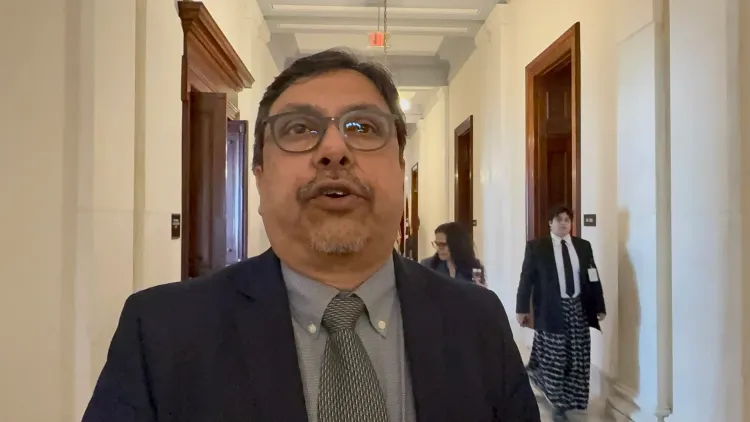
Washington, Jan 16 (NationPress) The forthcoming Union Budget of India is anticipated to maintain its trajectory, with the government emphasizing fiscal consolidation, macroeconomic stability, and increased investment in high-technology sectors, as stated by Anit Mukherjee, Senior Fellow at ORF America, who has profound experience in fiscal and development policy.
“I foresee a continuation of existing policies since this represents the halfway point of the current government's term,” Mukherjee expressed in an interview with IANS, indicating that significant policy changes are unlikely in the upcoming budget.
He highlighted recent initiatives as indicative of an incremental strategy, particularly the overhaul of India’s largest social welfare program, previously known as MGNREGA, which is shifting focus towards livelihoods instead of being solely a direct benefits transfer program.
“We have already observed some critical announcements,” he stated, adding that the program is being revamped “to focus more on providing livelihoods rather than just direct benefits.”
On the fiscal front, Mukherjee noted that revenue growth is expected to remain robust despite recent reductions in the goods and services tax (GST). He pointed out that the external sector is stable, offering grounds for cautious optimism as global trade dynamics shift.
“The external sector remains stable,” he remarked, observing that even a slight reorientation in trade could favor India.
He suggested that a relative decline in India’s traditional trade partnerships might be advantageous if the country redirects trade from the United States to other partners, which could positively influence the current account balance reflected in the budget.
Overall, Mukherjee anticipates that the finance minister will remain focused on core macroeconomic objectives. “I expect the finance minister to stay focused on the essential goals,” he stated, underscoring the significance of fiscal consolidation, maintaining a check on the fiscal deficit, and managing moderate inflation.
He emphasized the necessity for continued public investment in emerging and strategic sectors where India's competitiveness is already evident. “We are ready to invest significantly in high technology, in AI, and in various sectors where Indian competitiveness is already apparent and requires further investment,” he conveyed to IANS.
Mukherjee also commented on the changes to the restructured rural employment program, drawing from his extensive research on its impact across various Indian states. He noted that the program has been operational for nearly 20 years with minimal alterations to its fundamental structure, even as the Indian economy and labor market have evolved.
“Considering how long [the program] has been in operation, it’s been nearly 20 years,” he noted, adding that “the general structure… remained unchanged, making it time for a change as the Indian economy has transformed, and the needs have shifted.”
Describing the reform as “a positive step” and “a move in the right direction,” Mukherjee stated that the overhaul modernizes databases and management systems while enhancing state autonomy in implementation. However, he cautioned against losing sight of the program’s original purpose.
“The entire concept… was to provide employment when it was needed during the fallow season, during a drought, for instance,” he emphasized, noting that with climate change, the employment guarantee aspect is still crucial, even if the nature of jobs evolves.
Mukherjee also addressed the repercussions of US trade and tariff policies on India, asserting that the immediate effects have already been felt since the tariffs were enacted several months ago. “We should have observed that immediate impact already because the tariffs were implemented in April,” he noted.
He indicated that approximately $50 billion worth of goods trade has been impacted, though he added that the Indian government has taken measures to alleviate the effects on domestic industries. Despite this, Mukherjee expressed optimism regarding the potential for a bilateral free trade agreement.
“There is optimism surrounding an FTA,” he told IANS, adding that if such an agreement materializes, “there’s likely to be a positive feedback loop on the Indian economy and overall sentiment.”
The Union Budget of India outlines the government’s fiscal priorities, tax policies, and spending strategies for the upcoming financial year, and is closely monitored by investors, businesses, and state governments for indications on growth strategies and macroeconomic management.
Point of View
The upcoming Union Budget is crucial for sustaining India's economic growth and stability. The government's focus on technology and jobs, especially in high-tech sectors, is essential for addressing current economic challenges and enhancing competitiveness. As we look ahead, the emphasis on fiscal consolidation and strategic investments will be pivotal for shaping India's economic landscape.
NationPress
16/01/2026
Frequently Asked Questions
What are the key focuses of India's upcoming Union Budget?
The key focuses are fiscal consolidation, macroeconomic stability, and investment in high-technology sectors.
How will the social welfare program change?
The social welfare program will shift to emphasize livelihoods rather than just direct benefits.
What impact will global trade shifts have on India?
Global trade shifts could provide opportunities for India, especially if trade is redirected from traditional partners.
What does fiscal consolidation mean for India?
Fiscal consolidation refers to reducing the fiscal deficit and ensuring sustainable financial management.
How will technology investments shape India's economy?
Investments in technology, particularly in AI and high-tech sectors, will enhance India's competitiveness and drive economic growth.