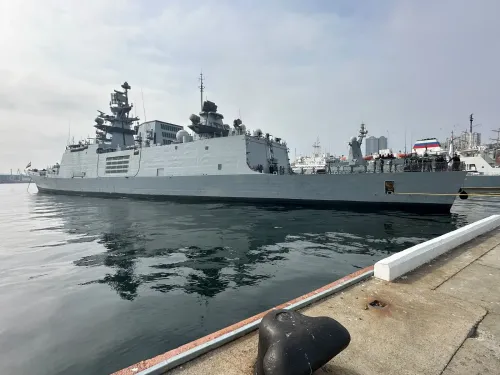
INS Sahyadri departs Yokosuka after MALABAR 2026 exercise with Quad navies
Synopsis
INS Sahyadri's departure from Yokosuka closes out MALABAR 2026 — the most symbolically loaded edition yet, coinciding with the 75th year of India-Japan ties. With all four Quad navies drilling together on ASW and maritime interdiction south of Honshu, the exercise is less a routine drill and more a live demonstration of collective Indo-Pacific resolve at a moment of heightened strategic competition.
Key Takeaways
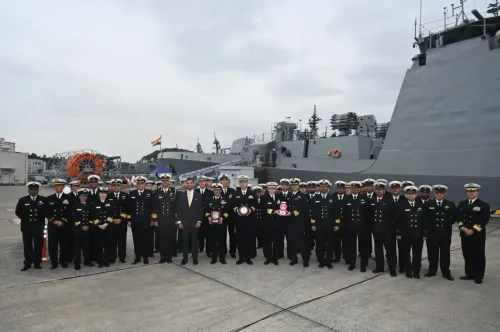
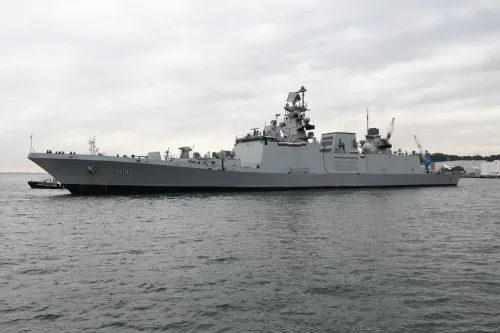
INS Sahyadri (F49) departed Yokosuka Naval Base , Japan, on 13 November 2026 after completing Exercise MALABAR 2026 .
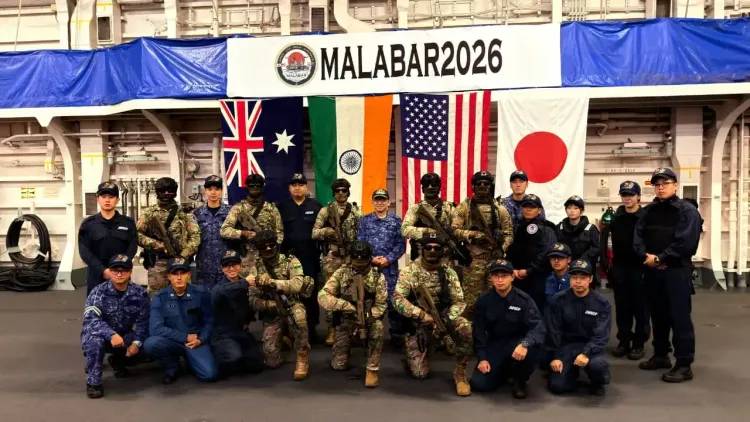
The exercise ran from 5–12 November , with navies of India , Japan , the United States , and Australia participating.
Sea Phase drills included Anti-Submarine Warfare , VBSS , Maritime Interdiction Operations, gunnery exercises, and cross-deck landings.
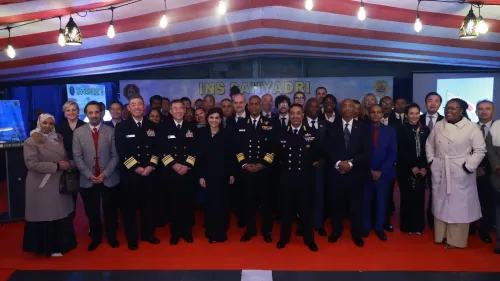
A deck reception on 6 November marked the 75th anniversary of India-Japan diplomatic ties , hosted by Ambassador Nagma Mallick and Vice Admiral A N Pramod .
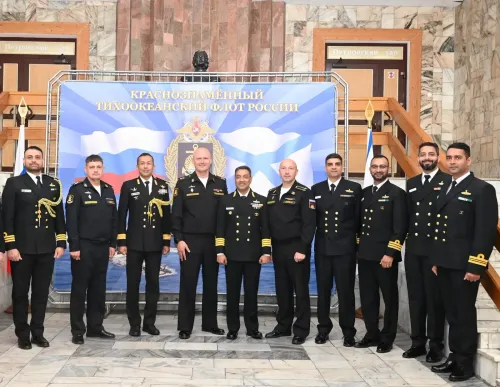
INS Sahyadri had previously participated in the IN-RoKN bilateral exercise at Busan before arriving in Japan.
The MoD linked the exercise to India's MAHASAGAR vision for collective Indo-Pacific security.
The Indian Navy's indigenous guided-missile stealth frigate INS Sahyadri (F49) departed Yokosuka Naval Base in Japan on 13 November 2026 following the successful conclusion of Exercise MALABAR 2026, the Ministry of Defence (MoD) confirmed in an official statement. The annual multilateral maritime drill brought together the naval forces of India, Japan, the United States, and Australia — the four Quad partner nations — for a combined harbour and sea phase spanning 5–12 November.
What the Sea Phase involved
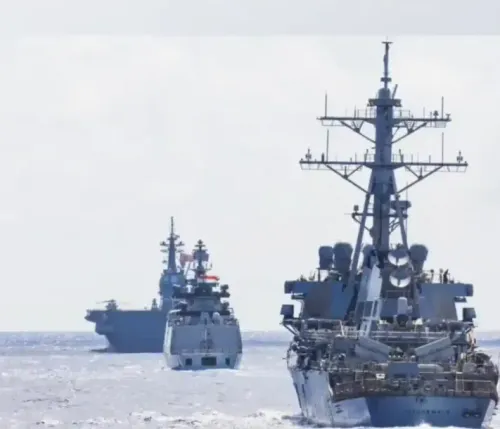
The Sea Phase, conducted south of the Kanto region on Japan's main island of Honshu, featured an intensive schedule of maritime operations. According to the MoD statement, drills included Anti-Submarine Warfare (ASW), Visit, Board, Search and Seizure (VBSS) operations, Maritime Interdiction Operations, gunnery exercises, replenishment approaches, and cross-deck landings. 'These engagements provided valuable opportunities to enhance interoperability, operational coordination and mutual understanding among participating navies,' the ministry said.
Assets deployed by each nation
The Japan Maritime Self-Defence Force (JMSDF) deployed helicopter destroyer JS Ise (DDH-182), frigate JS Mogami (FFM-1), a submarine, and a P-1 Maritime Patrol Aircraft. Australia contributed frigate HMAS Stuart (FFH153) and a Royal Australian Air Force P-8A Poseidon maritime patrol aircraft. India was represented by INS Sahyadri, an indigenously built warship from the Eastern Fleet.
Harbour Phase and diplomatic milestones
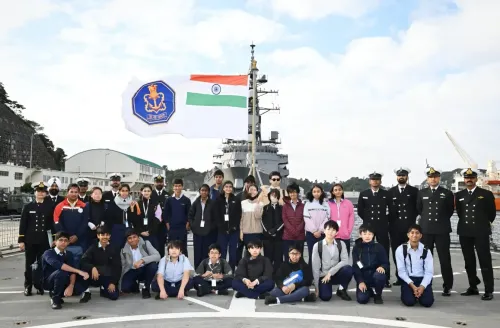
The Harbour Phase saw operational synchronisation, cross-deck visits, sporting engagements, and cultural activities designed to deepen bonds among participating naval personnel. Notably, on 6 November, India's Ambassador to Japan, Nagma Mallick, and Vice Admiral A N Pramod, Deputy Chief of the Naval Staff, hosted a deck reception aboard INS Sahyadri to mark the 75th anniversary of India-Japan diplomatic relations — underscoring the strategic significance layered into this year's edition of the exercise. The frigate had arrived at Yokosuka on 4 November and was accorded a ceremonial welcome by the JMSDF.
Broader strategic context
The MoD statement said the exercise's conclusion 'reaffirmed the shared commitment of participating navies to maritime cooperation and collective security in the Indo-Pacific, in consonance with India's vision of MAHASAGAR (Mutual and Holistic Advancement for Security and Growth Across Regions).' This comes amid intensifying great-power competition in the Indo-Pacific, where coordinated Quad maritime presence is increasingly seen as a signal of collective resolve. INS Sahyadri had arrived in Japan after participating in the bilateral India-Republic of Korea Navy (IN-RoKN) exercise at Busan — part of a broader regional maritime engagement tour. Last year's Malabar, held from 10–18 November, had its harbour phase in Guam, reflecting the exercise's rotating geography across the Indo-Pacific.
What comes next
With MALABAR 2026 concluded, attention will turn to whether the interoperability gains — particularly in ASW and VBSS — translate into more integrated operational protocols among Quad navies. India's expanding indigenous shipbuilding capability, demonstrated by INS Sahyadri's deployment, also signals a broader shift toward self-reliant naval power projection in the region.
Point of View
Within sight of Japan's core maritime zone, while simultaneously marking 75 years of India-Japan ties, packs diplomatic weight that a Guam harbour phase cannot replicate. What mainstream coverage tends to underplay is the ASW dimension: coordinated anti-submarine drills among all four Quad partners point to a shared concern about undersea activity in the Indo-Pacific that none of the four nations names explicitly in public statements. India's deployment of an indigenously built frigate also advances a quieter narrative — that 'Aatmanirbhar Bharat' is no longer just a domestic manufacturing slogan but a live element of force projection diplomacy.
NationPress
14 Nov 2026
Frequently Asked Questions
What is Exercise MALABAR 2026?
Exercise MALABAR 2026 is a multilateral naval exercise involving the navies of India, Japan, the United States, and Australia — the four Quad partner nations. It was held from 5–12 November 2026, south of the Kanto region off Japan's Honshu island, and included both a Harbour Phase and a Sea Phase covering anti-submarine warfare, maritime interdiction, and other drills.
Which ships and aircraft participated in MALABAR 2026?
India deployed INS Sahyadri (F49), Japan contributed JS Ise (DDH-182), JS Mogami (FFM-1), a submarine, and a P-1 Maritime Patrol Aircraft, while Australia sent HMAS Stuart (FFH153) and a Royal Australian Air Force P-8A Poseidon. The US Navy also participated as one of the four Quad nations.
Why is MALABAR 2026 significant for India-Japan relations?
This year's edition coincided with the 75th anniversary of India-Japan diplomatic ties. A special deck reception was held aboard INS Sahyadri on 6 November, hosted by India's Ambassador to Japan, Nagma Mallick, and Vice Admiral A N Pramod, Deputy Chief of the Naval Staff, underscoring the deeper bilateral dimension woven into the multilateral exercise.
What is India's MAHASAGAR vision referenced in the MALABAR 2026 statement?
MAHASAGAR stands for 'Mutual and Holistic Advancement for Security and Growth Across Regions' — India's framework for cooperative maritime engagement across the Indo-Pacific. The Ministry of Defence cited it as the strategic backdrop against which MALABAR 2026 was conducted, linking the exercise to India's broader regional security philosophy.
What did INS Sahyadri do before arriving in Japan for MALABAR 2026?
Before reaching Yokosuka, INS Sahyadri participated in the India-Republic of Korea Navy (IN-RoKN) bilateral exercise at Busan, South Korea. The ship is part of the Eastern Fleet and is an indigenously built guided-missile stealth frigate, reflecting India's growing domestic naval manufacturing capability.