What Key Strategic and Security Issues Did EAM Jaishankar and Greek Defence Minister Discuss?
Synopsis
EAM S. Jaishankar recently held discussions with Greek Minister of National Defence Nikos Dendias. Their dialogue focused on pivotal strategic and security matters, reflecting the strengthening ties between India and Greece. Dendias's visit also included engagements with US officials and discussions on the Eastern Mediterranean's role in global connectivity.
Key Takeaways
EAM Jaishankar and Nikos Dendias discussed vital strategic and security matters.
The discussions signify strengthening ties between India and Greece .
The Eastern Mediterranean Gateway Act aims to enhance connectivity among India , Middle East , and Europe .
Significant contracts were mentioned, including the F-35 procurement.
Future collaborations between the Greek and Indian defence sectors are being explored.
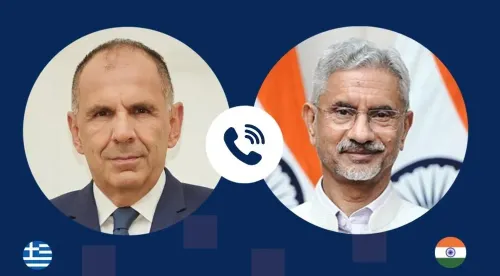
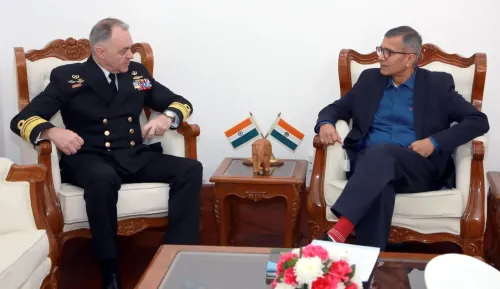
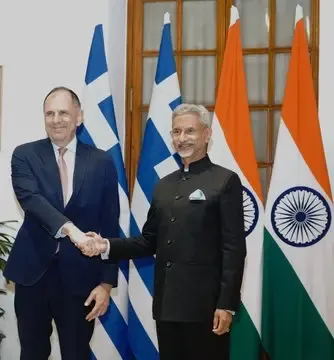
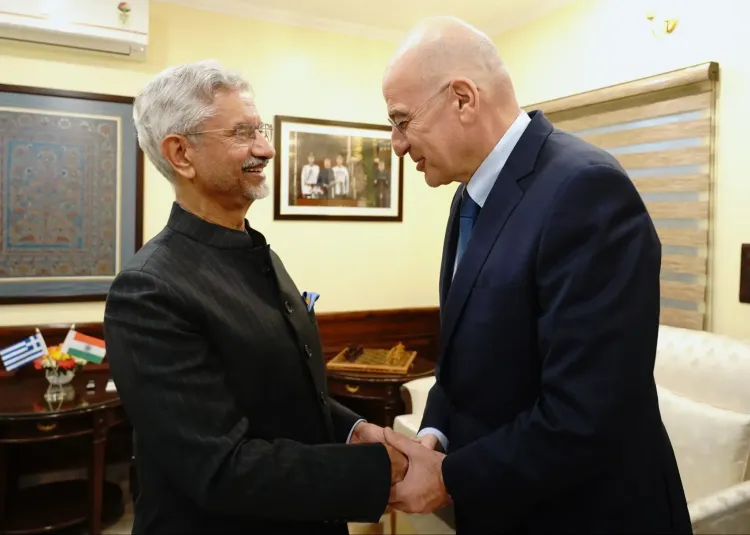
Athens/New Delhi, Feb 6 (NationPress) The External Affairs Minister, S. Jaishankar, engaged in crucial talks with Greece's Minister of National Defence, Nikos Dendias, who visited New Delhi earlier on an official invitation from his Indian counterpart, Defence Minister Rajnath Singh.
"It was a pleasure to welcome Minister Dendias this evening. We had a thorough discussion covering numerous critical strategic and security topics. I value his insightful perspectives," EAM Jaishankar tweeted following their meeting.
Earlier that day, Dendias mentioned that his official visit to India was at the behest of Rajnath Singh. He expressed eagerness for his engagements with the Indian Defence Minister and EAM Jaishankar. Furthermore, he will partake in discussions at the India–EU Forum concerning international developments and security matters, and will explore collaboration opportunities between the Greek and Indian defence sectors in Bangalore.
Earlier this week, Dendias was in Washington, where he met with US Secretary of War Pete Hegseth and Under Secretary of War, Elbridge Colby, focusing on a range of significant issues affecting their region, including the 'Agenda 2030' for reforming the Greek Armed Forces and recent contracts with the US, including the F-35 procurement.
In a pivotal development, a bipartisan US bill aimed at enhancing the role of the Eastern Mediterranean in American foreign policy passed through a critical stage in Congress last month. The Eastern Mediterranean Gateway Act received a 45–2 vote in the House Foreign Affairs Committee. Proponents argue that it reinforces the Eastern Mediterranean as a vital connection point among India, the Middle East, and Europe as part of the India–Middle East–Europe Economic Corridor (IMEC).
IMEC was introduced during the 2023 G20 summit, with support from the United States and various partners, aiming to establish connectivity from India to Europe through railways, ports, energy, and digital networks across the Middle East, using the Eastern Mediterranean as a crucial entry point into Europe.
Point of View
It is crucial to recognize the implications of the recent dialogue between India and Greece. Strengthening defence ties not only enhances bilateral relations but also underscores India's strategic interests in the Eastern Mediterranean, which is increasingly pivotal in global geopolitics.
NationPress
22 Sept 2026
Frequently Asked Questions
What was the purpose of the meeting between Jaishankar and Dendias?
The meeting aimed to discuss key strategic and security issues, enhancing the bilateral relations between India and Greece.
What is the Eastern Mediterranean Gateway Act?
The Eastern Mediterranean Gateway Act is a bipartisan US bill that aims to strengthen the Eastern Mediterranean’s role in American foreign policy, particularly in connecting India with Europe.
What discussions took place regarding the Greek defence industry?
Nikos Dendias mentioned exploring collaboration opportunities between the Greek and Indian defence industries during his visit.