Jensen Huang won't retire: Nvidia CEO on AI's next decade
Synopsis
Nvidia's Jensen Huang told a fireside chat in North Carolina that he won't retire — not because he has to keep working, but because he refuses to miss the next 10-15 years of AI. With projections of $20-$50 trillion in global economic gains on the table, Huang's decision to stay is as much a statement about AI's scale as it is about the man himself.
Key Takeaways
Jensen Huang said he will not retire, citing a determination not to miss AI's next 10-15 years .
He predicted tasks that currently take ten years will take one year , and year-long projects will be done in a month .
Innovators are discussing adding between $20 trillion and $50 trillion in global economic value through AI.
Huang rejected the idea that AI would simply eliminate jobs, arguing people retain purpose, context, and meaning in their roles.
US Commerce Secretary Howard Lutnick called Huang 'an American treasure' at the Chapel Hill event.
Huang co-founded Nvidia in 1993 and has led the company as President and CEO since its inception.
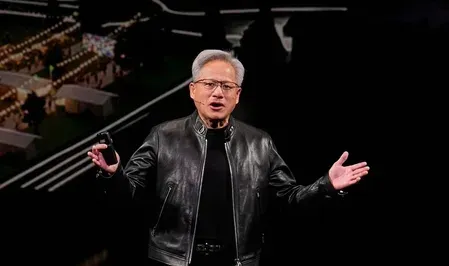
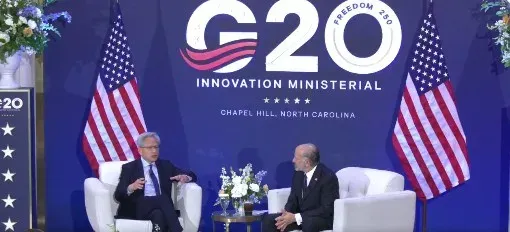
Nvidia co-founder and Chief Executive Jensen Huang says he has no intention of stepping back from work — not because he must keep going, but because he refuses to miss what artificial intelligence could deliver over the next ten to fifteen years. Speaking at a fireside chat in Chapel Hill, North Carolina, alongside US Commerce Secretary Howard Lutnick, Huang laid out a sweeping, optimistic vision of an AI-powered era that he says is unlike any moment in human history.
Why Huang Won't Walk Away
'I've been working a long time and surely I don't have to work, but I don't want to miss — I'm definitely not going to miss the next 10, 15 years,' Huang said. The admission is notable from the leader of one of the world's most valuable technology companies: it is not obligation but curiosity and ambition that keep him at the helm.
He described his own drive as having been 'supercharged' by the scale of what AI is making possible. 'The ambition of the industry, the ambition of my colleagues, my own ambition has really been supercharged,' he said.
A Compressed Timeline for Human Progress
Huang offered a striking forecast for AI's near-term impact on the pace of work and discovery. 'What do I expect in the next five, ten years? Things that take ten years are going to take one. Things that take one will take a month,' he said. This compression of timelines, in his view, is not incremental — it is civilisational in scale.
He pointed to economic projections that innovators are now discussing: between $20 trillion and $50 trillion in additional economic value generated globally through AI. 'No time in history have we been able to say things like that,' Huang noted. He argued that AI was giving 'average humans' the ability to contemplate making an impact on a 'hundred trillion dollar industry' — a scale of ambition previously confined to nation-states and mega-corporations.
AI as Equaliser, Not Job Destroyer
Huang pushed back firmly against the narrative that AI would simply displace human workers. He acknowledged that AI would automate certain skills and tasks, but argued that people would retain the purpose, context, and meaning that define their roles. Crucially, he framed AI as a great equaliser: because computers can now be addressed in ordinary human language, the barrier to accessing advanced knowledge has collapsed.
Lutnick echoed the point, suggesting the technology could place expert-level knowledge within everyone's reach. 'You now can have... a PhD in everything. That's right. At your fingertips,' Lutnick said. 'You are that person now. Right? Everybody is that person now,' Huang responded. Lutnick went on to call Huang 'an American treasure' and said Nvidia was 'leading us in a path that none of us, when we were young, ever dreamed possible.'
Historical Parallels and the Road Ahead
Huang drew comparisons between AI and earlier transformative technologies — electricity that allowed a light to be switched on from a distance, and automobiles and aircraft that became progressively safer as engineering matured. AI, he said, would follow the same arc: advancing through engineering, mathematics, software, and responsible development rather than arriving fully formed.
He urged countries to approach the technology with optimism rather than letting uncertainty dominate public debate. 'This is the time when you have to feel enlightened, inspired, supercharged, lifted, because you now have this incredible technology behind you,' he said.
The Man Behind Nvidia
Huang co-founded Nvidia in 1993 and has served as its President and Chief Executive since inception. Born in Taiwan, he moved to the United States as a child and studied electrical engineering at Oregon State University and Stanford University. The company started as a graphics technology specialist before its processors became foundational to modern AI development. Under Huang's leadership, Nvidia has grown into one of the world's most valuable technology companies — a trajectory that, by his own account, gives him every reason to stay.
Point of View
Which has implications for succession planning at a company now central to global technology infrastructure. The $20-$50 trillion economic projection he cited is striking but unattributed; mainstream coverage tends to pass such figures uncritically, when the sourcing and methodology behind them deserve scrutiny. And while Huang's optimism about AI as a job equaliser is genuine, the gap between his vision of AI augmenting workers and the ground-level reality of automation-driven displacement in lower-skilled roles remains the story his fireside chat did not address.
NationPress
18 Oct 2026
Frequently Asked Questions
Why is Nvidia CEO Jensen Huang not planning to retire?
Jensen Huang says he does not want to miss what artificial intelligence could deliver over the next ten to fifteen years. Speaking at a fireside chat in Chapel Hill, North Carolina, he said his ambition — and that of the broader industry — has been 'supercharged' by AI's potential.
What did Jensen Huang predict about AI's impact on work timelines?
Huang predicted that tasks currently taking ten years will be completed in one, and year-long projects will be finished within a month. He described this compression as a civilisational shift rather than an incremental improvement.
How much economic value does Jensen Huang say AI could generate?
Huang cited figures discussed among innovators of between $20 trillion and $50 trillion in additional global economic benefits from AI. He said this scale of ambition was unprecedented in human history.
Does Jensen Huang think AI will destroy jobs?
No. Huang rejected that view, arguing that while AI will automate certain skills and tasks, people will retain the purpose, context, and meaning that define their work. He described AI as a great equaliser because computers can now be addressed in ordinary human language.
What is Jensen Huang's background and how did he build Nvidia?
Huang co-founded Nvidia in 1993 and has served as its President and CEO since inception. Born in Taiwan, he studied electrical engineering at Oregon State University and Stanford University. Nvidia began as a graphics technology company before its processors became foundational to modern AI systems.