White House Honours Nvidia CEO Jensen Huang With National Medal of Science
Synopsis
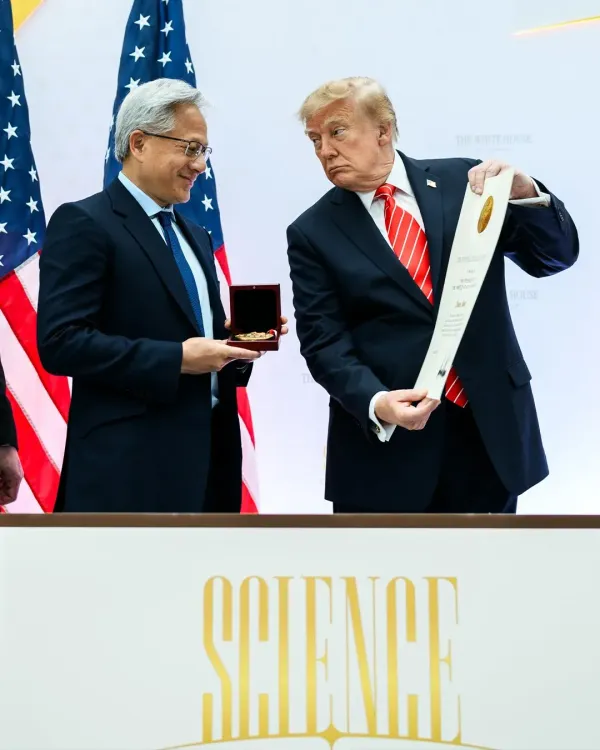
The White House has awarded Nvidia CEO Jensen Huang the National Medal of Science, honouring his role in co-founding Nvidia, reimagining the GPU as a general-purpose AI computing architecture, and advancing supercomputing, robotics, and data centre technology.
Key Takeaways
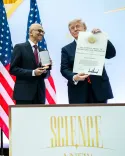
Jensen Huang , co-founder and CEO of Nvidia , has received the National Medal of Science from the White House .
Huang was credited with transforming the GPU from a graphics chip into a general-purpose computing architecture that underpins modern AI.
The White House cited his contributions to supercomputing , advanced chips , robotics , and data centre technology .
The award is the United States' highest scientific honour , conferred by the President.
The recognition signals Washington's intent to formally link AI hardware leadership with US national strategic interest.
The architect of the modern AI chip gets America's highest scientific honour. Jensen Huang, co-founder and CEO of Nvidia, has been awarded the National Medal of Science by the White House, recognising the role he played in transforming a niche graphics chip into the engine powering the global artificial intelligence revolution.
From Graphics Cards to the Engine of the AI Era
The White House credited Huang with helping 'put America at the forefront of the AI race' by co-founding Nvidia and, crucially, reimagining the GPU — graphics processing unit — as a general-purpose computing architecture. That pivot, once considered an engineering curiosity, became the foundational decision that made large-scale AI model training possible. Every major AI system trained today, from chatbots to medical imaging tools, runs on GPU infrastructure that Huang's vision made viable.
The citation also recognised Huang's contributions to supercomputing, advanced chip design, robotics, and data centre technology — four pillars that together define the technological competitiveness of nations in the 2020s. It is a rare sweep of domains for a single honouree, reflecting just how broadly Nvidia's architecture has permeated modern computing.
The National Medal of Science and What It Signals
The National Medal of Science is the United States' most prestigious award for scientific achievement, conferred by the President. Bestowing it on a sitting technology CEO — whose company's market value has made it one of the most consequential corporations in the world — is a deliberate signal: Washington views semiconductor leadership and AI infrastructure not merely as commercial success stories, but as matters of national strategic interest.
For India, which is investing heavily in its own semiconductor mission and AI infrastructure push, the optics carry weight. Huang, born in Taiwan and raised partly in the United States, represents the immigrant-founder archetype that US tech policy has long championed. His recognition at this level underscores how deeply the US government has intertwined its AI ambitions with the private sector companies driving chip innovation.
Why This Moment Matters Beyond the Medal
Nvidia's GPUs sit at the centre of a global contest — one that involves export controls, supply-chain diplomacy, and trillion-dollar infrastructure bets. The White House formally honouring Huang is as much a policy statement as a personal tribute: it anchors America's AI strategy to the people and companies building its hardware backbone. In a race where chips are the new oil, the man who redesigned the refinery just received his country's highest scientific salute.
Point of View
Not just market outcomes. For Nvidia, the honour cements its position as America's designated champion in the global chip race, at a moment when export controls and AI compute access have become primary levers of geopolitical competition. Countries like India, building their own chip and AI ambitions, will read the signal clearly: the US is betting that the private-sector-state partnership Nvidia embodies is the model to beat.
NationPress
9 Oct 2026
Frequently Asked Questions
What is the National Medal of Science?
The National Medal of Science is the highest scientific honour in the United States, awarded by the President to individuals who have made outstanding contributions to science, engineering, or mathematics.
Why did Jensen Huang receive the National Medal of Science?
Jensen Huang was recognised for co-founding Nvidia, transforming the GPU into a general-purpose computing architecture, and helping ignite the AI revolution while advancing supercomputing, robotics, and data centre technology.
Who is Jensen Huang and what did he do at Nvidia?
Jensen Huang is the co-founder and CEO of Nvidia. He led the company's pivot from making graphics chips for gaming to developing GPU-based architectures that now power large-scale artificial intelligence training worldwide.
What is a GPU and why does it matter for AI?
A GPU, or graphics processing unit, was originally designed for rendering images. Nvidia, under Huang, repurposed it as a massively parallel processor capable of training large AI models — making it the essential hardware of the modern AI era.
What does Nvidia's recognition mean for global AI competition?
The White House honouring Nvidia's CEO signals that the US views chip and AI infrastructure leadership as a national strategic priority, with major implications for export policy, international supply chains, and rivals including China.