Nvidia CEO Jensen Huang wins National Medal of Science
Synopsis
Nvidia CEO Jensen Huang has been awarded the US National Medal of Science for advancing GPU computing to power scientific breakthroughs, joining honorees Elon Musk, Lisa Su, Michael Dell, Satya Nadella, and Sergey Brin in a landmark recognition of the architects of modern computing infrastructure.
Key Takeaways
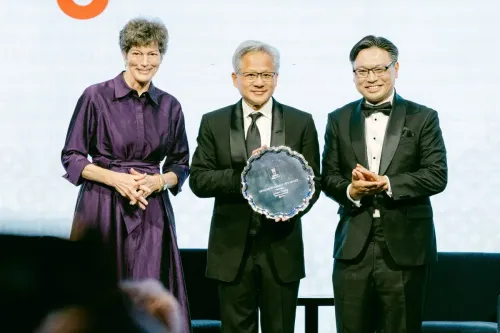
Jensen Huang , CEO of Nvidia , has received the National Medal of Science — the United States' highest federal science honour.
The award recognises Huang's role in advancing GPU computing to power scientific breakthroughs across research disciplines.
Fellow honorees include Elon Musk , Lisa Su , Michael Dell , Satya Nadella , and Sergey Brin — six architects of the modern computing era.
Nvidia's GPU architecture now underpins AI model training, genomic research, climate simulation, and supercomputing worldwide, including in India .
The award marks US government recognition that technology engineering and scientific discovery have converged in the AI era.
The United States government has bestowed one of its highest civilian honours on a cohort of technology titans who reshaped the modern world — and chief among them is Jensen Huang, the co-founder and chief executive of Nvidia Corporation, recognised for advancing GPU computing and powering scientific breakthroughs across disciplines.
Chip giant Nvidia announced the honour on Thursday, 8 October 2026, congratulating Huang on receiving the National Medal of Science — America's premier federal recognition for transformative contributions to scientific knowledge and technological capability.
A class of once-in-a-generation builders
Huang is not alone in the honour. The White House simultaneously recognised a remarkable constellation of technology leaders: Elon Musk, Lisa Su of AMD, Michael Dell of Dell Technologies, Satya Nadella of Microsoft, and Sergey Brin, co-founder of Google. Together, the six honorees represent the architects of the computing infrastructure that now underpins everything from artificial intelligence to space exploration.
For Huang personally, the medal anchors a decade of vindication. When Nvidia pivoted from gaming graphics to general-purpose GPU computing — a bet that drew scepticism for years — few anticipated it would become the foundational layer of the artificial intelligence revolution. Today, Nvidia's chips power the training runs of the world's most capable AI models, accelerate genomic research, and drive climate simulations at scales previously unimaginable.
Why GPUs became the engine of modern science
The National Medal of Science citation zeroes in on a precise contribution: advancing GPU computing to power scientific breakthroughs. That framing is deliberate. Graphics processing units, originally designed to render pixels faster than central processors, turned out to be extraordinarily well-suited for the massively parallel calculations that modern science demands — whether modelling protein folds, simulating fluid dynamics, or training neural networks on billions of parameters.
The ripple effects are global. Research institutions from Bengaluru to Boston now run GPU-accelerated workloads as standard practice. India's own supercomputing missions and AI research initiatives have leaned heavily on the GPU infrastructure that Nvidia's architecture made commercially viable.
What the honour signals for the AI era
A National Medal of Science is not a product award or an industry accolade — it is the United States government formally certifying that a body of work has advanced human understanding. Awarding it to six technology executives simultaneously sends an unmistakable message: the line between computing engineering and scientific discovery has dissolved. The people who built faster chips did not merely serve science — they became its infrastructure.
For a global industry watching where the next decade of compute investment flows, that validation matters. It cements Huang's standing not just as a business leader, but as a figure whose engineering choices will appear in the footnotes of future scientific histories.
Point of View
The recognition validates a long-held thesis: that GPU parallelism would become the universal engine of discovery. Globally, this sends a signal to governments and research institutions — including India's — that investing in indigenous GPU compute capacity is not merely an economic decision but a scientific one. The cohort named alongside Huang also underscores how tightly AI, cloud, and chip ecosystems are now intertwined at the highest levels of policy recognition.
NationPress
9 Oct 2026
Frequently Asked Questions
What is the National Medal of Science?
The National Medal of Science is the highest scientific honour awarded by the United States government, presented by the President to individuals who have made outstanding contributions to knowledge in the physical, biological, mathematical, engineering, or social sciences.
Why did Jensen Huang receive the National Medal of Science?
Jensen Huang was recognised for advancing GPU computing, which has become the foundational technology powering scientific breakthroughs in artificial intelligence, genomics, climate modelling, and other fields.
Who else received the National Medal of Science alongside Jensen Huang?
The other honorees announced alongside Huang were Elon Musk, Lisa Su (AMD), Michael Dell (Dell Technologies), Satya Nadella (Microsoft), and Sergey Brin (Google co-founder).
How does Nvidia's GPU technology impact scientific research in India?
India's supercomputing missions and AI research centres rely on GPU-accelerated computing infrastructure — much of it built on Nvidia's architecture — to run large-scale simulations, train AI models, and process genomic data.
What does this award mean for the AI industry?
The award signals that the US government formally views GPU-driven computing as a scientific contribution, not just a commercial one — reinforcing the centrality of AI infrastructure to future scientific and national-security priorities.