Nvidia's Jensen Huang Wins 2026 Van Fleet Award
Synopsis
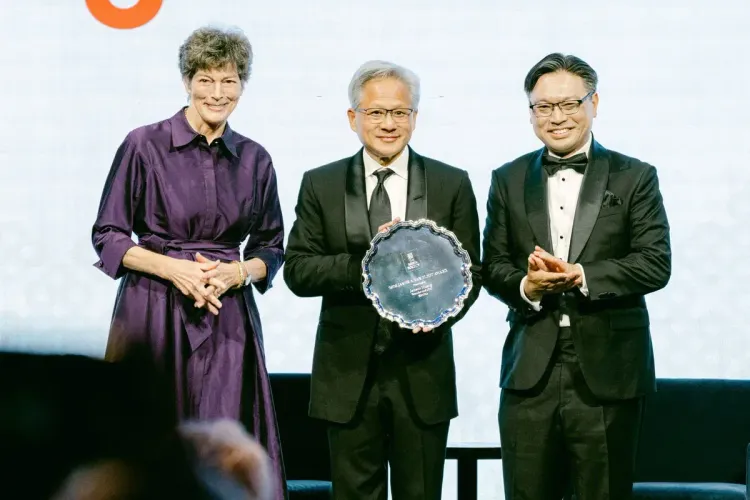
Nvidia CEO Jensen Huang has received the 2026 Van Fleet Award from The Korea Society, marking more than 25 years of deep U.S.–Korea technology ties that now underpin the global AI hardware supply chain.
Key Takeaways
Jensen Huang has been named the 2026 Van Fleet Award recipient by The Korea Society , a non-partisan body that promotes U.S.–Korea relations.
Nvidia stated it has worked with Korea for more than 25 years , spanning memory, packaging, and AI accelerator supply chains.
South Korean firms Samsung and SK Hynix are critical suppliers of high-bandwidth memory used in Nvidia's advanced AI GPUs.
The Van Fleet Award is named after General James A.
Van Fleet and recognises outstanding contributions to the bilateral relationship.
The recognition comes amid a global AI infrastructure boom that has made Nvidia's Korea-linked supply chains a geopolitical as well as commercial priority.
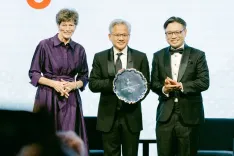
A quarter-century of chip-level collaboration between one of America's most powerful technology companies and one of Asia's most dynamic semiconductor ecosystems just received its most visible recognition yet. Nvidia announced on Saturday, 4 October 2026 that Jensen Huang, its chief executive, has been honoured with the 2026 Van Fleet Award by The Korea Society — a prestigious recognition of individuals who have made outstanding contributions to the U.S.–Korea relationship.
In its post on X, Nvidia wrote: 'Thank you to The Korea Society for honoring Jensen Huang with the 2026 Van Fleet Award and celebrating the U.S.–Korea partnership. We've worked with Korea for more than 25 years, and we're proud of what we've built together. Looking forward to what comes next.'
What the Van Fleet Award represents
The Van Fleet Award is named after General James A. Van Fleet, who commanded United Nations forces on the Korean peninsula during the early 1950s and later became a tireless advocate for strengthening ties between the two nations. The Korea Society, a non-partisan New York-based organisation, presents the award annually to leaders who have made a concrete, lasting difference to bilateral relations. Past recipients have included diplomats, business executives, and cultural figures whose work bridged the Pacific in tangible ways.
Nvidia's recognition signals how deeply the company's technology ambitions are intertwined with South Korea's industrial landscape — a relationship that goes well beyond routine supplier contracts.
25-plus years of Korea partnerships at Nvidia
Nvidia's ties with South Korea stretch back to the company's formative years in the late 1990s, when Korean memory and display manufacturers were already critical partners in building consumer graphics cards. Over the following decades those links deepened dramatically: Samsung Electronics and SK Hynix, two of the world's dominant memory chip producers, supply the high-bandwidth memory that powers Nvidia's most advanced AI accelerators, including the flagship H100 and successor data-centre GPUs. Korean manufacturers also play a key role in the advanced packaging and testing processes that allow Nvidia to push transistor density to its limits.
For South Korea, the relationship has been equally consequential. Nvidia's demand for cutting-edge HBM stacks has been a major driver of investment in next-generation memory fabrication, reinforcing Seoul's strategic bet that advanced memory — not just logic chips — is a pillar of national technology competitiveness.
Why this moment matters beyond ceremony
The timing of the award is notable. The global AI infrastructure buildout has pushed Nvidia's valuation and influence to historic highs, making its supply-chain geography a matter of geopolitical as well as commercial interest. Washington and Seoul have both signalled that technology supply chains are a cornerstone of the alliance — and Nvidia sits at the centre of that architecture.
Huang's personal recognition by The Korea Society therefore carries weight beyond a dinner-table trophy. It is a public acknowledgement that the AI hardware ecosystem — the one that every government and enterprise on the planet is now racing to secure access to — runs, in significant part, through Korean factories and Korean engineers.
The chips that will train tomorrow's AI models are, in no small measure, a joint U.S.–Korea production. The Van Fleet Award just put a name and a stage to that fact.
Point of View
Corporate recognition events like this increasingly function as soft-power markers of where the real AI supply-chain anchors lie. For investors and policymakers watching Nvidia's geopolitical footprint, the award is less a ceremony than a data point.
NationPress
3 Oct 2026
Frequently Asked Questions
What is the Van Fleet Award?
The Van Fleet Award is presented annually by The Korea Society to individuals who have made outstanding contributions to the U.S.–Korea relationship. It is named after General James A. Van Fleet, a key military and diplomatic figure in Korean-American history.
Why did Jensen Huang receive the 2026 Van Fleet Award?
The Korea Society honoured Jensen Huang in recognition of Nvidia's more than 25-year partnership with South Korea, which spans memory chip supply, AI hardware development, and broader technology collaboration between the two countries.
How long has Nvidia worked with South Korea?
Nvidia has worked with South Korea for more than 25 years, according to the company's own statement. The partnership covers Korean memory manufacturers and advanced packaging suppliers critical to Nvidia's GPU and AI accelerator products.
Which Korean companies work with Nvidia?
Samsung Electronics and SK Hynix are among the most prominent South Korean companies partnering with Nvidia, supplying the high-bandwidth memory used in the company's data-centre AI accelerators such as the H100 series.
What is The Korea Society?
The Korea Society is a non-partisan, non-profit organisation based in New York that promotes greater awareness, understanding, and cooperation between the United States and South Korea through policy, arts, education, and corporate programmes.