Is Pakistan's Foreign Policy Driven by Military Ambitions Leading to Uncontrollable Conflicts?
Click to start listening
Synopsis
As Pakistan grapples with a severe economic crisis and political instability, its military-driven foreign policy is leading to entanglements in conflicts, risking the nation's stability and image. This report delves into the implications of these strategic missteps.
Key Takeaways
- Pakistan is currently facing a severe economic crisis and political instability.
- Military-driven foreign policy is leading to entanglements in conflicts.
- The nation is seen as increasingly vulnerable to external pressures.
- Recent diplomatic moves may undermine relations with key allies.
- The potential deployment of troops to Gaza raises significant risks.
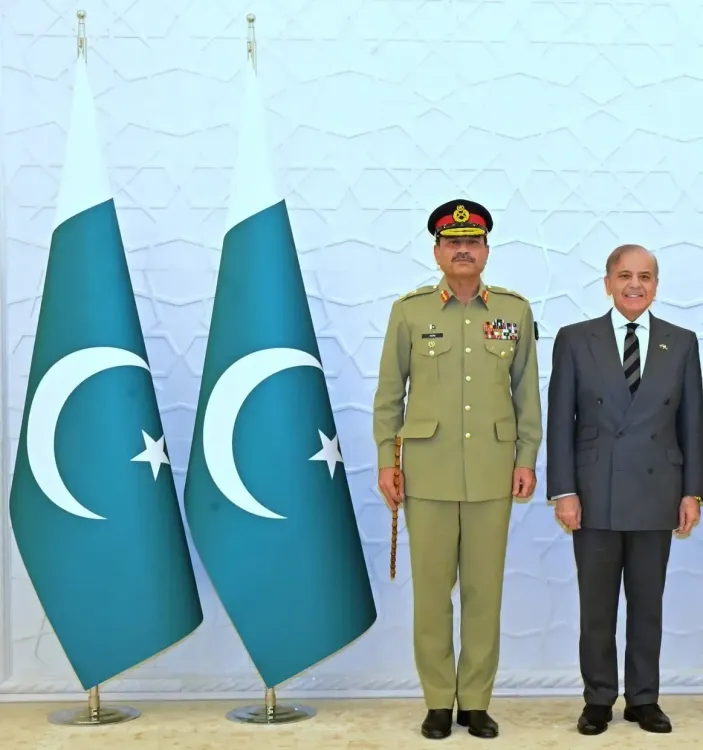
Dhaka, Jan 15 (NationPress) Struggling with a dire economic situation, political turmoil, and internal militant threats, Pakistan finds itself unable to pursue a foreign policy that is primarily motivated by the aspirations of a security apparatus eager to extend its influence abroad, even as peace at home remains out of reach, a report emphasized on Thursday.
It pointed out Islamabad's diplomatic overreach and contradictory statements, illustrating how Prime Minister Shehbaz Sharif, along with key cabinet members like Deputy PM and Foreign Minister Ishaq Dar, met with UAE President Sheikh Mohammed bin Zayed at his lavish estate in Rahim Yar Khan on the same morning Saudi Arabia launched strikes against what it claimed were Emirati-linked arms shipments.
The situation was rife with irony, as Pakistan expressed solidarity with Riyadh while hosting the very leader Riyadh pressured militarily. Reports suggested that Saudi Arabia declined a meeting request from Field Marshal Asim Munir, Pakistan's powerful army chief, which further indicated that Islamabad's balancing act was becoming increasingly fragile, noted author and columnist Arun Anand in the Bangladeshi weekly, Blitz.
Such occurrences are not coincidental; they reveal a deeper strategic issue stemming from a military-centric foreign policy that entangles Pakistan in conflicts it neither governs nor fully comprehends.
Over the last decade, Pakistan has transitioned from being a peripheral player in the Middle East to finding itself increasingly exposed. The shift has been dictated by military diplomacy, as highlighted by the recent Strategic Mutual Defence Agreement with Saudi Arabia, leaving the country awkwardly positioned between competing power blocs—China and the United States globally, and Saudi Arabia and the UAE regionally. While all allies demand loyalty, none provide protection when interests clash, the report stated.
The prospect of sending Pakistani troops to the war-ravaged Palestinian territories presents additional risks. US President Donald Trump has openly requested Pakistan's commitment to contribute forces to a proposed security or stabilization initiative in the area.
The Gaza stabilization force would likely entail disarming Hamas, enforcing cease-fire agreements, and operating under an American or Israeli security framework. Such a role would conflict with public sentiment in Pakistan, where there is widespread support for the Palestinian cause. Moreover, it could tarnish the nation's reputation in the broader Muslim community, as involvement in what many would see as an externally imposed security measure or the disarming of a group viewed as Palestinian resistance could be interpreted as complicity with Israel, the Blitz article elaborated.
However, should the Pakistan Army take on such a role, it would not be unprecedented; the military has a history of collaborating with regional powers. For instance, during the 1970 Black September crisis, Pakistani military officials assisted Jordan's monarchy in brutally suppressing Palestinian fighters. This past involvement, overseen by Brigadier Mohammad Zia-ul-Haq, who later ruled as a military dictator, left a lasting negative impression on Pakistan's image among Palestinians, and repeating such actions in Gaza could be even more detrimental.
Gaza is not the only area where Pakistan's Middle East policy appears to be failing.
Asim Munir, the Pakistani army chief, recently signed a monumental $4.6 billion arms deal with Khalifa Haftar in Benghazi, which is reportedly the largest in Pakistan's history, marking yet another instance of strategic overreach without clarity.
While the deal signifies Pakistan's strategic reach on paper, it has been described as a diplomatic blunder of significant magnitude. Libya is a nation divided, with rival administrations in control. The internationally recognized Abdul Hamid Dbeibeh's Government of National Unity (GNU) in Tripoli stands opposed to Khalifa Haftar's unrecognized Government of National Stability (GNS) in Benghazi. Furthermore, Libya remains under a UN arms embargo imposed in 2011, making any significant arms transfer to an unrecognized body a potential violation of international law.
This deal not only contravenes UN sanctions but also complicates Islamabad's regional strategy. By aligning itself with Haftar, Pakistan has effectively taken sides in a complex proxy struggle, as the military leader is backed by the UAE and Egypt, while the GNU is supported by the UN and Saudi Arabia. This outreach to Benghazi undermines Pakistan's relations with Riyadh, especially when Saudi goodwill is urgently needed.
These decisions indicate that the leadership of the Pakistan Army seems to believe that visibility equates to influence, assuming that being present guarantees relevance. In reality, this has left Pakistan vulnerable to pressures from more powerful nations with clearer agendas.
If Pakistan continues on this trajectory—becoming embroiled in Gulf rivalries, pressured to deploy troops to Gaza, and aligning with contentious figures like Khalifa Haftar—it risks becoming a pawn rather than the mediator its elite aspires for. In the unforgiving geopolitical landscape of the Middle East, pawns are easily sacrificed.
Point of View
It is crucial to emphasize that while Pakistan's military has historically played a significant role in foreign affairs, the current trajectory poses serious risks. A balanced approach is necessary to ensure that Pakistan does not become ensnared in conflicts that undermine its national interests and stability.
NationPress
15/01/2026
Frequently Asked Questions
What are the main challenges facing Pakistan's foreign policy?
Pakistan's foreign policy is currently challenged by economic instability, political turmoil, and a military-centric approach that often leads to entanglements in conflicts beyond its control.
How does military influence affect Pakistan's diplomatic relations?
The military's influence often leads to a foreign policy that prioritizes power projection over national stability, resulting in strained relations with key allies and potential backlash from the international community.
What are the implications of Pakistan's arms deal with Khalifa Haftar?
The arms deal with Khalifa Haftar complicates Pakistan's regional policy by aligning it with contested actors, potentially undermining relationships with traditional allies like Saudi Arabia and violating international law.
Why is Pakistan's involvement in the Gaza region considered risky?
Engaging in the Gaza region could place Pakistan at odds with domestic public sentiment, which largely supports the Palestinian cause, and may damage its reputation in the broader Muslim world.
What historical precedents affect current military engagements?
Past military engagements, such as assisting Jordan during the Black September crisis, have left a lasting negative perception among communities like the Palestinians, making similar future roles potentially damaging.