How Does the Modi-Putin Summit Highlight India's Balancing Act Between Washington and Moscow?
Click to start listening
Synopsis
In a world of geopolitical tensions, the Modi-Putin summit sheds light on India's strategic balancing act between the West and Russia. As pressures mount from Washington, India seeks to maintain crucial ties with Moscow while navigating energy dependencies and trade negotiations.
Key Takeaways
- India is navigating complex geopolitical pressures between Washington and Moscow.
- Energy security remains a central theme in India's relationship with Russia.
- The summit emphasized the personal rapport between Modi and Putin.
- India aims for a USD 100 billion trade target with Russia by 2030.
- The U.S. is pressuring India to decrease Russian oil imports.
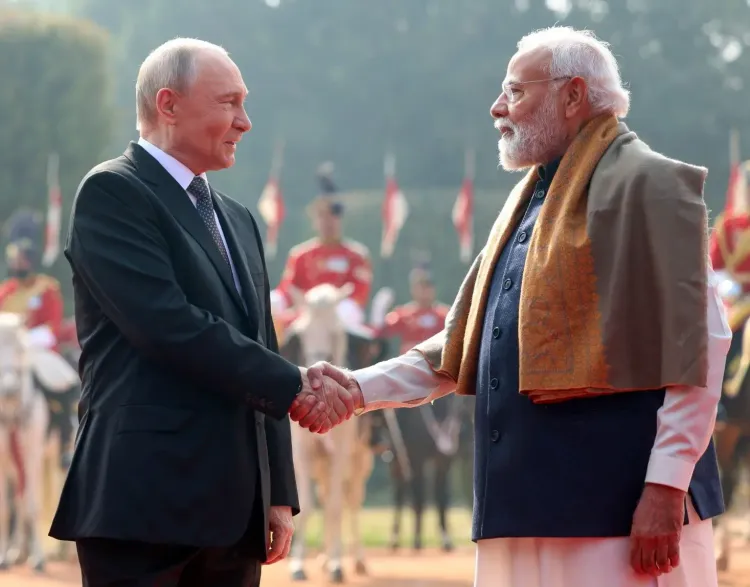
Washington, Dec 6 (NationPress) Major U.S. media outlets portrayed the recent summit in New Delhi between Prime Minister Narendra Modi and Russian President Vladimir Putin as a critical exhibition of India's strategic balancing skills.
Coverage of the Modi-Putin summit emphasized how energy security, geopolitical pressures from Washington, and the personal rapport between the two leaders influenced the discussions.
The Wall Street Journal noted that the meeting occurred under the shadow of U.S. sanctions affecting India's dependence on discounted Russian crude.
The publication indicated that the energy alliance, pivotal since 2022, now confronts challenges as Washington targets traders associated with Rosneft and Lukoil, compelling Indian refiners to rethink their procurement strategies.
Despite these pressures, both leaders conveyed a sense of continuity, with President Putin assuring that Russia is “prepared to continue uninterrupted fuel shipments,” while PM Modi labeled energy security as a “strong and vital pillar” of their partnership.
The Washington Post characterized the summit as a crucial moment for India's foreign policy, suggesting it tested New Delhi's ability to uphold its long-standing relationship with Moscow while responding to U.S. calls for a peace agreement in Ukraine and seeking closer ties with partners.
The Post highlighted PM Modi's warm greeting for Putin and the announcement of an economic cooperation initiative aiming to boost bilateral trade to USD 100 billion by 2030.
It also pointed out that the United States has increasingly urged India to reduce its imports of Russian oil, recalling that President Trump earlier this year escalated tariffs on Indian products to 50 percent.
Experts cited by the Post suggested that the Moscow visit “underscores New Delhi's strategic tightrope walk between the West and the rest,” with India balancing its Russian partnership against vital trade dialogues with the U.S. and the European Union.
The New York Times underscored the personal connection between the two leaders, quoting PM Modi as praising his “deep and unbreakable relationship” with Putin, likening India-Russia ties to a “North Star.” The Times asserted that the summit illustrated India's assertion of “strategic autonomy,” despite tensions in its relationship with Washington due to tariffs and Western sanctions that have significantly curtailed India's Russian crude intake.
The publication also noted the visit's symbolism—from PM Modi's warm reception at the airport to the Indian media's celebratory narratives surrounding the partnership—and cited analysts who indicated that Russia is increasingly viewing India as a hedge against its “colossal dependence” on China.
Across various reports, U.S. outlets concurred that New Delhi is striving to safeguard its energy supplies, navigate pressures from Washington and Europe simultaneously, and uphold a functional relationship with Moscow amid global uncertainties.
For India, U.S. analyses suggest, the path ahead involves maintaining its historic partnership with Russia while simultaneously seeking deeper economic and strategic collaboration with the United States.
Point of View
My perspective aligns with the significance of India's diplomatic maneuvers. Navigating relationships with both Washington and Moscow is vital for India's national interests. The Modi-Putin summit exemplifies this delicate balance, showcasing the need for India to sustain its strategic partnerships while addressing the pressures of global geopolitics. Our coverage aims to provide a comprehensive view of these developments, ensuring our readers stay informed.
NationPress
06/12/2025
Frequently Asked Questions
What was the main focus of the Modi-Putin summit?
The summit primarily focused on energy security, geopolitical pressures, and the personal rapport between the leaders.
How does the U.S. view India's relationship with Russia?
The U.S. has expressed concerns regarding India's reliance on Russian oil and encourages India to reduce its imports.
What is the significance of the economic cooperation program announced?
The program aims to elevate bilateral trade between India and Russia to USD 100 billion by 2030, highlighting the importance of their partnership.