Modi's New Zealand visit: First PM trip in 40 years seals FTA, USD 20 bn pledge
Synopsis
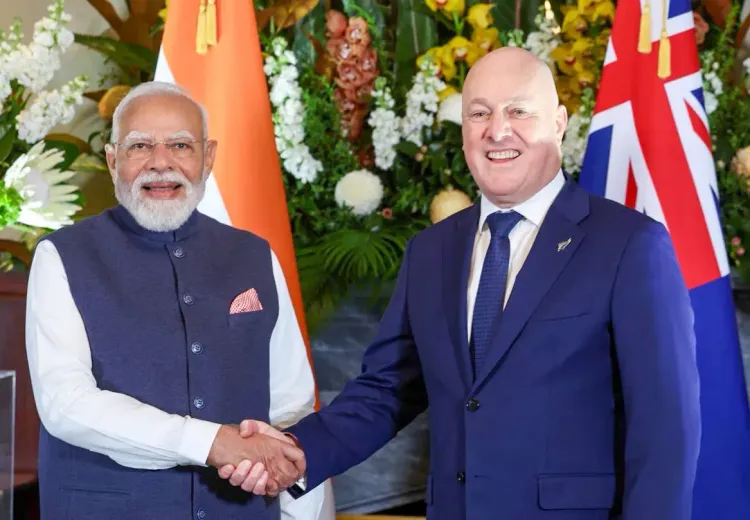
For the first time in 40 years, an Indian Prime Minister landed in Auckland — and left with a free trade agreement, a USD 20 billion investment pledge, and MoUs across defence, dairy, and skills mobility. Modi's New Zealand visit signals that India's Indo-Pacific pivot is no longer just about big neighbours; smaller but strategically placed partners are now firmly in the frame.
Key Takeaways
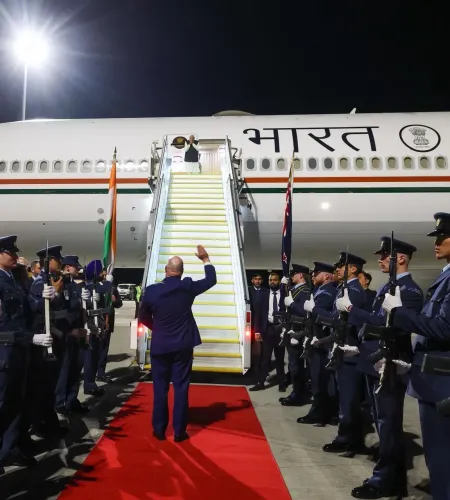
PM Narendra Modi visited New Zealand on 10-11 July — the first Indian PM visit to Auckland in 40 years .
India and New Zealand signed a landmark Free Trade Agreement (FTA) covering agriculture, food technology, skills mobility, and investment.
New Zealand committed to invest USD 20 billion in India over 15 years .
The agreement opens a pathway for 5,000 skilled Indian workers annually to work in New Zealand.
Both sides signed multiple MoUs covering defence, maritime security, dairy, tourism, sports, and ocean research.
Modi addressed 10,000 members of the Indian diaspora at the 'Kia Ora Modi' event in Auckland.
Prime Minister Narendra Modi's 10-11 July visit to New Zealand — the first by an Indian Prime Minister to Auckland in 40 years — marked a significant deepening of bilateral ties, culminating in a landmark free trade agreement and a USD 20 billion New Zealand investment commitment to India over 15 years. The visit, according to reports, underscored India's renewed strategic and economic engagement with the Pacific nation.
Key Developments from the Auckland Visit
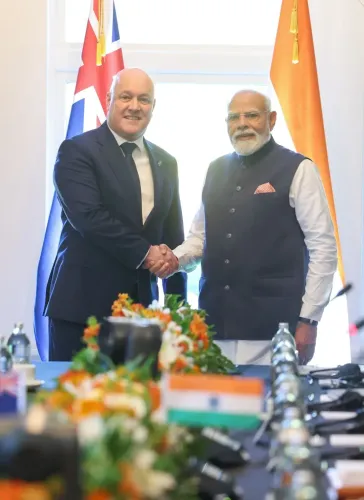
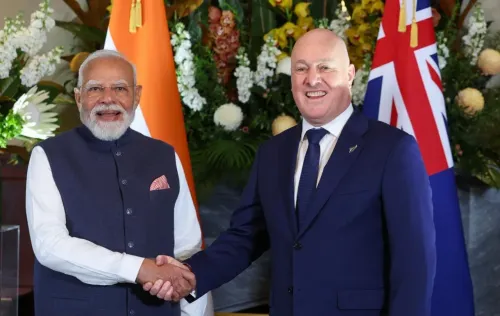
Modi held wide-ranging talks with New Zealand Prime Minister Christopher Luxon covering trade and investment, defence and security, agri-tech, sports, education, tourism, culture, and people-to-people ties. Both leaders subsequently witnessed the signing of several Memoranda of Understanding (MoUs) spanning defence and maritime security, hydrography, sports, disaster management, dairy, tourism, maritime heritage, culture, food technology, and ocean research.
Modi described the India-New Zealand Free Trade Agreement (FTA) as a 'landmark' that would 'add depth and dynamism to the bilateral economic ties, and open new opportunities for market access, investment, services, technology and talent mobility.'
What the Trade Agreement Covers
The newly signed trade agreement focuses on agriculture, food technology, skills mobility, and investment. New Zealand gains greater access to India's market for products such as apples, kiwi fruit, and Manuka honey, while India retains protections for its dairy sector. Notably, the agreement carves out a pathway for 5,000 skilled Indian workers annually to work in New Zealand — a significant labour mobility provision that directly affects the Indian professional community.
This comes amid a broader pattern of India expanding its FTA network across the Indo-Pacific, with agreements already in place or under negotiation with the UAE, Australia, and the United Kingdom.
Strategic and Diaspora Dimensions
The visit carried clear Indo-Pacific strategic weight. India regards New Zealand as a key partner in its 'Act East' policy and broader Indo-Pacific strategy. The two nations signalled greater collaboration on maritime security and regional stability — areas of increasing salience given evolving power dynamics in the Pacific.
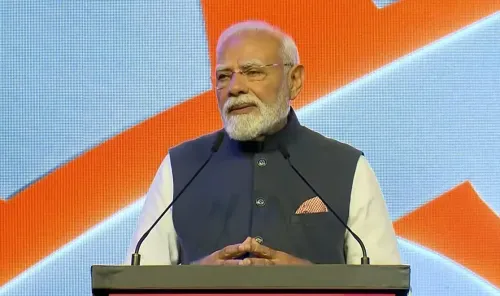
The Indian diaspora in New Zealand, numbering approximately 300,000 people, featured prominently. Modi addressed 10,000 members of the Indian community at the 'Kia Ora Modi' event, which Luxon also attended as a special gesture — a rare instance of a host-country PM participating in a diaspora event.
Business and People-to-People Engagement
Modi and Luxon met a select group of CEOs and business leaders, signalling intent to translate diplomatic goodwill into commercial outcomes. The two leaders also attended a gala luncheon themed 'India-New Zealand: A Winning Partnership', attended by figures from politics, business, academia, technology, sports, and the arts. They walked through a display of innovative sports equipment and interacted with decorated New Zealand athletes.
Building on the 2025 Strategic Partnership
The Auckland visit builds on Luxon's trip to India in 2025, when both leaders announced the India-New Zealand Strategic Partnership, endorsed a Roadmap to 2030 as a shared framework for joint action, and signed 10 bilateral agreements. The current visit, with its FTA and expanded MoU basket, represents the next structural layer of that partnership. With the Roadmap to 2030 now operative, further milestones in defence and economic cooperation are expected in the years ahead.
Point of View
000 Indian workers annually — is the provision most likely to generate durable people-to-people capital, but it also raises questions about whether New Zealand's labour market commitments will survive domestic political cycles. The dairy carve-out, meanwhile, reflects a familiar tension: India can open markets selectively, but its farm-sector sensitivities remain a ceiling on how far any trade deal can go. The real test of the Roadmap to 2030 will be whether defence and maritime cooperation moves from MoU to operational reality.
NationPress
15 Oct 2026
Frequently Asked Questions
Why is PM Modi's New Zealand visit historically significant?
It is the first visit by an Indian Prime Minister to Auckland in 40 years, marking a major reset in bilateral engagement. The visit produced a free trade agreement, a USD 20 billion investment pledge, and a wide range of MoUs across defence, dairy, sports, and ocean research.
What does the India-New Zealand Free Trade Agreement include?
The FTA covers agriculture, food technology, skills mobility, and investment. It gives New Zealand greater market access for apples, kiwi fruit, and Manuka honey, while India retains dairy-sector protections. It also allows 5,000 skilled Indian workers annually to work in New Zealand.
How much has New Zealand committed to invest in India?
New Zealand has committed to invest USD 20 billion in India over 15 years as part of the agreements signed during Modi's July 2025 visit to Auckland.
What is the India-New Zealand Strategic Partnership and Roadmap to 2030?
The Strategic Partnership was announced during New Zealand PM Christopher Luxon's visit to India in 2025, when both leaders also endorsed a Roadmap to 2030 as a shared framework for joint action. The July 2025 Auckland visit added the FTA and expanded MoUs as the next layer of that partnership.
Who attended the 'Kia Ora Modi' diaspora event in Auckland?
Approximately 10,000 members of the Indian community attended the 'Kia Ora Modi' event, at which PM Modi addressed the gathering. New Zealand PM Christopher Luxon also joined the event as a special gesture.