NASA ends MAVEN Mars mission after 11 years following spacecraft loss
Synopsis
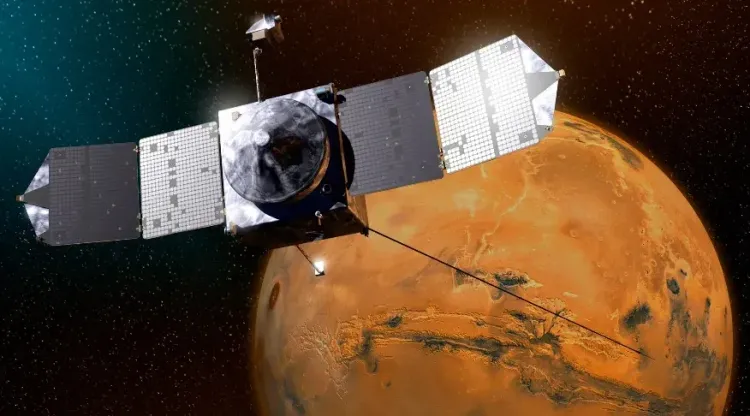
MAVEN, NASA's first dedicated Martian atmosphere probe, is officially dead — six months after a silent slip behind Mars sent it spinning and drained its batteries. Built for one year, it lasted over 11, reshaping how scientists understand atmospheric loss on the Red Planet and feeding directly into the radiation safety blueprint for future human missions.
Key Takeaways
NASA formally ended the MAVEN mission after determining the spacecraft is unrecoverable.
Contact was lost on 6 December 2025 when MAVEN passed behind Mars and entered a high-rate rotation.
Launched on 18 November 2013 , the probe entered Mars orbit on 21 September 2014 .
Designed for a one-year mission, it operated for more than 11 years .
An anomaly review board convened in February 2026 confirmed the spacecraft cannot be revived.
A final root-cause report is expected later this year; decommissioning and data archiving are under way.
NASA has officially ended its MAVEN (Mars Atmosphere and Volatile Evolution) mission after determining the spacecraft is unrecoverable, six months after it lost contact with Earth on 6 December 2025. The decision, announced on Wednesday from the agency's Washington headquarters, closes an 11-year chapter of Martian atmospheric research that exceeded its original one-year mandate by more than a decade.
How the mission ended
The spacecraft was last heard from on 6 December 2025, when it experienced an unexpected loss of signal after passing behind Mars. Preliminary findings indicate MAVEN entered a high-rate rotation following the pass, disrupting its orbit trajectory and eventually draining its batteries. The resulting power loss to the communications system left the probe unable to contact Earth.
Anomaly review and final verdict
NASA convened an anomaly review board in February 2026 to evaluate recovery options and assess the spacecraft's condition. The board concluded that MAVEN is not recoverable and is no longer capable of performing its science and data-relay role — a finding consistent with the mission team's own assessment. The agency noted that the root cause of the anomaly remains under investigation, with a final report expected later this year.
A mission that outlived its design
Launched on 18 November 2013, MAVEN entered Mars orbit on 21 September 2014 as the first NASA mission dedicated solely to studying the Martian atmosphere and its evolution. Designed for a one-year primary mission, it instead delivered more than 11 years of data on how Mars lost much of its atmosphere over geological time — a question central to understanding why the Red Planet became uninhabitable.
Why it matters for human exploration
“The science MAVEN has given us is key to informing what kind of radiation protection and safety measures we must take before sending humans to Mars,” said Louise Prockter, director of the Planetary Science Division at NASA Headquarters in Washington. The probe also served as a critical communications relay for surface assets, a role that will now have to be absorbed by other orbiters.
What happens next
NASA has begun the formal decommissioning process, following standard procedures to archive the full mission dataset for the global science and exploration community. The final anomaly report is expected before the end of the year, and its findings could shape design choices for future long-duration Mars orbiters.
Point of View
Even for a probe that outlived its design tenfold. The real loss isn't sentimental — it's operational: MAVEN doubled as a relay for surface assets, and its silence puts more load on an ageing fleet of orbiters at a time when NASA's Mars Sample Return is already under budget strain. The bigger question the final report must answer is whether the rotation anomaly was a one-off or a class risk for long-duration orbiters now being designed for crewed-era missions.
NationPress
21 Oct 2026
Frequently Asked Questions
What was the MAVEN mission?
MAVEN, short for Mars Atmosphere and Volatile Evolution, was NASA's first mission dedicated solely to studying the Martian atmosphere and how it has evolved over time. Launched in November 2013, it entered Mars orbit in September 2014 and operated for more than 11 years before contact was lost.
Why did NASA end the MAVEN mission?
NASA ended the mission after an anomaly review board concluded the spacecraft is not recoverable. MAVEN lost signal on 6 December 2025 after passing behind Mars, entered a high-rate rotation, and drained its batteries, leaving its communications system without power.
When did MAVEN lose contact with Earth?
MAVEN was last heard from on 6 December 2025, when it experienced an unexpected loss of signal after passing behind Mars. Recovery attempts over the following weeks were unsuccessful.
What happens to MAVEN's data now?
NASA has begun formal decommissioning and will archive the full mission dataset for the global science and exploration community. A final report on the root cause of the anomaly is expected later this year.
Why is MAVEN important for future human missions to Mars?
MAVEN's findings on atmospheric loss and radiation environment directly inform the protective measures needed before sending astronauts to Mars. Louise Prockter, director of NASA's Planetary Science Division, said the science is key to designing radiation protection and safety systems for crewed missions.