Gwadar enforced disappearances: Paank condemns abduction of four Baloch men
Synopsis
Four Baloch men — including two brothers who had previously been disappeared and released — were allegedly abducted by Pakistani security forces in Gwadar and Turbat. Paank's documentation of repeated targeting of the same individuals signals a pattern that goes beyond isolated incidents, raising urgent questions about accountability and the rule of law in Balochistan.
Key Takeaways
Paank condemned the enforced disappearance of four Baloch men across two separate incidents on 23 August .
Sajid Baloch and Akeel Baloch , labourers from Kolwah , were intercepted by military personnel in Gwadar ; their whereabouts remain unknown.
Mehraj Baloch and Irshad Baloch were abducted during a security raid in Turbat on 18 August .
Both Mehraj and Irshad had previously been subjected to enforced disappearance — Mehraj was held for over a year before his release.
Paank holds Pakistani state authorities fully responsible and demands the immediate and safe release of all four men.
Paank, the human rights department of the Baloch National Movement (BNM), on Sunday, 23 August condemned the enforced disappearance of four men from Balochistan, including two brothers picked up by Pakistani military forces in Gwadar and two others abducted during a security raid in Turbat. The rights body has demanded their immediate and safe release, holding state authorities fully responsible for their well-being.
The Gwadar Disappearance
Sajid Baloch and Akeel Baloch, sons of Muhammad Bakhsh and residents of Sandum village in Kolwah, were reportedly working as labourers in the Kantani area of Gwadar. According to Paank, the two brothers were intercepted by military personnel while travelling back to their hometown and were forcibly disappeared. Their whereabouts remain unknown as of this report.
Paank described enforced disappearance as a 'grave violation of international human rights law,' stating that it places victims outside the protection of the law and exposes them to the risk of torture and other serious abuses.
The Turbat Raid
Paank also condemned the enforced disappearance of Mehraj Baloch and Irshad Baloch, sons of Hasil, who were allegedly abducted by Pakistani security forces during a military raid in the Bhan area of Turbat on the evening of 18 August. Originally from Patok village in Dasht, the two brothers had relocated to Turbat, where they were residing at the time of the raid.
According to Paank, security forces subjected residents to harassment and house searches before forcibly disappearing the two men. The rights body characterised this case as 'particularly alarming.'
A Pattern of Repeated Targeting
What makes the Turbat case especially concerning, according to Paank, is that both Mehraj and Irshad had previously been subjected to enforced disappearance. Paank stated that Mehraj endured more than a year of unlawful detention before his release, while Irshad had also been previously disappeared. 'The repeated targeting of the same individuals reflects a disturbing pattern of abuse and a complete disregard for fundamental human rights and the rule of law,' the rights body said in its statement on X.
Paank's Demands
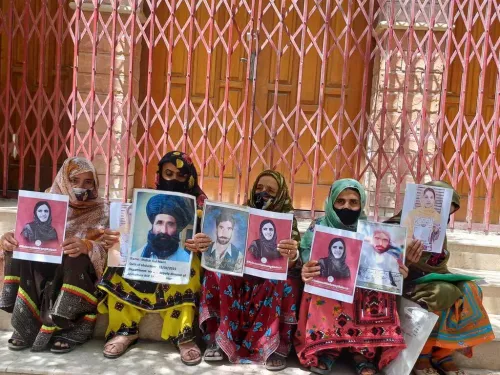
Paank has called for the immediate and safe release of all four men — Sajid Baloch, Akeel Baloch, Mehraj Baloch, and Irshad Baloch — and demanded an end to the ongoing practice of enforced disappearances across Balochistan. The organisation holds Pakistani state authorities fully accountable for the physical and psychological well-being of the disappeared individuals. This comes amid longstanding international concern over enforced disappearances in Balochistan, a practice that human rights groups have documented for over two decades.
Point of View
Systematic approach rather than arbitrary security operations. Balochistan's enforced disappearance crisis has been documented for over two decades, yet accountability mechanisms remain effectively absent. The international community's response has been largely rhetorical. Until Pakistan faces concrete consequences — at the UN Human Rights Council or through bilateral diplomatic pressure — Paank's demands, however legitimate, are unlikely to produce results on the ground.
NationPress
8 Oct 2026
Frequently Asked Questions
Who are the four men disappeared in Gwadar and Turbat?
The four men are Sajid Baloch and Akeel Baloch, sons of Muhammad Bakhsh from Sandum village in Kolwah, who were abducted in Gwadar, and Mehraj Baloch and Irshad Baloch, sons of Hasil from Patok village in Dasht, who were abducted during a military raid in the Bhan area of Turbat on 18 August.
What is Paank and why is it condemning these disappearances?
Paank is the human rights department of the Baloch National Movement (BNM). It condemned the abductions as grave violations of international human rights law, warning that enforced disappearances place victims outside legal protection and expose them to torture and other serious abuses.
Why is the Turbat case described as particularly alarming?
Both Mehraj Baloch and Irshad Baloch had previously been subjected to enforced disappearance. Mehraj was held for more than a year before being released, and Irshad had also been previously disappeared. Their re-abduction points to a pattern of repeated targeting of the same individuals.
What has Paank demanded from Pakistani authorities?
Paank has demanded the immediate and safe release of all four disappeared men and called for an end to the broader practice of enforced disappearances across Balochistan. It holds Pakistani state authorities fully responsible for the physical and psychological well-being of the victims.
How widespread is the enforced disappearance crisis in Balochistan?
Human rights organisations have documented enforced disappearances in Balochistan for over two decades. The practice has drawn repeated condemnation from international bodies, though accountability for perpetrators has remained largely absent according to rights groups.