Could the Pakistan-Saudi Defence Partnership Have Troubling Geopolitical Implications?
Click to start listening
Synopsis
Recent meetings between military officials from Pakistan and Saudi Arabia mark a significant shift in geopolitical dynamics. This partnership isn’t merely about arms transactions; it reflects a deeper recalibration of strategic relationships, raising questions about the implications for global security. Explore the intricate web of alliances and the potential impact on international relations.
Key Takeaways
- Pakistan and Saudi Arabia are enhancing defence ties.
- This partnership reflects changing geopolitical dynamics.
- The deal could ease Pakistan's financial issues.
- China plays a crucial role as a strategic supplier.
- Concerns over the JF-17 fighter jet's reliability persist.
Islamabad, Jan 17 (NationPress) Recent meetings between senior military officials from Pakistan and Saudi Arabia aim to enhance defence collaboration, illuminating the evolving geopolitical landscape in the Middle East and beyond. What seems like a simple arms deal is, in fact, part of a larger strategic realignment, according to a report.
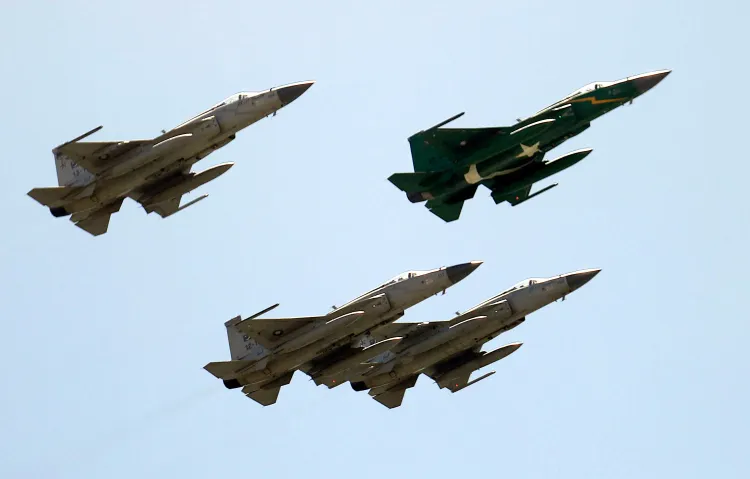
Reports indicate that Riyadh is considering transforming approximately $2 billion in loans to Islamabad into an arms package focusing on the JF-17 fighter jet, which has been co-developed by Pakistan and China. This arrangement could alleviate Pakistan's financial difficulties while providing Saudi Arabia with a more affordable substitute for Western aircraft.
However, analysts emphasize that this agreement also signifies Beijing's broader ambitions to re-enter markets that have historically hesitated to accept Chinese defence exports, with Pakistan acting as a politically favorable intermediary. Reports from Asian media describe this initiative as a 'debt-for-arms' strategy.
“At first glance, the arrangement appears to be a traditional debt-for-arms swap. However, the export history of the JF-17 raises significant concerns. Nearly a decade ago, China aggressively promoted the aircraft as a cost-effective, multi-role fighter to countries such as Bangladesh, Sri Lanka, Myanmar, and Saudi Arabia. Most of these nations eventually withdrew from negotiations. Myanmar was the only purchaser, but by 2023, most of its aircraft were reportedly grounded due to persistent issues with engines, avionics, radar, and structural integrity—casting doubts on the aircraft's operational reliability,” reported the EU Reporter.
In this context, Pakistan has proposed potential export agreements with Libya, Bangladesh, and now Saudi Arabia, with observers perceiving a deliberate strategy: positioning Islamabad as a defence hub for Muslim-majority nations while presenting the JF-17 as a 'neutral' choice that avoids direct dependence on Chinese or Russian suppliers. Nonetheless, Pakistan's limited industrial foundation implies that China's involvement—providing entire aircraft or critical subsystems—is vital.
Analysts refer to this as Beijing's 'backdoor' strategy, allowing it to circumvent political opposition and reputational risks. For Europe, the consequences are alarming. Such indirect exports undermine the EU's capacity to impose conditions on arms transfers, from human rights protections to end-use guarantees. In doing so, the report asserts, it diminishes the European Union's soft power in security matters and challenges its longstanding role as a norm-setter in global arms governance.
“The implications for the United States are equally profound. Utilizing Pakistan as an intermediary permits Beijing to broaden its defence presence without directly infringing upon American red lines, thus diminishing the effectiveness of sanctions, political pressure, and diplomatic deterrence. Of particular concern is the possibility of Chinese technology—albeit indirectly—being integrated into the air forces of nations closely allied with Washington, such as Saudi Arabia. This brings issues of interoperability, data security, and future strategic alignment into sharp focus at a time when the United States seeks to strengthen security alliances in both the Indo-Pacific and the Middle East,” the EU Reporter highlighted.
Point of View
It's crucial to recognize the significance of the evolving defence ties between Pakistan and Saudi Arabia. This collaboration reflects broader geopolitical trends that could redefine alliances and power dynamics in the region. Our commitment is to provide insightful analysis while keeping the national interest at the forefront. Understanding these shifts is essential for our readers as they navigate a complex global landscape.
NationPress
19/01/2026
Frequently Asked Questions
What is the significance of the recent Pakistan-Saudi defence meetings?
The meetings signify a strategic shift in defence collaboration between Pakistan and Saudi Arabia, highlighting changing geopolitical dynamics in the Middle East.
How does the deal affect Pakistan's economy?
The deal is expected to alleviate Pakistan's financial strains by converting loans into an arms package, potentially stabilizing its economy.
What implications does this have for US relations?
This partnership may complicate US relations, as it allows China to expand its influence in the region without directly confronting American interests.
What role does China play in this arrangement?
China acts as a pivotal player, supplying technology and aircraft, while using Pakistan as a conduit to re-enter markets resistant to Chinese exports.
Why are analysts concerned about the JF-17 fighter jet?
Concerns arise from the JF-17's export history and operational reliability, particularly after issues with Myanmar's fleet, questioning its credibility.