Is Pakistan's Growth Stuck at 3 Percent?
Synopsis
Pakistan's economic growth remains stagnant at 3%, according to the World Bank. Despite slight improvements in industrial activity, challenges in agriculture and high public debt hinder significant economic advancements. Can structural reforms and recovery from climate-induced disasters pave the way for a brighter economic future?
Key Takeaways
Pakistan's growth is forecasted to remain around 3 percent for the next few years.
Structural weaknesses and climate challenges are primary obstacles.
Recovery in agriculture and industrial activity could provide some support.
Public debt levels are at historical highs, limiting governmental growth support.
Strategic reforms are essential for economic advancement.
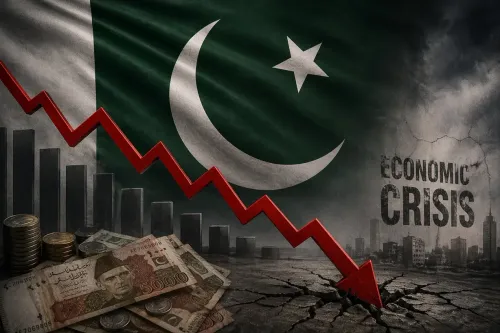
Washington, Jan 13 (NationPress) The World Bank reports that Pakistan's economy is expected to experience limited growth, remaining around 3 percent due to ongoing structural challenges and climate-related disruptions. According to their latest Global Economic Prospects report, the World Bank projects that Pakistan's economy grew 3.0 percent in FY2024-25, with a similar forecast for FY2025-26, before showing a slight increase to 3.4 percent in FY2026-27.
The report highlights that recent growth was aided by an uptick in industrial activities, following the easing of import restrictions and an increase in bank credit.
However, this progress has been countered by a decline in agricultural performance, which the World Bank attributes in part to a series of floods in 2025.
Pakistan is categorized within the Middle East, North Africa, Afghanistan, and Pakistan region, where overall growth is anticipated to improve, but the World Bank notes significant disparities among the economies.
The outlook for Pakistan remains hindered by structural issues, climate risks, and fiscal constraints.
The World Bank anticipates that recovery in agriculture and reconstruction from last year’s flooding may provide some degree of support going forward. Nevertheless, growth is still significantly below the levels necessary to enhance income or keep pace with population growth.
The report cautions that public debt in emerging and developing nations has reached its highest point in over fifty years, which restricts governments' capacity to stimulate growth.
“With public debt in emerging and developing economies at its highest level in more than half a century, restoring fiscal credibility has become an urgent priority,” stated M. Ayhan Kose, Deputy Chief Economist of the World Bank Group.
He emphasized that fiscal regulations could help stabilize debt and rebuild reserves, but the effectiveness depends on credibility, enforcement, and political commitment.
Pakistan’s economy has encountered multiple shocks in recent years, including flooding, balance-of-payments challenges, and policy instability, all of which have hindered investment and growth.
Point of View
I recognize the pressing challenges facing Pakistan's economy. The stagnation at 3% growth underscores the urgent need for structural reforms and strategic initiatives to address climate risks and fiscal pressures. Our focus must remain on advocating for solutions that empower the nation and enhance economic resilience.
NationPress
17 Sept 2026
Frequently Asked Questions
What is the current growth rate of Pakistan's economy?
Pakistan's economy is currently experiencing a growth rate of around 3 percent as reported by the World Bank.
What factors are affecting Pakistan's economic growth?
Structural weaknesses, climate shocks, and high public debt levels are major factors impacting Pakistan's economic growth.
When does the World Bank project growth will increase?
The World Bank projects that growth may slightly increase to 3.4 percent in FY2026-27.
How have climate events impacted agriculture in Pakistan?
Recent floods in 2025 have significantly dampened agricultural output in Pakistan, affecting overall economic performance.
What is needed for Pakistan's economic recovery?
A combination of structural reforms, recovery in agriculture, and effective fiscal policies is needed for economic recovery.