Pakistan's Fragile Production Capacity Poses Risks to Economic Recovery: Experts
Synopsis
As skepticism grows over Pakistan's economic recovery, experts highlight the critical issue of a deteriorating production base that undermines growth. This report sheds light on the nation's economic fragility and calls for urgent reforms.
Key Takeaways
Economic Recovery claims are met with skepticism.
A deteriorating production base is a critical challenge.
High inflation and unemployment continue to stress the economy.
Urgent reforms are necessary to address structural issues.
Government initiatives have not yielded significant results.
New Delhi, March 18 (NationPress) The claims made by Pakistan regarding economic stabilization and recovery are increasingly met with skepticism, as experts caution that entrenched structural issues—especially a declining production base—are undermining the nation’s economic prospects, according to a report.
As detailed in a report by The Express Tribune, while the government has touted its achievement in averting default, analysts assert that the overall economy remains precariously fragile, showing scant evidence of a consistent recovery.
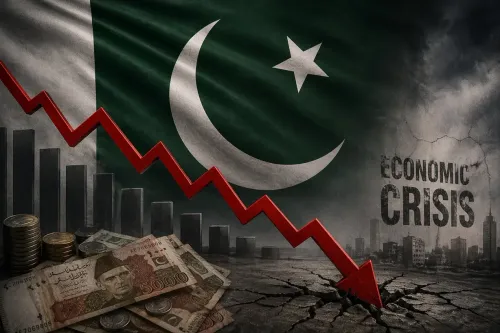
Key metrics indicate ongoing stress, characterized by sluggish growth, soaring inflation, rising unemployment, and a ballooning debt burden.
Experts point to insufficient production capacity as the most significant obstacle, hampering the country's potential for sustainable growth.
Over the years, Pakistan’s production framework has progressively declined due to policy neglect and ineffective governance.
Both industrial and agricultural outputs—critical to economic activity—have either stagnated or declined. A revision of data in 2021 revealed that the industrial sector’s contribution to GDP dropped from 20.9 percent to 19.5 percent, highlighting a structural decline, as reported.
The large-scale manufacturing sector is still struggling, while agriculture is facing increasing pressures from soaring input costs, declining output prices, and climate-related disruptions. Inadequate policy support has further burdened farmers, exacerbating poverty levels in vital regions.
The fragile production base has also aggravated external imbalances. A restricted export capacity and an increasing dependence on imports have depleted foreign exchange reserves, compelling the country into frequent borrowing cycles. Over the last two decades, public debt has surged, raising sustainability concerns.
Moreover, currency devaluation has intensified these challenges, driving inflation and diminishing purchasing power, thereby worsening economic conditions.
Experts warn that the ongoing economic crisis is now impacting the social fabric. Rising poverty, food insecurity, and inequality are deepening societal divides and heightening the risk of instability, according to the report.
The report also pointed out that government-sponsored initiatives, such as the Special Investment Facilitation Council (SIFC), have yet to yield significant results, thus calling their effectiveness into question.
Analysts contend that an over-reliance on short-term strategies—including subsidies, welfare spending, and asset sales—has further weakened the economic structure without tackling core issues. They urge that without immediate and comprehensive reforms aimed at rebuilding production capacity, enhancing governance, and fortifying the business environment, Pakistan’s economic challenges could worsen, delaying any genuine recovery.
Point of View
The current economic narrative in Pakistan is concerning. While the government celebrates achievements, the underlying issues of a weak production base and structural weaknesses must be addressed urgently to ensure a stable recovery and future prosperity.
NationPress
14 Sept 2026
Frequently Asked Questions
What are the main challenges to Pakistan's economy?
The primary challenges include a declining production base, high inflation, rising unemployment, and increasing public debt.
How has the production capacity of Pakistan's economy changed?
Pakistan's production capacity has deteriorated over the years due to policy neglect and weak governance.
What is the impact of currency depreciation on Pakistan's economy?
Currency depreciation has fueled inflation, eroded purchasing power, and worsened economic hardships for the populace.
What role does agriculture play in Pakistan's economy?
Agriculture is a crucial sector facing significant pressures, contributing to rising poverty levels and economic instability.
What reforms are necessary for economic recovery in Pakistan?
Urgent reforms focused on rebuilding production capacity, improving governance, and enhancing the business environment are essential.