Ramaswamy backs Berkeley faculty critique of underprepared admissions

Synopsis
Entrepreneur Vivek Ramaswamy amplified a UC Berkeley faculty critique on June 2, 2026, arguing that admitting severely underprepared students to advanced programmes benefits only ideologically motivated administrators, reigniting the post-SFFA debate over merit versus diversity in US college admissions.
Key Takeaways
Ramaswamy endorsed a UC Berkeley faculty member's statement calling out admissions of 'severely underprepared students' as serving administrator careers rather than students.
The post was published on June 2, 2026 , nearly three years after the US Supreme Court struck down race-based admissions in the 2023 Students for Fair Admissions ruling.
California's Proposition 209 (1996) had already banned racial preferences in public university admissions, yet debates over proxy-based diversity criteria have continued.
Ramaswamy campaigned in 2024 on eliminating DEI bureaucracies at federally funded universities and restoring merit-based admissions standards.
The critique's origin inside UC Berkeley 's own faculty gives it unusual rhetorical force, signalling internal dissent at a university central to progressive admissions debates.
Congressional scrutiny and state legislative responses to post-2023 admissions data are the key near-term developments to watch.
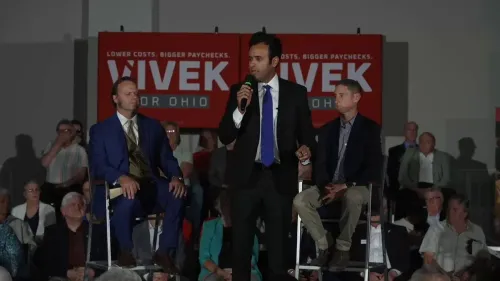
Entrepreneur Vivek Ramaswamy, founder of Strive Asset Management and former co-lead of the US Department of Government Efficiency (DOGE) advisory effort, on Tuesday, June 2, 2026, amplified a sharp critique from a UC Berkeley faculty member targeting university admissions practices that prioritise ideological goals over academic preparation.
Context
Ramaswamy quoted a UC Berkeley faculty member's statement without attribution by name: 'Admitting severely underprepared students to advanced programs at the wrong schools serves no one but administrators who build careers by promoting ideological goals.' He added that he 'couldn't have said it better' himself, signalling full endorsement of the critique.
The remark is notable because it originates from within one of America's most prominent public research universities — an institution long at the centre of debates over affirmative action, campus ideology, and admissions standards — rather than from an outside conservative commentator.
Policy Backdrop
The post lands nearly three years after the US Supreme Court's landmark 2023 ruling in Students for Fair Admissions v. Harvard, which struck down race-conscious admissions policies at colleges nationwide, holding that they violated the Equal Protection Clause.
California had already pre-empted that ruling by more than two decades: voters approved Proposition 209 in 1996, banning racial preferences in public university admissions and employment across the state. Despite that ban, critics argue that selective institutions have pursued diversity through proxies — socioeconomic weighting, essay prompts, and holistic review — that can produce similar outcomes without explicit racial criteria.
During his 2024 Republican presidential campaign, Ramaswamy made the dismantling of DEI (Diversity, Equity and Inclusion) bureaucracies at federally funded universities a central plank, calling for a return to merit-based admissions and the defunding of administrative offices he described as ideologically driven.
Stakeholders and Impact
The debate directly affects three groups: university administrators who design admissions frameworks, currently enrolled students whose credentials and classroom experience are shaped by who sits beside them, and prospective applicants who compete for limited seats at selective institutions.
Conservative critics, including Ramaswamy, invoke 'mismatch theory' — the academic argument that placing underprepared students in programmes beyond their current readiness harms those very students by setting them up for poor outcomes, while also diluting academic rigour for peers. Supporters of broader access policies counter that structural inequalities in schooling make standardised metrics an incomplete measure of potential.
The fact that the critique Ramaswamy amplified originates from UC Berkeley's own faculty lends it unusual rhetorical weight in this debate, suggesting internal dissent within an institution often identified with progressive admissions philosophy.
What's Next
Attention is now turning to state legislative responses as post-2023 admissions data from selective universities becomes available for public scrutiny. Federal lawmakers have also signalled interest in congressional hearings examining whether universities are complying with the Students for Fair Admissions ruling or circumventing its intent through alternative criteria.
For Ramaswamy, the post reinforces a consistent public positioning: that the reform agenda he championed through DOGE and on the campaign trail has allies inside the very institutions he has criticised, and that the conversation about merit, preparation, and administrative incentives is moving from outside agitators to internal faculty voices.
Point of View
Making it harder to dismiss on ideological grounds alone. The post fits a broader post-DOGE pattern in which Ramaswamy positions himself as a validator of dissent within institutions rather than merely an external critic. With post-SFFA admissions data beginning to surface, the mismatch theory argument is likely to gain traction in both congressional hearings and state-level legislation. The episode underscores how the culture-war terrain in US higher education is shifting from courtrooms to faculty senates and budget committees.
NationPress
17 Oct 2026
Frequently Asked Questions
What did Vivek Ramaswamy say about UC Berkeley admissions?
Ramaswamy endorsed a statement attributed to a UC Berkeley faculty member arguing that admitting severely underprepared students to advanced programmes benefits only administrators pursuing ideological goals, not the students themselves.
What is mismatch theory in college admissions?
Mismatch theory is an academic argument holding that placing underprepared students in programmes significantly beyond their current readiness harms those students through poor outcomes such as lower grades and higher dropout rates, while also reducing academic rigour for other students in the same cohort.
Did the US Supreme Court end affirmative action in college admissions?
Yes. In its 2023 ruling in Students for Fair Admissions v. Harvard , the Supreme Court held that race-conscious admissions policies violate the Equal Protection Clause, effectively ending explicit affirmative action at colleges and universities nationwide.
What is Proposition 209 in California?
Proposition 209 , approved by California voters in 1996 , banned the use of racial preferences in public university admissions and public employment across the state, pre-dating the national Supreme Court ruling by nearly three decades.
What has Ramaswamy proposed on DEI in universities?
During his 2024 presidential campaign and through his work with the DOGE advisory effort, Ramaswamy called for defunding DEI administrative offices at federally funded universities and replacing diversity-weighted admissions criteria with strictly merit-based standards.