Ramaswamy Backs Civics Graduation Mandate at Ohio Event
Synopsis
Entrepreneur Vivek Ramaswamy posted a video from Canton, Ohio, showing an 11-year-old's reaction to his proposal to make civics education a high school graduation requirement — a policy he says he would sign as governor.
Key Takeaways
Entrepreneur Vivek Ramaswamy shared a video on June 21, 2026 from a public event in Canton, Ohio .
An 11-year-old attendee was invited to the front of the audience to discuss a proposed civics education graduation requirement .
Ramaswamy stated he would 'sign into law as Governor' a policy mandating civic education standards for high school graduation.
The proposal aligns with positions Ramaswamy championed during his 2024 Republican presidential campaign .
No formal 2026 Ohio gubernatorial candidacy announcement has been made, and no draft legislation has been released publicly.
The policy fits a broader Republican pattern of pushing mandatory civics requirements at state and federal levels.
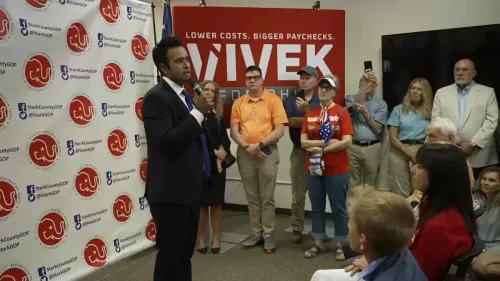
Entrepreneur Vivek Ramaswamy shared a video on Sunday, June 21, 2026, of an exchange he had with an 11-year-old at a public event in Canton, Ohio, in which the child responded to questions about a proposed civics education requirement Ramaswamy says he would sign into law as governor.
Context
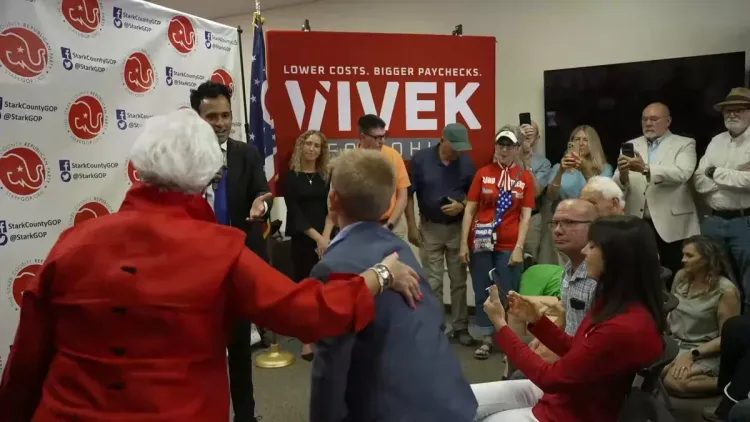
At the Canton event, Ramaswamy invited the young attendee to join him at the front of the audience for a conversation. He asked the child how he felt about making civic education standards a mandatory condition for high school graduation — a policy Ramaswamy described as one he 'would sign into law as Governor' and one that 'would apply to his generation.' The video, posted to his official X account, invites followers to hear the child's response directly.
Canton is located in Stark County, Ohio, and has historically served as a venue for political outreach in the state's manufacturing heartland. The setting underscores Ramaswamy's apparent focus on building a grassroots base in Ohio ahead of what many observers regard as a prospective 2026 gubernatorial run, though no formal candidacy announcement has been made.
Policy Backdrop
Ramaswamy's push for mandatory civics standards is consistent with positions he articulated during his 2024 Republican presidential campaign, when he repeatedly called for stronger K-12 civics requirements and criticised existing social-studies curricula as ideologically skewed. The proposal fits within a broader Republican policy pattern at both federal and state levels, where mandatory civics examinations or structured coursework have been promoted as tools to reinforce constitutional literacy and national identity.
Such proposals have frequently emerged alongside parallel legislative efforts in several states to restrict certain diversity-focused or social-emotional-learning content in public school curricula. Proponents argue that a standardised civics threshold raises civic participation; critics contend that adding graduation requirements places additional pressure on already stretched school districts.
Stakeholders and Impact
Ohio's roughly 1.7 million public school students and their families would be the most directly affected constituency if such a policy were enacted. High school students in the state currently must meet a range of graduation requirements set by the Ohio Department of Education and Workforce, and adding a civics-specific standard would require legislative action or regulatory revision.
Parent groups, teachers' unions, and school administrators would all have a stake in how the requirement is designed — specifically, whether it takes the form of a standardised examination, a course completion mandate, or a competency demonstration. The Canton exchange, featuring a child respondent, appears designed to signal that even young Ohioans support the concept.
What's Next
Ramaswamy has not yet filed formal paperwork for a 2026 Ohio gubernatorial bid, and no detailed model legislation or education platform document has been publicly released. Political watchers in Ohio will look for a formal candidacy announcement and the release of a specific civics-education bill or policy framework that would give the proposal legislative shape.
If Ramaswamy does enter the race, his civics-mandate proposal is likely to become a defining education plank — one that draws both enthusiasm from conservative voters and scrutiny from educators and civil-liberties advocates over implementation details and potential gatekeeping effects on graduation rates.
Point of View
Non-partisan face. The move signals that he is actively building a retail-politics footprint in Ohio even before a formal gubernatorial announcement, using education as a wedge issue that resonates with conservative suburban and rural voters. His framing — that the requirement 'would apply to his generation' — is designed to cast the policy as a long-term civic investment rather than an ideological imposition. Whether the proposal gains traction will depend heavily on how it is translated into legislation and whether it can survive scrutiny over standardised-testing burdens and equity concerns.
NationPress
21 Jun 2026
Frequently Asked Questions
Is Vivek Ramaswamy running for Ohio governor in 2026?
Ramaswamy has not filed formal candidacy papers for the 2026 Ohio gubernatorial race as of June 2026, though his public appearances and policy statements in Ohio have fuelled widespread speculation about a potential bid.
What is Ramaswamy's civics education proposal?
Ramaswamy has proposed making civic education standards a mandatory condition for high school graduation in Ohio, a policy he says he would sign into law if elected governor.
What happened at the Canton, Ohio event?
At a public event in Canton, Ohio, Ramaswamy invited an 11-year-old attendee to the front of the audience and asked him how he felt about the proposed civics graduation requirement; he shared the child's response in a video posted on June 21, 2026.
Why do Republicans support mandatory civics requirements?
Republican lawmakers and candidates have promoted mandatory civics examinations or coursework to emphasise constitutional literacy and national identity, often framing them as a counterweight to what they describe as ideologically skewed social-studies curricula.
How would a civics graduation requirement affect Ohio students?
If enacted, the requirement would apply to Ohio's roughly 1.7 million public school students and would likely necessitate either a new standardised examination, a specific course completion mandate, or a competency demonstration, requiring action by the state legislature or education regulators.