Ramaswamy Addresses School Funding vs Property Tax Debate

Synopsis
Entrepreneur Vivek Ramaswamy engaged a Butler County public school teacher's question on how property taxes can be cut without harming school quality, posting a video response on August 1, 2026. The exchange spotlights a long-running structural tension in US public education finance.
Key Takeaways
Entrepreneur Vivek Ramaswamy posted on August 1, 2026 about a question he received from a public school teacher in Butler County .
The teacher asked how property taxes can be reduced while simultaneously improving public schools — a central tension in US education funding.
US public schools are predominantly funded through local property taxes, linking school quality directly to neighbourhood wealth.
Ramaswamy, former co-lead of the DOGE advisory effort and 2024 Republican presidential candidate , has positioned himself as an advocate for government efficiency.
The post includes a video response, though specific policy proposals have not yet entered the public record.
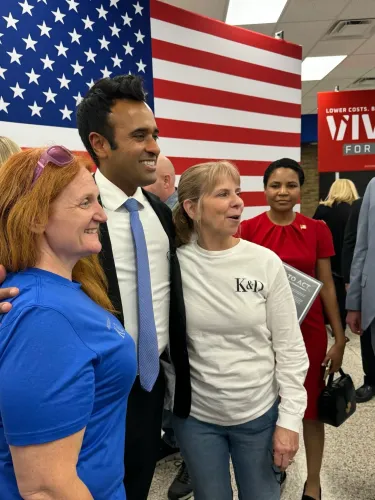
A public school teacher in Butler County put one of American education policy's sharpest dilemmas directly to entrepreneur Vivek Ramaswamy — and he says he had an answer. On Saturday, August 1, 2026, Ramaswamy posted to X that a teacher had asked him how the US can cut property taxes without shortchanging public schools, and that he responded on the spot.
The question the teacher raised is not a new one, but it cuts to the core of a structural tension that has defined American public education for generations. US public schools are funded overwhelmingly through local property taxes — a system that ties the quality of a child's education directly to the wealth of the neighbourhood they happen to be born into. Cut those taxes, and the fear is that school budgets bleed out. Leave them untouched, and homeowners — particularly in working- and middle-class counties like Butler County — bear a growing fiscal burden.
Why Butler County's Question Echoes Nationally
Butler County, located in Ohio, sits in exactly the kind of suburban and exurban belt that has become a flashpoint in debates over government spending, tax relief, and school quality. Teachers there, like across much of the country, work within systems where per-pupil funding is tightly coupled to local property values — meaning any move to reduce property tax revenue triggers alarm among educators and parents alike. Ramaswamy, who built his public profile as a vocal critic of government inefficiency and ran for the 2024 Republican presidential nomination, has consistently argued that government at all levels can deliver more with less. His brief tenure as co-lead of the Department of Government Efficiency (DOGE) advisory effort under the Trump administration placed him at the centre of exactly this kind of spending-versus-services argument.A Video Answer, but No Policy Detail Yet
The post itself — accompanied by a video — teases a response but the research record does not yet confirm the specific proposals Ramaswamy laid out. What the post does establish is that he is actively engaging with educators on the ground, framing the property tax-versus-school-quality debate as one with a workable answer rather than an unavoidable trade-off. For Indian observers tracking US political economy, the parallel is instructive: debates over decentralised education funding and local tax structures are not unique to America. The question of whether efficiency-driven reform can coexist with quality public services is one that resonates across democracies. The teacher in Butler County asked a fair question. Whether Ramaswamy's answer holds up to scrutiny — and whether it translates into a coherent policy platform — is what the next chapter of this story will have to answer.Point of View
Casting him as a reformer who engages with frontline public servants rather than just fiscal hawks. The property tax-school funding nexus is one of the most politically treacherous in US domestic policy, and any credible answer requires more than efficiency rhetoric. For Ramaswamy, who is rebuilding a national political profile post-DOGE, this video is as much about positioning as it is about policy. The substance of his answer, when fully scrutinised, will reveal whether his government-efficiency instincts extend to a genuine alternative funding model or remain at the level of a campaign talking point.
NationPress
16 Sept 2026
Frequently Asked Questions
Who is Vivek Ramaswamy and what is his connection to education policy?
Vivek Ramaswamy is an entrepreneur, founder of Strive Asset Management, former co-lead of the DOGE advisory effort, and 2024 Republican presidential candidate. He has increasingly engaged with US domestic policy debates including school funding and government efficiency.
Why are US public schools funded through property taxes?
US public schools have historically relied on local property taxes as their primary revenue source, a system rooted in local governance traditions. This ties school budgets to local property values, creating significant funding disparities between wealthy and less wealthy communities.
What is Butler County and why does it matter in this debate?
Butler County is a county in Ohio situated in the suburban and exurban belt that frequently features in US debates over tax policy and public services. It represents the kind of working- and middle-class community where property tax burdens and school quality concerns intersect most sharply.
What did Ramaswamy say about cutting property taxes and improving schools?
Ramaswamy posted a video response to a Butler County teacher's question on this topic on August 1, 2026. The specific proposals in his response have not yet been independently confirmed in the public record.
How does the US property tax-school funding debate compare to education funding debates in India?
Both countries grapple with the tension between decentralised funding mechanisms and equitable access to quality public education. In India, education funding flows more through central and state government budgets rather than local property taxes, but the core challenge of linking resources to outcomes is shared.