Ramaswamy Takes Unscripted Q&A at Dayton Anti-Poverty Forum
Synopsis
Entrepreneur Vivek Ramaswamy addressed a Democrat-leaning anti-poverty group in Dayton, Ohio, and took impromptu questions — something co-speaker 'Amy' did not do. Ramaswamy called the exchange 'surprising and beautiful,' framing his openness to unscripted dialogue as a key distinction in his public style.
Key Takeaways
Vivek Ramaswamy and a speaker identified as 'Amy' both addressed a Democrat-leaning anti-poverty forum in Dayton, Ohio on Friday, 25 July 2026 .
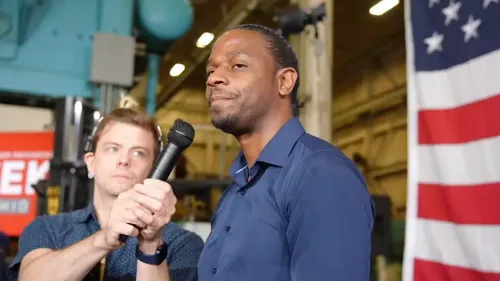
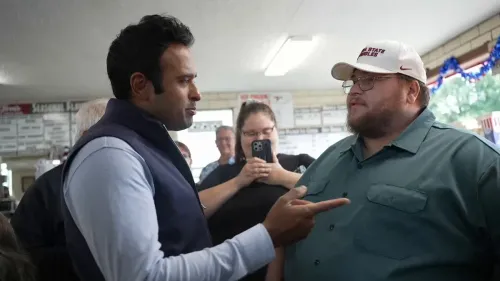
Ramaswamy says he was the only speaker to open the floor for impromptu, unscripted questions from the audience.
He described the resulting exchange as producing 'surprising and beautiful moments.' The audience comprised leaders of anti-poverty organisations who largely lean Democratic — outside Ramaswamy's typical political base.
Ramaswamy positioned his willingness to face critics without a script as a defining difference between himself and 'Amy.' The event continues a pattern established during his 2024 Republican presidential campaign of prioritising direct, unscripted voter engagement.
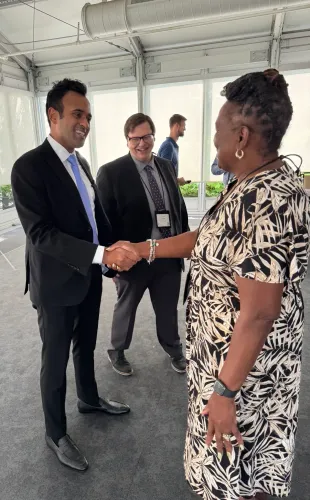
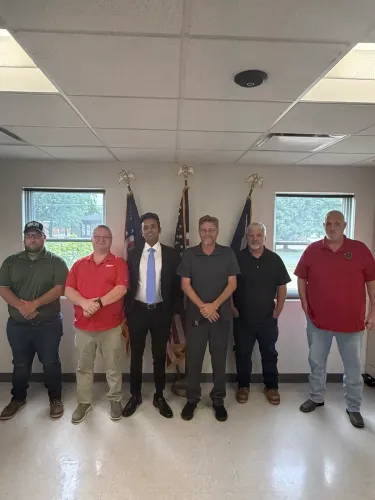
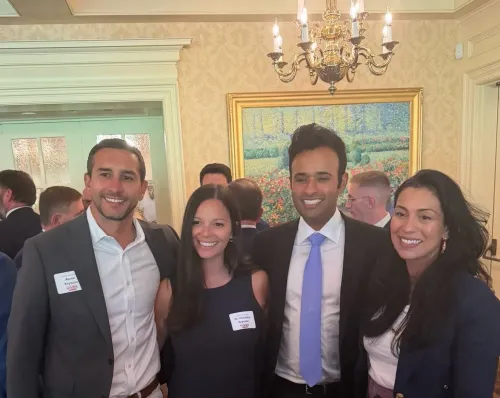
Entrepreneur Vivek Ramaswamy drew a sharp contrast with a fellow speaker at a Democrat-leaning anti-poverty group leaders' forum in Dayton, Ohio, on Friday, 25 July 2026, by opening the floor to impromptu questions from an audience that largely does not share his political views. Ramaswamy said the exchange produced 'surprising and beautiful moments,' positioning his willingness to engage with critics as a defining difference between himself and the other speaker, identified only as 'Amy.'
Context
Ramaswamy posted on X (formerly Twitter) that both he and a woman named Amy addressed the gathering of anti-poverty advocates in Dayton. He noted he was 'the only one to open it up for impromptu Q&A,' framing the moment as evidence of a fundamental difference in approach between the two speakers. The identity of 'Amy' was not disclosed in the post.
Dayton is a city in southwestern Ohio with a long manufacturing history and a politically mixed electorate, making it a meaningful venue for cross-partisan outreach on economic issues such as poverty reduction.
Policy Backdrop
Ramaswamy built a reputation during the 2024 Republican presidential primaries for participating in unscripted town halls and open debates, consistently emphasising direct voter engagement over managed appearances. That campaign style carried a clear message: willingness to face hard questions signals authenticity.
As former co-lead of the Department of Government Efficiency (DOGE) advisory effort, Ramaswamy has continued to engage publicly on domestic policy, including government spending priorities that intersect with anti-poverty programmes. His current role as founder and executive chairman of Strive Asset Management keeps him active in national policy conversations.
Stakeholders and Impact
The audience — described as leaders of anti-poverty organisations with a Democratic lean — represents a constituency that would not typically be Ramaswamy's natural base. His decision to take unscripted questions from that group signals an attempt to build credibility across partisan lines on economic hardship issues.
For anti-poverty advocates, the encounter offers a rare direct channel to a prominent Republican-aligned figure on questions of welfare, government efficiency, and social spending. Ramaswamy's characterisation of the Q&A as producing 'beautiful moments' suggests at least some productive dialogue occurred, though specific outcomes of the session remain unconfirmed.
What's Next
Ramaswamy's public engagement in Ohio — a key battleground state — with audiences outside his political base is worth watching as a signal of his broader ambitions. Future forums or policy announcements on anti-poverty measures or government efficiency, either in Ohio or at the national level, could clarify whether this event marks the start of a sustained outreach strategy.
His post implicitly challenges other public figures to match his approach to open, unscripted dialogue — a pressure point that is likely to generate further commentary in U.S. political circles in the days ahead.
Point of View
He is reinforcing a personal brand built on confrontational authenticity — a trait that proved both an asset and a liability during his 2024 primary run. The choice of a Democrat-leaning Ohio audience is politically significant: Ohio's working-class voters are a perennial swing constituency, and outreach on poverty and economic anxiety could serve future electoral or policy ambitions. Whether this signals a formal re-entry into electoral politics or simply sustained public influence remains the key question to watch.
NationPress
28 Jul 2026
Frequently Asked Questions
Who is Vivek Ramaswamy and why is he in the news?
Vivek Ramaswamy is an entrepreneur, founder of Strive Asset Management, former co-lead of the DOGE advisory effort, and a 2024 Republican presidential candidate. He is in the news after posting about taking unscripted questions at a Democrat-leaning anti-poverty forum in Dayton, Ohio.
What happened at the Dayton anti-poverty forum in July 2026?
Ramaswamy and a co-speaker identified as 'Amy' addressed a group of Democrat-leaning anti-poverty organisation leaders in Dayton. Ramaswamy says he was the only one to open the floor for impromptu Q&A, which he described as producing 'surprising and beautiful moments.'
Who is 'Amy' mentioned in Ramaswamy's post?
Ramaswamy referred to the co-speaker only as 'Amy' without providing further identification. Her full identity was not disclosed in his post.
What is Ramaswamy's connection to DOGE?
Ramaswamy served as a co-lead of the Department of Government Efficiency advisory effort alongside Elon Musk before departing the role. He has continued to engage publicly on government spending and efficiency issues.
Why does Ramaswamy emphasise unscripted Q&A sessions?
Ramaswamy has consistently used unscripted town halls and open debates as a marker of political authenticity since his 2024 presidential campaign. He frames willingness to face hard questions from critics as evidence of genuine engagement, contrasting it with what he sees as managed or scripted political appearances.