Is the Balochistan Government's Claim of Resolved Missing Persons Issue Accurate?
Click to start listening
Synopsis
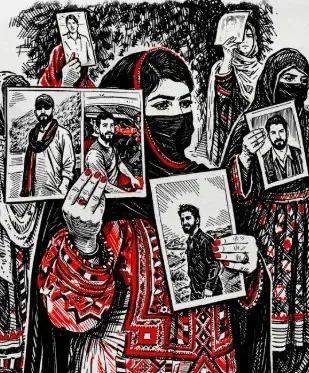
The Balochistan government claims the issue of missing persons is resolved, but a leading human rights group counters this assertion, stating the ongoing crisis of enforced disappearances is far from over. Families continue to search for their loved ones, as the organization calls for accountability.
Key Takeaways
- Ongoing Crisis: The issue of enforced disappearances in Balochistan remains unresolved.
- False Claims: Government assertions that the issue is resolved have been labeled misleading.
- Families Affected: Hundreds of families are still searching for their missing loved ones.
- Call for Accountability: The rights organization demands immediate action for accountability.
- Legal Concerns: New legislation may legitimize enforced disappearances under a different name.
Quetta, Jan 21 (NationPress) A prominent human rights organization has firmly dismissed the Balochistan provincial government’s assertion that the situation regarding missing persons has been "resolved on a permanent basis." They labeled the statement as "false and contradicting ground realities."
According to the Human Rights Council of Balochistan (HRCB), the announcement made after the Balochistan provincial cabinet meeting on Tuesday—which proclaimed the issue resolved while families are still searching for their disappeared relatives—is a "grave misrepresentation of facts."
In its findings for 2025, HRCB reported a total of 1,455 cases of enforced disappearance, which includes 1,443 men and 12 women. Of these, they stated that 1,052 individuals are still unaccounted for, 317 were released, 83 were found dead in custody, and 3 were transferred to jail.
The rights organization emphasized that "these figures illustrate the ongoing scale of illegal detentions and highlight that the so-called ‘resolution’ is a false claim."
“Hundreds of individuals in Balochistan continue to be victims of enforced disappearance. Numerous families have sought justice through courts, commissions, and human rights organizations, yet the whereabouts of their loved ones remain unknown,” the HRCB noted.
Reiterating that Baloch civilians are being abducted illegally, without due process or lawful arrests, the organization stated that these individuals were never presented before any court, which represents a clear violation of both Pakistan’s constitution and international human rights obligations.
“Enforced disappearance is a grave crime under international law, not a political slogan or propaganda. The portrayal of enforced disappearances as ‘propaganda’ is profoundly offensive to the affected families and undermines years of documented evidence,” it added.
The HRCB asserted that the crisis concerning enforced disappearances in Balochistan remains unresolved and ongoing, declaring that “any claim to the contrary is misleading and irresponsible.”
The organization demanded that all forcibly disappeared individuals be immediately produced before courts or released, and that those responsible for these unlawful acts be held accountable.
Meanwhile, Paank, the Human Rights Department of the Baloch National Movement, strongly criticized the Balochistan cabinet’s approval of the “so-called” Balochistan Centre of Excellence on Countering Violent Extremism Rules 2025 and the associated detention frameworks. The rights body argued that this legislation does not address the missing persons issue and instead seeks to legitimize enforced disappearances under a new guise.
“By creating detention facilities devoid of transparent judicial oversight, the state risks normalizing arbitrary arrests, secret detention, and abuse. Offering families limited access does not substitute for due process, court proceedings, or accountability for those responsible for disappearances,” Paank emphasized.
Point of View
We maintain a commitment to truth in reporting. The claims regarding missing persons in Balochistan are deeply concerning and warrant serious scrutiny. It is crucial that the voices of affected families are heard and that accountability is demanded from those in power.
NationPress
21/01/2026
Frequently Asked Questions
What is the current status of missing persons in Balochistan?
The Human Rights Council of Balochistan reports ongoing cases of enforced disappearances, with 1,052 individuals still missing despite government claims of resolution.
What actions have families taken regarding missing loved ones?
Families have approached courts, commissions, and human rights organizations in search of their disappeared relatives, yet many remain unaccounted for.
How does international law view enforced disappearances?
Enforced disappearance is classified as a serious crime under international law, violating fundamental human rights.