Could Chinese Researchers Revolutionize Eye Surgery with a New Robot?
Synopsis
Chinese researchers have made a groundbreaking advancement with an autonomous robotic system designed for delicate eye surgery. This innovative technology promises to enhance precision and safety in treating retinal diseases, offering potential for remote surgical procedures.
Key Takeaways
Autonomous robotic system for eye injections developed by Chinese researchers.
Improves precision and safety in treating retinal diseases.
Achieved 100% success rate in animal tests for injections.
Reduces positioning errors by 80% compared to manual surgery.
Potential for remote surgeries in areas lacking specialists.
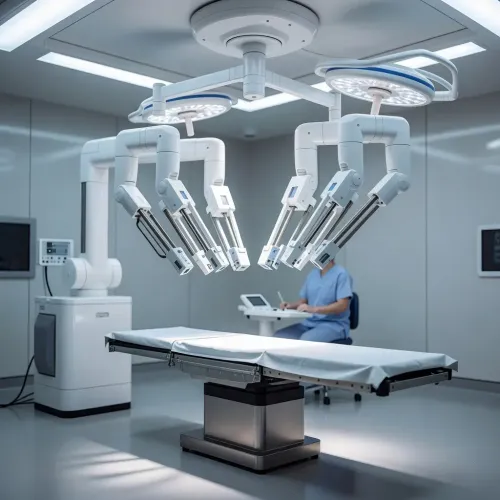
Beijing, Jan 21 (NationPress) A group of researchers from China has innovatively created an autonomous robotic system capable of executing intricate eye injections in the limited confines of the human eye.
The surgery robot, engineered by the Institute of Automation under the Chinese Academy of Sciences, holds the promise of improving the precision and safety of procedures designed to address severe retinal diseases, as reported by the Xinhua news agency.
In their findings published in the esteemed journal Science Robotics, the research team highlighted that the robot achieved a flawless success rate in performing subretinal and intravascular injections during animal trials.
Eye surgery, especially those involving the retina, presents significant challenges due to the organ's delicate and minuscule structures.
The newly developed system employs a collection of sophisticated algorithms for three-dimensional (3D) spatial perception, precise positioning across scales, and trajectory control to maneuver a robotic arm.
Tests conducted using eyeball models, ex vivo porcine, and in vivo animal eyes demonstrated that the autonomous robot markedly decreased average positioning errors by almost 80 percent compared to traditional manual surgery.
Moreover, positioning errors were reduced by approximately 55 percent when contrasted with robot-assisted surgery managed by a surgeon, according to the team.
"These findings illustrate the clinical viability of an autonomous microsurgical robot for intraocular procedures, showcasing its capacity to enhance injection precision, safety, and consistency," stated the researchers.
"This autonomous system could significantly bolster surgical consistency and safety, while also shortening the training duration for surgeons," they further noted.
Additionally, this advancement could facilitate complex eye surgeries in remote regions or extreme environments where specialized surgeons are not available.
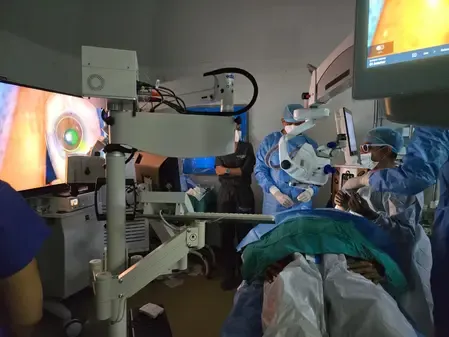
In a groundbreaking event in November 2025, Xinhua reported that a Chinese medical team executed a pioneering remote robotic eye surgery, employing a 5G-connected robot to treat a patient over 4,000 kilometers away.
The procedure, involving a retinal injection performed with micron-level accuracy, represented a major step in utilizing technology to close the medical resource gap between developed coastal areas and remote locations.
After the robot in Urumqi positioned the microscopic needle on the patient's eye, surgeons in Guangzhou took over remotely, guiding the needle to the retina's surface, penetrating it to a pre-determined depth, and administering the medication.
The total duration of the remote surgery was under seven minutes, with a stable network ensuring seamless robot operation without any tremors.
Point of View
It's essential to recognize the transformative potential of this autonomous robotic system in the field of ophthalmology. The implications for precision surgery, especially in under-resourced areas, are significant. This advancement exemplifies the intersection of technology and healthcare, paving the way for enhanced patient outcomes.
NationPress
30 Sept 2026
Frequently Asked Questions
What is the main function of the newly developed eye surgery robot?
The eye surgery robot is designed to perform delicate eye injections with enhanced precision and safety, particularly for treating retinal diseases.
How does the new robotic system improve surgical accuracy?
The system utilizes advanced algorithms for three-dimensional spatial perception and precise positioning, significantly reducing positioning errors compared to manual and even surgeon-controlled robotic surgery.
What are the potential applications of this technology?
This technology could enable complex eye surgeries in remote areas where specialized surgical expertise is scarce, improving access to care.
What was a significant milestone reported in November 2025?
A Chinese medical team performed a groundbreaking remote robotic eye surgery using a 5G-connected robot to treat a patient over 4,000 kilometers away.
What does the successful performance of this robot indicate?
The successful trials suggest the clinical feasibility of autonomous microsurgical robots, enhancing injection precision, safety, and consistency.