China's AI pig-vaccination robot hits 93% accuracy with needle-free shots
Synopsis
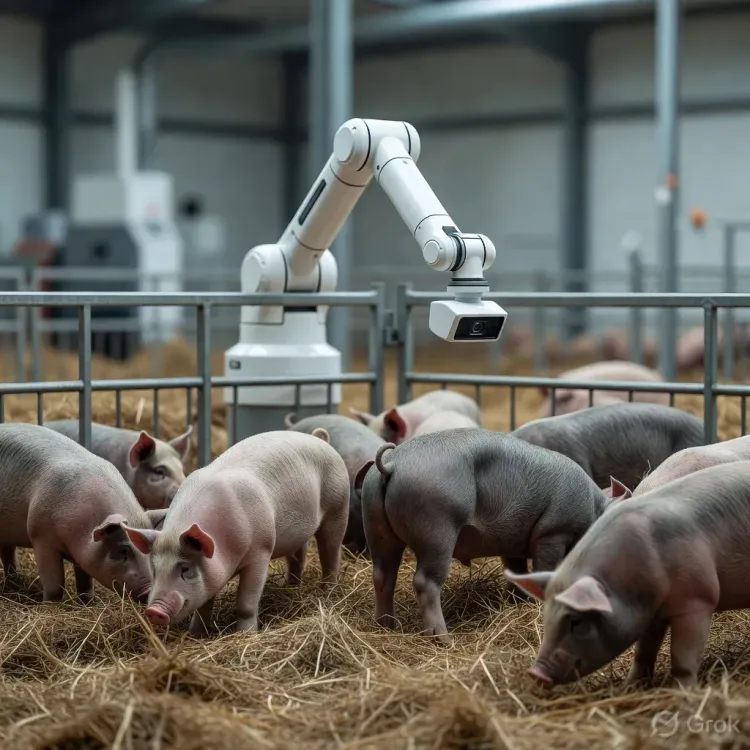
A Beijing research team has built an AI robot that sneaks up on pigs while they eat, locks onto the tail base with a camera, and delivers a needle-free vaccine with 93.3% accuracy — potentially transforming labour-intensive swine health management in the world's top pork-producing nation.
Key Takeaways
Li Bin of the Intelligent Equipment Research Centre, Beijing Academy of Agriculture and Forestry Sciences led the development of the AI-powered pig-vaccination robot.
The robot achieves a success rate of 93.3 per cent using a camera-guided, needle-free injection system targeting the pig's buttock via tail-root detection.
The study was published in June 2026 in the peer-reviewed Transactions of the Chinese Society of Agricultural Engineering .
The project received funding under China's National Key Research and Development Programme for New Generation Artificial Intelligence .
Researchers say the system could enable 'less-human, automated and intelligent large-scale pig farming,' addressing chronic issues such as broken needles, missed injections, and inaccurate placements.
China is the world's largest pork producer, making scalable swine health automation a strategic priority.
A Beijing-developed AI robot that tracks a pig's tail to deliver needle-free vaccinations has achieved a 93.3 per cent success rate, offering a glimpse into the future of large-scale automated livestock management in the world's biggest pork-producing nation. The system was detailed in a peer-reviewed study published in June 2026 in the Transactions of the Chinese Society of Agricultural Engineering.
How the buttock-tracking robot works
The robot approaches a pig from behind while the animal is eating — minimising stress and resistance. An onboard camera identifies the base of the pig's tail, then the system precisely delivers a needle-free vaccine injection into the buttock. The approach is designed to operate without alerting the animal, keeping the process low-disruption at scale.
The technology was developed by Li Bin, a research fellow at the Intelligent Equipment Research Centre of the Beijing Academy of Agriculture and Forestry Sciences, along with his team. The work received support under China's National Key Research and Development Programme for New Generation Artificial Intelligence.
Why it matters for pig farming
'Current pig vaccination still relies largely on human workers, creating problems including broken needles, missed injections and inaccurate placement,' Li wrote in the study. Breeding pigs require multiple injections across their production cycles, making vaccination one of the most labour-intensive recurring tasks on large farms.
The robot could support 'less-human, automated and intelligent large-scale pig farming,' according to Li and his team. China produces more pork than any other country, making efficiency gains in swine health management a matter of national food-security significance.
The competitive backdrop
Agricultural robotics is an expanding frontier globally, with countries including the United States, the Netherlands, and Japan deploying automated systems for crop harvesting, dairy milking, and poultry management. China's push into AI-driven livestock robotics reflects a broader state-backed drive to reduce dependence on manual farm labour amid demographic pressures and rising wages.
The needle-free injection mechanism also addresses biosecurity concerns — traditional needles can break and cause injury or infection, risks that are amplified in high-density commercial pig operations.
What's next
The 93.3 per cent accuracy rate, while promising, suggests further refinement is needed before the system is ready for full commercial deployment. Researchers at the Beijing Academy of Agriculture and Forestry Sciences are expected to continue iterating on the platform, with Qinhuangdao cited as a location connected to the research effort. Watch for pilot deployments at large integrated pig farms as the next milestone in validating the technology at scale.
Point of View
Which have historically been flashpoints for African swine fever outbreaks that devastated China's herd in 2018–2019. A 93.3 per cent accuracy rate is commercially borderline today, but the trajectory — peer-reviewed, state-funded, tested in a real farm environment — suggests rapid iteration. The broader pattern is clear: China is systematically applying AI to every labour-intensive node of its food supply chain, and livestock health is now firmly on that map.
NationPress
21 Sept 2026
Frequently Asked Questions
What is the Chinese AI pig-vaccination robot and how does it work?
The robot is an AI-powered system developed at the Beijing Academy of Agriculture and Forestry Sciences that approaches pigs from behind while they eat, uses a camera to locate the base of the tail, and delivers a needle-free vaccine injection into the buttock. It achieved a 93.3 per cent success rate in trials, according to the research team.
Who developed the pig-vaccination robot?
Li Bin , a research fellow at the Intelligent Equipment Research Centre of the Beijing Academy of Agriculture and Forestry Sciences , led the research team. The project was supported by China's National Key Research and Development Programme for New Generation Artificial Intelligence .
Why does China need automated pig vaccination?
China is the world's largest pork producer, and vaccination is a high-frequency, labour-intensive task — breeding pigs require multiple injections per production cycle. Human-administered vaccinations carry risks including broken needles, missed injections, and inaccurate placement, all of which the robot is designed to eliminate.
Where was the pig-vaccination robot study published?
The study was published in June 2026 in the peer-reviewed journal Transactions of the Chinese Society of Agricultural Engineering .
Is the pig-vaccination robot ready for commercial use?
Not yet at full commercial scale. The current 93.3 per cent accuracy rate is promising but indicates further refinement is needed. Researchers are expected to continue development, with large integrated pig farms likely to serve as the next pilot environments.