China tests world's first AI squid fishing robot in Pacific
Synopsis
China has deployed the world's first adaptive AI squid fishing robot on a 90-day Pacific sea trial, a machine that mimics skilled human fishing motions in real time — a potential game-changer for the country's vast distant-water fleet.
Key Takeaways
China launched sea trials of the world's first intelligent squid fishing robot aboard the research vessel Song Hang on June 8, 2026 .
The robot was developed jointly by Shanghai Ocean University and state-owned China Fisheries Zhoushan Ocean Fishery Co .
The Song Hang is conducting a 90-day fishery resource survey in the northwestern Pacific Ocean , expected to conclude in September 2026 .
The machine adapts its behaviour based on squid bite response, surpassing the precision of conventional automated jigging equipment.
China is the world's largest seafood producer and operates thousands of distant-water vessels, including squid boats off the South American coast.
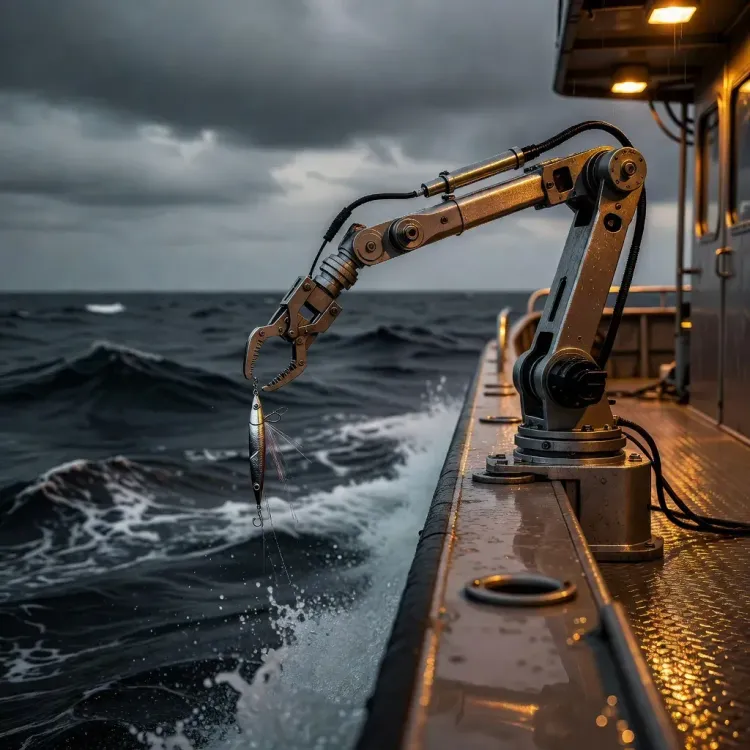
China has launched sea trials of what it describes as the world's first intelligent squid fishing robot, a machine capable of mimicking human fishing motions to lure deep-water squid to the surface. The robot is currently being tested aboard the Song Hang scientific research vessel, which departed Changxing Island off the coast of Shanghai on June 8, 2026 for a 90-day survey of fishery resources in the high seas of the northwestern Pacific Ocean.
How the robot works
Unlike conventional automated squid-jigging equipment deployed on fishing vessels worldwide, the new machine adapts its behaviour in real time based on how squid respond to its lure — offering a level of precision previously achievable only by experienced human fishers. The system is designed to replicate the nuanced rod movements that skilled operators use to attract squid from depth, a technique that standard mechanised jigging machines have historically struggled to replicate.
Who built it and why it matters
The robot was jointly developed by Shanghai Ocean University and the state-owned China Fisheries Zhoushan Ocean Fishery Co, and was launched aboard the Song Hang alongside the vessel's broader fishery resource survey mission. The Song Hang is expected to remain on survey operations in the northwestern Pacific until September 2026, according to state-run People's Daily. The trial represents a convergence of robotics, adaptive AI, and China's strategic interest in expanding its distant-water fishing capabilities.
The competitive backdrop
As the world's largest seafood producer, China operates one of the planet's most extensive distant-water fishing fleets, comprising thousands of vessels — including squid boats — stationed across global waters, from the northwestern Pacific to the waters off the South American coast. Automating squid fishing at scale could significantly reduce labour costs and improve catch efficiency across this vast fleet. The technology, if proven effective during sea trials, would give China a meaningful edge in a sector where squid accounts for a substantial share of global distant-water catch volumes.
What's next
The outcome of the current sea trials aboard the Song Hang will be closely watched by both the fishing industry and technology developers. A successful demonstration could accelerate deployment across China's broader distant-water fleet and prompt competing fishing nations to fast-track their own automation programmes. The intersection of adaptive robotics and commercial fisheries is an emerging frontier — and China appears intent on defining its early standards.
Point of View
Geopolitically sensitive, and increasingly scrutinised by international regulators. Adaptive AI that can replicate skilled human technique at sea could compress crew requirements and extend operational range, giving China structural advantages that rival fishing nations will struggle to close quickly. What mainstream coverage tends to overlook is the dual-use dimension: the sensor fusion and real-time behavioural adaptation technologies embedded in such systems have direct parallels in maritime surveillance and autonomous vessel development. The September trial results will signal whether this moves from prototype to fleet-wide rollout — and how quickly competing seafood powers respond.
NationPress
18 Sept 2026
Frequently Asked Questions
What is China's AI squid fishing robot?
China's AI squid fishing robot is an intelligent machine developed by Shanghai Ocean University and China Fisheries Zhoushan Ocean Fishery Co that mimics human fishing motions to attract squid to the surface. Unlike conventional automated jigging equipment, it adapts its behaviour in real time based on how squid respond to the lure.
Where is the squid fishing robot being tested?
The robot is undergoing sea trials aboard the Song Hang scientific research vessel in the northwestern Pacific Ocean . The vessel departed Changxing Island off Shanghai on June 8, 2026 and is expected to complete its survey by September 2026 .
Why is China developing an autonomous squid fishing machine?
As the world's largest seafood producer, China operates thousands of distant-water fishing vessels globally. Automating squid fishing could reduce labour costs, improve catch efficiency, and strengthen China's competitive position in international fisheries.
How does the AI squid robot differ from existing fishing equipment?
Standard automated squid-jigging machines use fixed, repetitive motions. The new robot uses adaptive AI to modify its lure movements based on squid bite behaviour, replicating the precision of skilled human fishers in a way conventional equipment cannot.
Who could be affected by China's fishing robot technology?
Competing distant-water fishing nations — particularly those operating large squid fleets in the Pacific and off South America — face the prospect of a significant automation gap if China scales this technology across its fleet. Fishing crews and labour markets in the sector could also be affected over the longer term.