China deploys snake robots on power lines for gaokao grid checks
Synopsis
Snake-shaped robots inspected over 130 km of live power lines in Kunming, China, during the 2026 gaokao — working three times faster than human crews and bypassing no-fly zones where drones are banned.
Key Takeaways
Snake-shaped robots were deployed by the Guandu district power supply bureau in Kunming, Yunnan to inspect power lines during the June 2026 gaokao .
The robots covered more than 130 km (81 miles) of distribution lines serving exam venues near airport no-fly zones.
Robotic inspection was reported to be three times as efficient as manual inspection teams.
The Kunming Power Supply Bureau is a subsidiary of the state-owned China Southern Power Grid .
Aerial drones — the more common alternative — cannot operate in no-fly zones and are susceptible to electromagnetic interference from high-voltage lines.
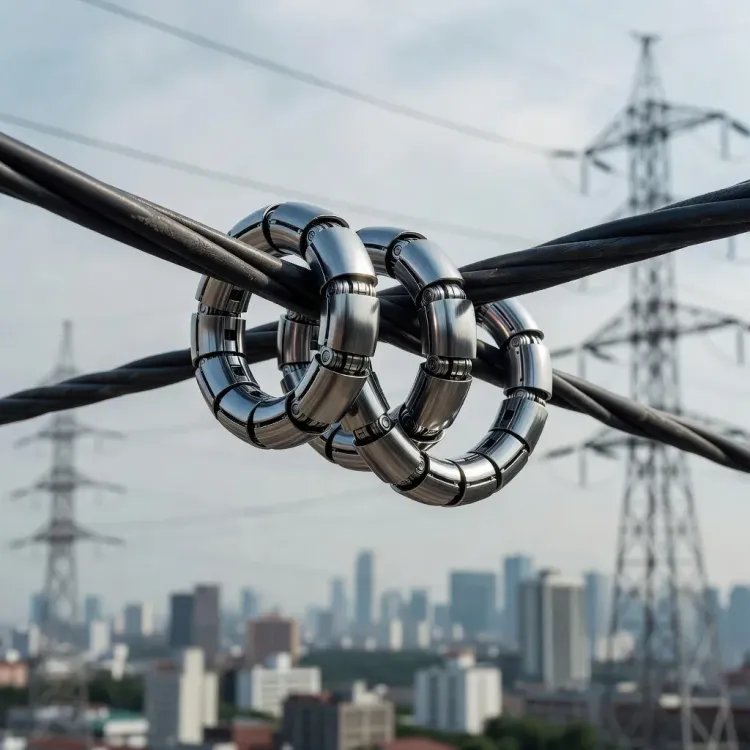
Kunming, Yunnan — China deployed snake-shaped inspection robots along power distribution lines in Kunming to safeguard electricity supply during the country's high-stakes national college entrance examination, the gaokao, in June 2026. The robotic devices, developed by the power supply bureau of Kunming's Guandu district, spiralled along live cables to detect faults and ensure uninterrupted power to exam venues.
What the robots do
The snakelike machines wrap around power lines and scan for hazards including broken wires, worn components, and abnormal temperatures. According to the developer, the robots inspected more than 130 km (81 miles) of power distribution infrastructure serving examination sites located near airport no-fly zones. The bureau reported that the robots proved three times as efficient as conventional manual inspection teams.
Why conventional methods fall short
Manual line inspection is labour-intensive, physically demanding, and frequently dangerous. Aerial drones — widely used for similar utility checks — cannot operate in no-fly zones and are vulnerable to high-voltage electromagnetic interference, which degrades control signals and image quality. Drones also face constraints from limited battery life and adverse weather conditions, making them unreliable for critical infrastructure corridors.
The gaokao connection
The gaokao is one of the most consequential annual events in China, with millions of students sitting exams simultaneously across the country. Any power disruption at an exam venue carries significant social and political weight. The Kunming Power Supply Bureau, a unit of the state-owned China Southern Power Grid, said on social media on Tuesday that 'power company personnel tracked and promptly addressed the hazards that were identified to ensure a stable and orderly power supply to examination venues.'
Broader trend in grid robotics
The deployment reflects a wider push across China's state utility sector to automate hazardous inspection tasks using purpose-built robots. Robotic dogs and aerial drones have already been rolled out for substation patrols and tower inspections in various provinces. Snake-form robots, however, offer a distinct advantage on energised distribution lines where physical contact with the cable is required and airspace is restricted.
What's next
As grid operators face growing pressure to maintain reliability during peak demand periods and national events, robotic inspection platforms are likely to see accelerated procurement across China Southern Power Grid's service territory — which spans five southern provinces. The performance data gathered from the Kunming deployment could inform wider rollouts ahead of future high-priority examination cycles and major public events.
Point of View
And the gaokao deployment in Kunming illustrates how state-owned grid operators are using high-visibility national events to field-test automation under real pressure. What mainstream coverage often misses is the regulatory constraint driving the choice: no-fly zones around airports eliminate drones as an option, making cable-contact robots not a preference but a necessity. The 3x efficiency claim, if it holds at scale, has procurement implications well beyond Yunnan — China Southern Power Grid alone manages infrastructure across five provinces. As China accelerates grid modernisation to support its AI data-centre buildout and EV charging load, robotic inspection platforms could shift from novelty deployments to standard operating procedure faster than Western utilities have managed.
NationPress
26 Oct 2026
Frequently Asked Questions
What are the snake robots deployed on China's power lines?
They are snakelike inspection robots developed by the power supply bureau of Kunming's Guandu district that coil around live power cables to detect faults such as broken wires, worn components, and abnormal temperatures. They were deployed during the June 2026 gaokao to protect electricity supply to exam venues.
Why were snake robots used instead of drones for power line inspection?
The exam venues were located near airport no-fly zones where aerial drones cannot legally operate. Drones are also susceptible to high-voltage electromagnetic interference, have limited battery life, and are affected by weather — limitations that do not apply to cable-mounted robotic snakes.
How much ground did the robots cover during the gaokao?
According to the developer, the robots inspected more than 130 km (81 miles) of power distribution lines serving gaokao examination sites in Kunming, Yunnan . The bureau said this was three times as efficient as manual inspection work.
Who operates the Kunming Power Supply Bureau?
The Kunming Power Supply Bureau is part of the state-owned China Southern Power Grid , one of China's two major national grid operators. It manages power distribution infrastructure across Kunming , the provincial capital of Yunnan .
Will snake robots be used more widely on China's power grid?
The Kunming deployment serves as a real-world performance test for cable-contact inspection robots. Given the reported efficiency gains and the limitations of drones in restricted airspace, broader adoption across China Southern Power Grid's five-province service territory is a plausible next step, particularly ahead of future national examinations and peak-demand periods.