China coastguard proposes robotic drone fortress for South China Sea islands

Synopsis
China's coastguard researchers have proposed turning South China Sea islands into fully autonomous robotic fortresses defended by coordinated swarms of air, surface, and underwater drones — a direct response to the cheap drone threat that reshaped the war in Ukraine.
Key Takeaways
China's coastguard and Dalian Maritime University researchers proposed converting South China Sea islands into autonomous drone-defended fortresses.
The proposal was published in July 2026 in the journal Command Control & Simulation , supervised by state-run China Shipbuilding Industry Corporation .
The plan integrates uncrewed aerial vehicles , uncrewed surface vehicles , and uncrewed underwater vehicles into a seamless multi-domain defence network.
Beijing explicitly cites low-cost drone swarms — the same asymmetric tactic seen in Ukraine — as the threat driving the proposal.
The paper remains a research proposal; no formal procurement or deployment timeline has been announced.
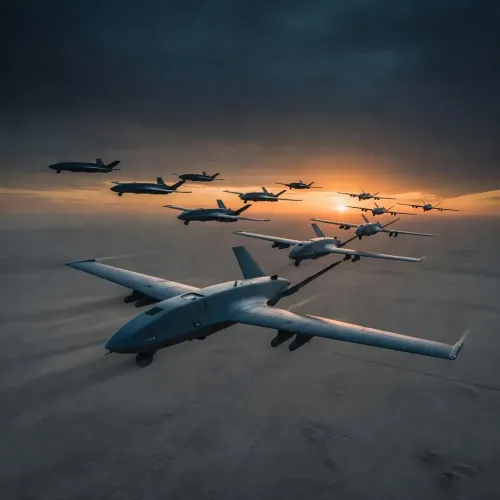
China's coastguard has proposed converting the South China Sea's contested islands into autonomous, robotic defence fortresses, according to a paper published in July 2026 by the military technology journal Command Control & Simulation. The plan envisions replacing human-led island garrisons with coordinated swarms of air, surface, and underwater drones — a direct response to the rising threat of low-cost uncrewed platform attacks.
What the proposal entails
Researchers from the China Coast Guard Academy's ship command department and Dalian Maritime University's Marine Electrical Engineering College outlined a multi-domain autonomous defence network in their paper. The system would integrate uncrewed aerial vehicles (UAVs), uncrewed surface vehicles (USVs), and uncrewed underwater vehicles (UUVs) into a seamless, coordinated shield around island outposts. The journal is supervised by the state-run China Shipbuilding Industry Corporation.
Why it matters
The proposal is a direct acknowledgement by Beijing that traditional, soldier-based island defences are increasingly vulnerable to cheap drone swarm attacks — a tactic that has fundamentally reshaped naval warfare, most visibly in Ukraine, where Russian forces have faced relentless pressure from low-cost uncrewed systems including the Magura V5 surface drone. “In view of the current complex situation in the surrounding sea areas and the practical challenges of low-cost unmanned platform clustering defence, this paper studies the feasible path of uncrewed system defence,” the researchers wrote. The admission signals that China sees asymmetric drone warfare as a credible threat to its own positions, not just an offensive tool.
The competitive backdrop
The South China Sea remains one of the world's most contested maritime zones, with overlapping territorial claims from multiple nations and a persistent US military presence, including assets from the US Air Force. Low-cost drone swarms have emerged as the asymmetric equaliser of modern naval conflict, allowing smaller or less-capitalised forces to threaten conventionally superior opponents. Beijing's move to explore robotic island fortresses reflects a broader global arms race in autonomous systems that has accelerated sharply since the conflict in Ukraine demonstrated the battlefield viability of uncrewed platforms at scale.
What's next
The paper, as of its July 2026 publication, represents a research proposal rather than a confirmed procurement or deployment programme. However, publication in a journal supervised by China Shipbuilding Industry Corporation — a major state defence contractor — suggests the concept has institutional backing and could advance toward formal development. Analysts and rival claimants in the South China Sea will be watching closely for follow-on procurement signals or field trials of multi-domain autonomous systems in the region.
Point of View
Long regarded as a leading developer of offensive drone swarm capabilities, is now formally studying how to defend its own island positions against the very asymmetric tactics it has helped pioneer. This mirrors a broader pattern seen since Ukraine — where cheap uncrewed systems have neutralised expensive conventional assets — forcing every major naval power to rethink static, human-garrisoned outposts. Publishing the concept in a journal tied to China Shipbuilding Industry Corporation is not accidental; it signals that state industrial capital is being invited into the conversation, likely as a precursor to funded development. What mainstream coverage underplays is the legal and escalation dimension: fully autonomous lethal systems on disputed territory would mark a significant threshold in the militarisation of the South China Sea, with implications for international maritime law and crisis stability that go well beyond the technology itself.
NationPress
5 Oct 2026
Frequently Asked Questions
What is China's coastguard proposing for the South China Sea islands?
China's coastguard researchers have proposed replacing human-led island garrisons in the South China Sea with autonomous robotic defence systems. The plan, published in July 2026 , envisions coordinated swarms of air, surface, and underwater drones forming a seamless multi-domain shield around contested island outposts.
Why is China developing robotic island defences?
Beijing is responding to the demonstrated threat of low-cost drone swarms, which have reshaped naval warfare — most visibly in Ukraine . The researchers explicitly stated the proposal addresses 'the practical challenges of low-cost unmanned platform clustering defence,' acknowledging that traditional human-led defences are increasingly vulnerable.
Who conducted the research behind this proposal?
The research was conducted by scientists from the China Coast Guard Academy's ship command department and Dalian Maritime University's Marine Electrical Engineering College. Their findings were published in the journal Command Control & Simulation , which is supervised by the state-run China Shipbuilding Industry Corporation .
Is this a confirmed military programme or just a proposal?
As of its July 2026 publication, the plan is a research proposal with no confirmed procurement or deployment timeline. However, its publication in a journal linked to a major state defence contractor suggests meaningful institutional interest that could lead to formal development.
How does this fit into the broader South China Sea dispute?
The South China Sea is contested by multiple nations, with a significant US military presence in the region. Deploying fully autonomous weapons systems on disputed islands would represent a major escalation in militarisation, raising questions under international maritime law and increasing the risk of miscalculation by rival claimants.