PLA scientists detail missile swarm plan to hit US carriers at 3,000km

Synopsis
Scientists at China's top military university have openly published a peer-reviewed operational blueprint for destroying a US carrier strike group using coordinated missile swarms at 3,000km — exactly the distance from Shanghai to Guam — signalling that the island's assumed safety margin may be narrowing.
Key Takeaways
Associate professor Gao Tianyun of the National University of Defence Technology (NUDT) in Nanjing led the research, published on May 25 in Tactical Missile Technology .
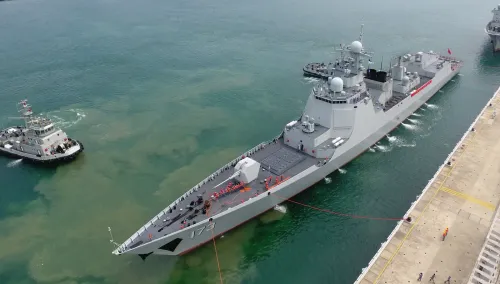
The paper details how anti-ship missile swarms can be coordinated to defeat a US carrier strike group — including Aegis destroyer escorts — at a range of 3,000km (1,865 miles) .
3,000km is the approximate distance from Shanghai to Guam , a US island territory that has become a key repositioning hub for US Navy assets.
The research was published openly in a peer-reviewed journal, suggesting institutional confidence and a deliberate strategic signal.
The findings implicitly challenge the US Navy 's Distributed Maritime Operations (DMO) doctrine, which relies on dispersal to complicate enemy targeting.
The study extends China 's A2/AD strategic logic from the first island chain toward the second, where Guam is located.
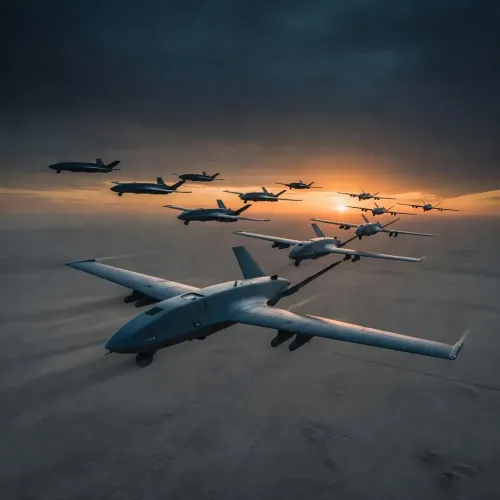
Chinese defence scientists at the National University of Defence Technology (NUDT) in Nanjing have published a peer-reviewed blueprint for destroying a US carrier strike group from a distance of 3,000 kilometres — precisely the range separating Shanghai from the US territory of Guam in Micronesia. The paper, released on May 25, lays out a step-by-step operational framework using coordinated anti-ship missile swarms under what researchers call 'distributed confrontation.'
The research and what it proposes
The study, formally titled 'Research on the effectiveness of anti-ship missile swarm operation under distributed confrontation', was published in Tactical Missile Technology, one of China's most authoritative defence journals. It was led by associate professor Gao Tianyun of the College of International Studies at NUDT. The paper does not merely theorise — it offers a structured methodology for coordinating missile salvos against a dispersed naval formation at extreme range.
The research is openly available in a peer-reviewed format, a deliberate choice that signals institutional confidence in the findings. Publishing such material openly is itself a form of strategic communication.
Why it matters: Guam as the new frontier
The US Navy has been gradually repositioning its most valuable assets — aircraft carriers and their escort vessels — away from forward positions near Japan, South Korea, the Philippines, and the South China Sea. Guam, roughly 3,000km (1,865 miles) from Shanghai, has emerged as a key hub in this strategic pullback. The island sits beyond the effective range of most of China's current mid-range ballistic missiles, hypersonic gliders, and cruise missile systems — the arsenal underpinning its anti-access/area-denial (A2/AD) doctrine.
For the People's Liberation Army (PLA), that distance is not a deterrent — it is a targeting problem to be solved. The NUDT paper is, in effect, an answer to that problem, addressing how swarms of anti-ship missiles can be coordinated to saturate the layered defences of a carrier group — including Aegis destroyers — at distances that were previously considered a safe buffer.
The competitive backdrop: A2/AD goes long-range
China's A2/AD strategy has historically focused on denying access within the so-called 'first island chain.' The NUDT research suggests a deliberate push to extend that envelope to the 'second island chain,' where Guam sits. This aligns with broader PLA modernisation trends, including development of the DF-26 'Guam killer' ballistic missile, which reportedly has a range of approximately 4,000km.
The concept of Distributed Maritime Operations (DMO) — the US Navy's own counter-strategy of dispersing assets to complicate targeting — is implicitly challenged by the swarm-coordination framework in the paper. If missile swarms can be effectively directed against dispersed formations, the logic of dispersion as a defensive tool is undermined.
What's next
The publication adds academic weight to a capability Pentagon planners have long war-gamed. With US Defence Secretary Pete Hegseth overseeing a period of significant strategic repositioning, the pressure on Guam's defensive infrastructure — including missile defence batteries and hardened facilities — is likely to intensify. Analysts will be watching whether this research accelerates US investment in active defence systems capable of defeating saturation attacks at extended ranges.
Point of View
Not just developing. By placing a carrier-killing blueprint in a peer-reviewed journal, NUDT is communicating to Pentagon planners that the assumed sanctuary of Guam's distance is being systematically eroded. Mainstream coverage tends to focus on hardware — missile ranges, warhead yields — but the more consequential story here is doctrinal: the swarm-coordination framework directly targets the logic of Distributed Maritime Operations, the US Navy's primary answer to A2/AD. If saturation attacks can be effectively orchestrated at 3,000km, dispersion stops being a shield and becomes a targeting grid. The pressure this creates on Guam's missile defence investment timeline — already strained — is the real number to watch.
NationPress
26 Oct 2026
Frequently Asked Questions
What did Chinese military scientists publish about attacking US carriers?
Scientists at the National University of Defence Technology in Nanjing published a peer-reviewed paper on May 25 detailing how coordinated anti-ship missile swarms could destroy a US carrier strike group from 3,000km away. The paper was published in Tactical Missile Technology , one of China 's leading defence journals.
Why is 3,000km significant in this context?
3,000km is approximately the distance from Shanghai to Guam , the US island territory in Micronesia that the US Navy has been using as a repositioning hub for its carrier groups. That distance was previously considered beyond the effective reach of most of China 's conventional missile systems.
Who led the Chinese missile swarm research?
Associate professor Gao Tianyun of the College of International Studies at NUDT in Nanjing led the research team. The paper was published openly in a peer-reviewed format in Tactical Missile Technology on May 25 .
How does this affect US military strategy in the Pacific?
The research directly challenges the US Navy 's Distributed Maritime Operations (DMO) doctrine, which disperses naval assets to complicate enemy targeting. If missile swarms can be effectively coordinated against dispersed formations at extreme range, the defensive value of that dispersion is reduced, putting greater pressure on Guam 's active missile defence systems.
Is this research part of a broader Chinese military trend?
Yes. The paper extends China 's established anti-access/area-denial (A2/AD) strategy from the first island chain — covering Japan , the Philippines , and the South China Sea — toward the second island chain where Guam sits. It complements existing platforms like the DF-26 ballistic missile, which reportedly has a range of approximately 4,000km and has been informally labelled the 'Guam killer.'