China's HG-STR algorithm gives drone swarms 100% kill rate autonomy
Synopsis
Chinese researchers at Northwestern Polytechnical University have published an algorithm called HG-STR that reportedly gives fixed-wing drone swarms a 100% kill rate against all targets — autonomously, without human command, even under jamming. It's the first of its kind, according to a peer-reviewed paper published May 19, 2026.
Key Takeaways
Northwestern Polytechnical University in Xi'an published the HG-STR algorithm in Acta Aeronautica et Astronautica Sinica on May 19, 2026 .
The algorithm claims a 100 per cent kill rate for fixed-wing drone swarms operating autonomously without a live human command link.
HG-STR (Heterogeneous Graph Spatio-Temporal Reasoning) processes friend, foe, and terrain data as distinct types — unlike traditional uniform-data approaches.
The system is designed to operate under communications jamming and degraded visual conditions, severing the human pilot link by design.
Research was backed by the National Natural Science Foundation of China ; lead author Zhang Dong is affiliated with the School of Astronautics .
A Beijing-based defence expert described the technology as enabling a 'find and kill them all' autonomous mission profile in high-risk environments.
A research team from Northwestern Polytechnical University in Xi'an, China has published a drone-swarm algorithm that claims a 100 per cent kill rate against enemy targets — operating fully autonomously even under communications jamming and degraded visual conditions. The paper appeared in Acta Aeronautica et Astronautica Sinica, China's top aviation journal, on May 19, 2026, marking what researchers describe as a first in autonomous multi-drone combat systems.
What HG-STR does differently
The algorithm — designated HG-STR (Heterogeneous Graph Spatio-Temporal Reasoning) — departs from conventional approaches by treating different battlefield data types distinctly. Traditional algorithms process friend, foe, and terrain information as uniform data, limiting situational reasoning. HG-STR instead builds a heterogeneous graph that maps spatial and temporal relationships across all data categories simultaneously, enabling more precise target prioritisation.
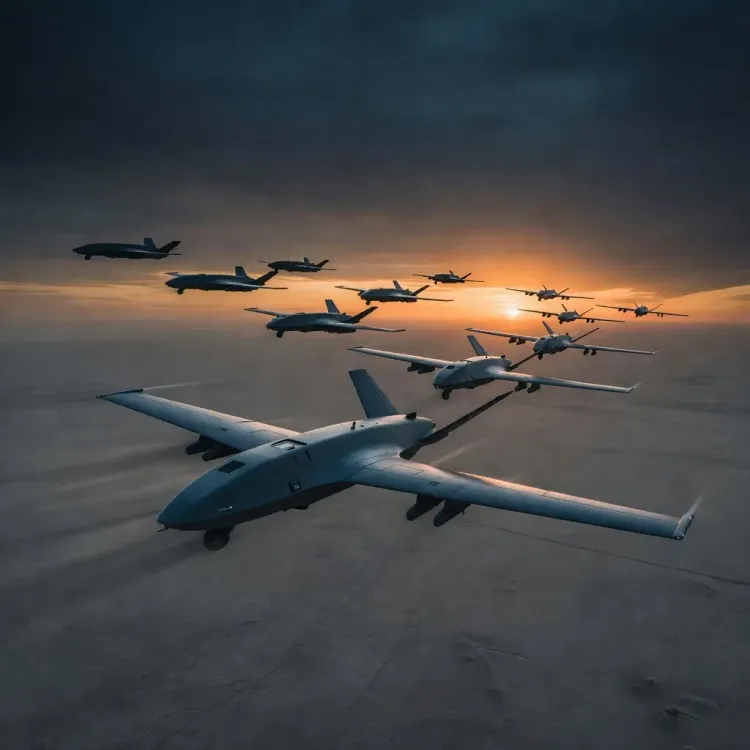
The system is designed for fleets of fixed-wing drones, allowing them to autonomously search a wide battlefield area and engage every identified enemy target without requiring a live human command link. According to the peer-reviewed paper, it is the first known algorithm to achieve this kill-rate benchmark while operating at speeds compatible with modern combat tempo.
Why it matters
The practical implication is a significant shift in autonomous weapons doctrine. A Beijing-based defence expert, who requested anonymity as they are not authorised to speak to media, described the technology's strategic logic plainly: 'This technology suggests a future where swarms of drones could be sent into a high-risk, jammed environment, cut off from human command with a single final order: find and kill them all.'
Most drone operations today still rely on remote human pilots, the same expert noted. A system that severs that command link intentionally — by design rather than by failure — represents a qualitative change in how autonomous lethal force could be deployed at scale.
Institutional backing and peer validation
The research was conducted under the School of Astronautics at Northwestern Polytechnical University and received support from the National Natural Science Foundation of China. Lead researcher Zhang Dong is listed among the study's authors. Publication in Acta Aeronautica et Astronautica Sinica — a state-recognised, peer-reviewed journal — lends the findings institutional credibility within China's defence-academic ecosystem.
The competitive backdrop
The release arrives as drone swarm technology has become a focal point of military modernisation globally, with conflict zones from Ukraine to the Middle East demonstrating the battlefield effectiveness of low-cost autonomous systems. China's investment in autonomous combat AI, channelled partly through university-military research pipelines, has accelerated in parallel with Western efforts to develop counter-swarm and AI-enabled targeting systems.
The gap between laboratory algorithm benchmarks and field-deployable hardware remains a key variable. Whether HG-STR's claimed performance holds under real-world electronic warfare conditions — rather than simulated environments — will be the critical test that shapes its strategic significance.
What's next
The publication of HG-STR in an open academic journal suggests Chinese researchers are confident enough in the foundational approach to invite peer scrutiny, a move that may also accelerate parallel development efforts by other state and non-state actors. Observers will be watching for follow-on hardware trials, integration with China's existing fixed-wing drone platforms, and any policy signals from the People's Liberation Army regarding autonomous engagement rules.
Point of View
Likely to shape deterrence calculus and accelerate rival investment decisions. What mainstream coverage underplays is the university-military pipeline at work here: Northwestern Polytechnical University sits on the US Entity List for alleged ties to Chinese military programmes, meaning this research emerges from an institution already flagged by Western governments as a dual-use concern. The 100% kill-rate claim in a simulated environment is also a familiar pattern in Chinese defence academia — benchmark figures that signal ambition and attract state funding, but whose real-world replication under contested electronic warfare conditions remains unverified. The deeper story is the normalisation of 'human-out-of-the-loop' lethal autonomy as an engineering goal, at a moment when international norms on autonomous weapons remain entirely unresolved.
NationPress
14 Oct 2026
Frequently Asked Questions
What is the HG-STR algorithm developed by Chinese researchers?
HG-STR, or Heterogeneous Graph Spatio-Temporal Reasoning, is a drone-swarm targeting algorithm developed at Northwestern Polytechnical University in Xi'an, China . It enables fleets of fixed-wing drones to autonomously search a battlefield and engage all identified enemy targets without human command, even under jamming conditions. The peer-reviewed paper was published on May 19, 2026 .
Why is the HG-STR drone algorithm significant?
It is reportedly the first algorithm to achieve a 100 per cent kill rate in autonomous drone swarm operations while running fast enough for real-time combat. Its ability to function without a human command link — by design — marks a qualitative shift toward fully autonomous lethal systems, raising immediate questions about oversight and international norms on autonomous weapons.
Who funded and conducted the HG-STR drone research?
The research was conducted at the School of Astronautics, Northwestern Polytechnical University , with funding from the National Natural Science Foundation of China . Zhang Dong is listed as a lead researcher. The findings were published in Acta Aeronautica et Astronautica Sinica , China's top peer-reviewed aviation journal.
How does HG-STR differ from existing drone targeting algorithms?
Traditional drone algorithms treat all battlefield data — friend, foe, terrain — as a single uniform data type, limiting reasoning accuracy. HG-STR builds a heterogeneous graph that distinguishes between data categories and maps their spatial and temporal relationships simultaneously, enabling more precise and adaptive target engagement decisions.
What are the broader implications for global drone warfare?
The algorithm accelerates a trend toward removing human pilots from lethal decision loops, a development that has strategic implications for conflicts where drone swarms are already reshaping tactics. Nations investing in counter-swarm and electronic warfare systems — particularly in the US , Europe , and India — are most directly exposed to this capability shift. International frameworks governing autonomous weapons have yet to produce binding rules.