China exports seabed cable-detection robots to Middle East, Europe, Asia
Synopsis
China is exporting robots that locate buried submarine cables with less than 5% positioning error — developed at Dalian Jiaotong University — directly challenging Western dominance in a sector that underpins 95% of global internet traffic.
Key Takeaways
China plans to export seabed cable-detection robots to Southeast Asia , the Middle East , and Europe , according to Science and Technology Daily in July 2026 .
The robots, built by Dalian Jiaotong University , locate cables buried under silt with a positioning error of less than 5 per cent .
The machines operate at depths of up to 300 metres (984 feet) around the clock and can withstand turbulent ocean currents.
They also cover exposed cables with sediment for protection — combining detection and safeguarding in a single platform.
Professor Chen Shaohua of Dalian Jiaotong University described the dual-function design as giving the robot “two complementary eyes.” The export push is framed as a strategy to embed Chinese marine technology into the global submarine cable maintenance ecosystem.
China is moving to export advanced underwater robots capable of locating and protecting marine cables buried beneath the seabed, targeting clients in Southeast Asia, the Middle East, and Europe, according to Science and Technology Daily. The push, announced in early July 2026, signals Beijing's intent to challenge established foreign players in the global marine infrastructure maintenance sector.
What the technology does
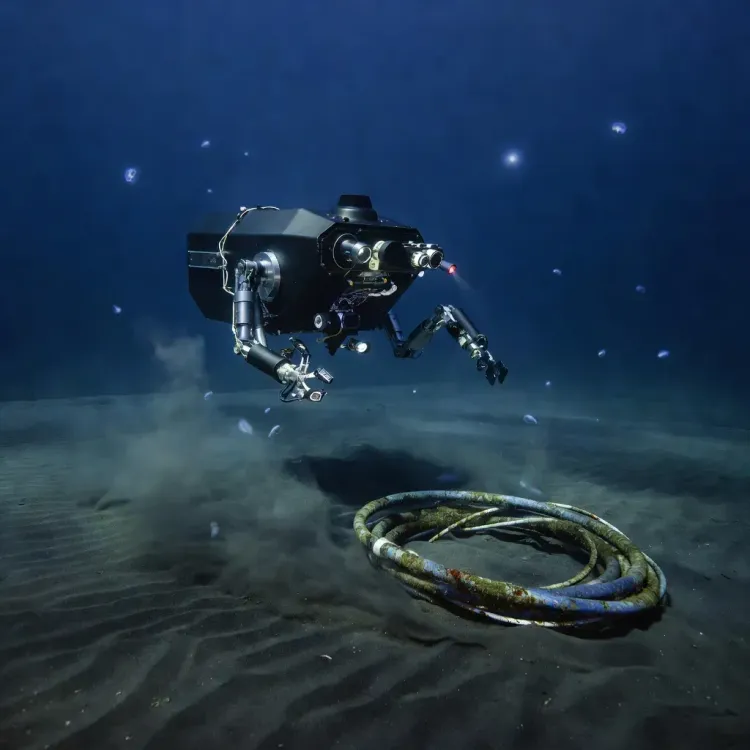
Developed by a research team at Dalian Jiaotong University, the robots are engineered to detect submarine cables buried under silt with a positioning error of less than 5 per cent. Beyond detection, the machines can cover exposed cables with sediment to shield them from damage — a dual capability that sets them apart from single-function survey tools. The robots operate continuously at depths of up to 300 metres (984 feet) and are designed to maintain stability in turbulent ocean currents, enabling round-the-clock deployment in challenging offshore environments.The engineering breakthrough
Chen Shaohua, a professor at Dalian Jiaotong University's school of railway intelligent engineering, described the design philosophy in straightforward terms. “We gave a robot two complementary eyes,” Professor Chen said, referring to the system's combined detection and sediment-laying functions. The university's involvement underscores a broader pattern of Chinese academic institutions contributing directly to strategic industrial exports, particularly in sectors with dual-use infrastructure implications.Why it matters
Submarine cables carry an estimated 95 per cent of international internet and financial data traffic, making their maintenance a matter of both commercial and geopolitical significance. Foreign firms — primarily from the United States, France, and Japan — have historically dominated the specialised vessel and equipment market for cable laying and repair. China's entry into this space with exportable robotic technology represents a direct challenge to that dominance. According to the official report, the goal is to “integrate Chinese intelligent cable detection solutions into the global ecosystem and bolster the international competitiveness of domestic marine equipment.”The competitive backdrop
The announcement comes as global scrutiny of submarine cable security has intensified, with multiple governments investing in cable resilience and repair capacity. Southeast Asia and the Middle East are among the fastest-growing regions for subsea cable infrastructure, driven by surging data demand and ongoing digital economy expansion. By targeting these markets, Chinese marine equipment manufacturers are positioning themselves at a critical juncture — before long-term supply relationships with cable operators in these regions are locked in with Western providers.What's next
No specific commercial contracts or deployment timelines were disclosed in the announcement. The key variable to watch is whether regional cable operators and governments in the targeted markets — particularly in Southeast Asia, where Chinese infrastructure investment already runs deep — move to trial or procure the technology. Regulatory approvals and geopolitical sensitivities around cable-route data could shape how quickly adoption scales.Point of View
Yet the specialised maintenance market remains tightly held by a handful of Western and Japanese firms; China is now offering an alternative supply chain to precisely the regions those firms covet most. What mainstream coverage tends to underplay is the data dimension: a robot that maps buried cable routes generates precise geospatial intelligence about undersea infrastructure, adding a layer of sensitivity that purely commercial framing obscures. Expect procurement decisions in Southeast Asia to become a proxy battleground for the broader contest over who builds — and who monitors — the physical backbone of the internet.
NationPress
3 Oct 2026
Frequently Asked Questions
What is China's new seabed cable-detection robot?
China has developed an underwater robot that can locate marine cables buried beneath the seabed with a positioning error of less than 5 per cent , according to Science and Technology Daily . Built by researchers at Dalian Jiaotong University , the robot also covers exposed cables with sediment for protection and operates at depths of up to 300 metres .
Which countries is China targeting for this marine robot technology?
China is targeting clients in Southeast Asia , the Middle East , and Europe for the export of its cable-detection robots. The aim, according to official reports, is to integrate Chinese solutions into the global submarine cable maintenance ecosystem.
Who developed China's submarine cable robot?
The technology was developed by a team at Dalian Jiaotong University , led by Professor Chen Shaohua from the school of railway intelligent engineering. Professor Chen described the dual-function design as giving the robot ‘two complementary eyes.’
Why does submarine cable detection technology matter geopolitically?
Submarine cables carry the vast majority of international internet and financial data traffic, making their maintenance strategically significant. Western firms have historically dominated this specialised market, and China's entry with exportable robotic technology represents a direct challenge to that dominance.
Has China signed any contracts for the cable-detection robot exports?
No specific commercial contracts or deployment timelines were disclosed in the July 2026 announcement. The current phase appears focused on signalling export intent and identifying potential clients in the targeted regions.