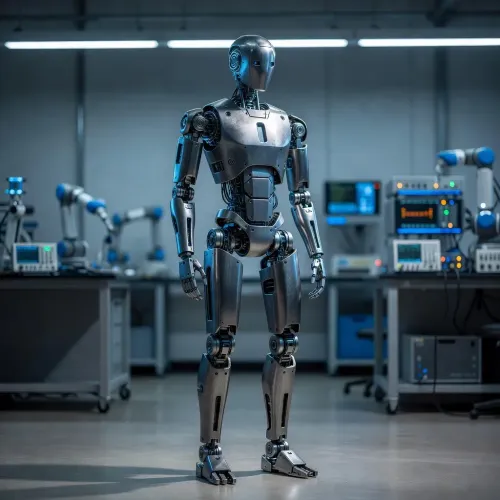
Lingyi iTech seeks $1.1bn Hong Kong IPO to fund AI and robotics

Synopsis
Apple supplier Lingyi iTech is raising up to US$1.1 billion in a Hong Kong IPO to fund a pivot into humanoid robotics and AI hardware, targeting 500,000 robot units annually by 2030 — a 50-fold production leap from this year’s 10,000-unit plan.
Key Takeaways
Lingyi iTech is offering 811.8 million shares at up to HK$10.18 each, targeting a raise of HK$8.3 billion (US$1.1 billion) on the Hong Kong Stock Exchange .
The company is expected to debut on Friday, 27 June 2026 , with the subscription period having opened on 18 June 2026 .
Cornerstone investors include GF Fund , Sunny Optical Capital and smartphone maker Honor .
In September 2025 , Lingyi acquired an 80 per cent stake in a joint venture with robot maker AgiBot ; a robotics factory in Beijing opened earlier this month.
Production targets scale from 10,000 humanoid robot units in 2026 to 500,000 units annually by 2030 .
Lingyi has partnerships with more than 20 Chinese robotics companies and has secured leading North American robotics customers.
Lingyi iTech, a Shenzhen-listed electronic components maker and key Apple supplier, is targeting a raise of up to HK$8.3 billion (US$1.1 billion) through a Hong Kong initial public offering as it pivots aggressively into artificial intelligence hardware and humanoid robotics. The company is expected to debut on the Hong Kong Stock Exchange on Friday, 27 June 2026, following an offering of 811.8 million shares at a maximum price of HK$10.18 each, according to a company filing.
Strategic shift beyond smartphones
The dual listing represents a deliberate effort by Lingyi and its founder, Zeng Fangqin, to reduce dependence on a maturing global smartphone market. Headquartered in Jiangmen, Guangdong province, the company has publicly committed to becoming one of the world’s top three suppliers of embodied-intelligence hardware — a segment encompassing humanoid robots, smart glasses, foldable devices and AI servers.
The subscription period opened on Wednesday, 18 June 2026, drawing cornerstone investors including GF Fund, Sunny Optical Capital and smartphone manufacturer Honor, signalling institutional confidence in the company’s diversification thesis.
Robotics factory and production targets
In September 2025, Lingyi acquired an 80 per cent stake in a joint venture with robot maker AgiBot, marking its formal entry into the humanoid robotics supply chain. Earlier this month, the company opened a dedicated robotics factory in Beijing and has set an ambitious production roadmap: from 10,000 units this year to 500,000 units annually by 2030.
By the end of November 2025, Lingyi had already assembled or supplied components for 5,000 humanoid robots. The company said it has secured leading North American robotics customers and established partnerships with more than 20 Chinese robotics companies.
Why it matters
The listing underscores a broader trend among Chinese electronics contract manufacturers racing to reposition themselves as robotics and AI infrastructure plays before the smartphone upgrade cycle plateaus further. Lingyi’s dual-market presence — Shenzhen and Hong Kong — is designed to attract both domestic and international capital pools simultaneously.
The involvement of Honor as a cornerstone investor adds a strategic dimension, given the smartphone maker’s own interest in next-generation form factors such as foldable devices and smart glasses, categories Lingyi is directly targeting.
What’s next
With IPO proceeds earmarked for AI hardware and robotics expansion, the market will watch closely whether Lingyi can translate its Apple supply-chain discipline into high-mix, lower-volume robotics manufacturing — a fundamentally different operational challenge. The company’s ability to scale from 10,000 to 500,000 humanoid robot units by 2030 will be the defining test of its pivot.
Point of View
A Chinese contract manufacturer quietly securing Western robotics contracts is strategically notable. The 50-fold production scale-up target by 2030 also echoes the same hyper-aggressive capacity playbook that defined China’s solar and EV dominance — industries where volume commitments preceded demand and ultimately reshaped global markets. Investors should watch whether humanoid robotics follows that same deflationary curve, and whether Lingyi’s dual listing gives it the balance-sheet flexibility to outlast less-capitalised rivals.
NationPress
20 Sept 2026
Frequently Asked Questions
What is Lingyi iTech’s Hong Kong IPO about?
Lingyi iTech is raising up to HK$8.3 billion (US$1.1 billion) through a Hong Kong Stock Exchange IPO, offering 811.8 million shares at a maximum price of HK$10.18 each. The proceeds are intended to fund expansion into AI hardware and humanoid robotics manufacturing.
When will Lingyi iTech debut on the Hong Kong Stock Exchange?
Lingyi iTech is expected to begin trading on the Hong Kong Stock Exchange on Friday, 27 June 2026 . The subscription period opened on Wednesday, 18 June 2026 .
Who are the cornerstone investors in Lingyi’s IPO?
Cornerstone investors in Lingyi’s Hong Kong IPO include GF Fund , Sunny Optical Capital , and smartphone manufacturer Honor . Their participation signals institutional backing for the company’s pivot away from smartphone components.
What is Lingyi iTech’s humanoid robotics strategy?
Lingyi acquired an 80 per cent stake in a joint venture with robot maker AgiBot in September 2025 and opened a robotics factory in Beijing in June 2026 . The company plans to grow annual humanoid robot production from 10,000 units in 2026 to 500,000 units by 2030 , with partnerships spanning more than 20 Chinese robotics firms and leading North American customers.
How does Lingyi’s IPO fit into the broader AI and robotics investment trend?
Lingyi’s dual listing reflects a wider shift among Chinese electronics manufacturers repositioning as AI infrastructure and robotics suppliers as the smartphone market matures. The company’s goal of becoming a top-three global embodied-intelligence hardware supplier places it in direct competition with both domestic peers and global contract manufacturers eyeing the same emerging demand.