Ant Group's Robbyant unveils LingBot-Depth 2.0 to fix robot glass perception
Synopsis
Ant Group's robotics unit Robbyant claims its new LingBot-Vision model outperforms Meta's 7-billion-parameter DINOv3 on depth-estimation benchmarks using just one-seventh the parameters — potentially cracking the long-unsolved problem of robots seeing through glass.
Key Takeaways
Robbyant (also known as Ant Lingbo Technology ), the embodied AI unit of Ant Group , launched LingBot-Depth 2.0 and LingBot-Vision on Tuesday, July 7, 2026 .
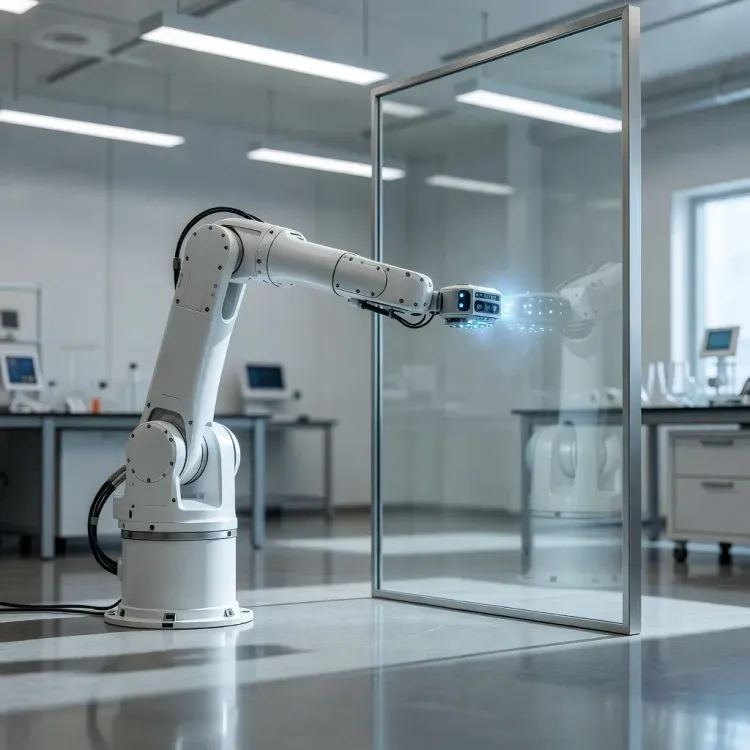
The models are designed to help robots accurately detect glass, mirrors, and transparent objects — a long-standing challenge in robotic perception.
LingBot-Vision is claimed to be the first model of its kind trained to recognise object edges down to a fraction of a single pixel.
According to a company research paper, LingBot-Vision surpassed Meta Platforms' 7-billion-parameter DINOv3 on the NYUv2 depth-estimation benchmark using just one-seventh the parameters and less than one-third the training data.
LingBot-Vision functions as the core engine powering LingBot-Depth 2.0 ; no commercial deployment timeline has been announced.
Robbyant, the embodied AI unit of Hangzhou-based fintech giant Ant Group, on Tuesday, July 7, 2026, launched two new vision models designed to solve one of robotics' most persistent hardware-software gaps: the inability of machines to reliably detect glass, mirrors, and transparent surfaces in real-world environments.
What was announced
The company — also known as Ant Lingbo Technology — unveiled LingBot-Depth 2.0, a next-generation spatial perception model, alongside a new foundational visual model called LingBot-Vision. According to the company, the two technologies work in tandem to enable robots to perceive complex physical spaces 'accurately and stably', addressing a critical bottleneck that has long limited robotic deployment in uncontrolled environments such as homes, hospitals, and retail floors.
Why it matters
LingBot-Vision is claimed to be the first model of its kind trained specifically to recognise the edges of objects, allowing the AI to pinpoint boundaries with high precision — down to a fraction of a single pixel — according to the company. This sub-pixel edge detection gives robots a sharper understanding of the 3D spaces around them, a capability that has direct implications for manipulation tasks, navigation, and safety in human-occupied spaces.
The transparent-object problem is well-documented in the robotics industry: standard depth sensors and vision models frequently misread or ignore glass surfaces entirely, causing robotic arms to misjudge distances or collide with objects they cannot 'see'. A reliable fix would meaningfully expand the range of environments where autonomous robots can operate.
The competitive backdrop
LingBot-Vision enters a field dominated by Meta Platforms' open-source vision model, DINOv3, which relies on massive computational scale to achieve performance. According to a research paper published by the Robbyant team, LingBot-Vision surpassed the 7-billion-parameter DINOv3 across multiple metrics on the NYUv2 depth-estimation benchmark — using just one-seventh as many parameters and less than one-third of the training data.
The efficiency claim is significant: smaller, leaner models are cheaper to train, faster to deploy on edge hardware, and easier to update — all critical factors for commercial robotics at scale. LingBot-Vision serves as the core engine powering LingBot-Depth 2.0.
Market context
The launch positions Ant Group — better known for its Alipay payments ecosystem — as a serious contender in the fast-expanding embodied AI race, where firms including Figure AI, Physical Intelligence, and a string of Chinese robotics startups are competing to build robots capable of operating in unstructured real-world settings. Chinese technology companies have accelerated embodied AI investment through 2025 and into 2026, driven partly by government industrial policy and partly by a domestic manufacturing sector eager to automate.
What's next
The company has not disclosed a commercial rollout timeline for either model, nor has it named specific hardware partners or customer deployments. Analysts will be watching whether the NYUv2 benchmark gains translate to consistent performance in real factory and logistics environments — the true test for any embodied AI perception system. How quickly rivals integrate comparable transparent-surface detection will determine whether Robbyant's efficiency edge proves durable.
Point of View
Less than one-third the training data, yet superior benchmark scores — land squarely in the middle of the AI commoditisation debate: the question is no longer whether frontier performance is achievable, but whether it can be achieved cheaply enough to run on edge hardware inside a robot. What mainstream coverage tends to underplay is the strategic logic: Ant Group, squeezed by years of Chinese fintech regulatory pressure, is diversifying aggressively into embodied AI where margins and geopolitical exposure look very different from payments. The transparent-object claim is also a pointed shot at Western open-source incumbents like Meta's DINOv3, signalling that Chinese AI labs are willing to compete on benchmark efficiency rather than raw scale — a tactic that has already reshaped the large-language-model landscape. Whether the NYUv2 gains hold in messy real-world deployments remains the critical unknown.
NationPress
6 Oct 2026
Frequently Asked Questions
What did Ant Group's Robbyant announce on July 7, 2026?
Robbyant, Ant Group's embodied AI unit, launched LingBot-Depth 2.0 and LingBot-Vision, two models designed to help robots accurately perceive glass, mirrors, and transparent objects. The announcement was made on Tuesday, July 7, 2026.
How does LingBot-Vision compare to Meta's DINOv3?
According to a research paper published by the Robbyant team, LingBot-Vision outperformed Meta's 7-billion-parameter DINOv3 across multiple metrics on the NYUv2 depth-estimation benchmark. It achieved this using one-seventh as many parameters and less than one-third of the training data.
Why is transparent-object perception a problem for robots?
Standard depth sensors and vision models frequently misread or ignore glass and transparent surfaces, causing robots to misjudge distances or collide with objects they cannot detect. Solving this is essential for deploying robots safely in homes, hospitals, and retail environments.
What is Robbyant and how does it relate to Ant Group?
Robbyant, also known as Ant Lingbo Technology, is the embodied AI arm of Hangzhou-based fintech giant Ant Group. It focuses on building the perception and spatial intelligence systems needed for robots to navigate real-world environments.
When will LingBot-Depth 2.0 be commercially available?
Ant Group has not disclosed a commercial rollout timeline for LingBot-Depth 2.0 or LingBot-Vision as of the July 7, 2026 announcement. No specific hardware partners or customer deployments have been named publicly.