Iron Bestie AI make-up arm wins Hong Kong's first physical AI hackathon
Synopsis
A business graduate with no coding background and a Shenzhen algorithm developer built Iron Bestie — an AI robotic arm that reads your calendar and applies your make-up — and beat more than 160 global teams to win Hong Kong's first physical AI hackathon.
Key Takeaways
Iron Bestie won the Grand MVP award at Hong Kong 's first physical AI hackathon on 6 August 2026 , held at Hong Kong Science Park , Sha Tin .
The AI robotic arm uses vision-language models and voice recognition to select and apply make-up based on the user's calendar, with local redaction middleware protecting personal data.
The winning team comprised Luo Yuqing ( City University of Hong Kong , no formal coding background) and Zeng Yitao (senior algorithm developer, Southern University of Science and Technology , Shenzhen ).
The competition attracted more than 160 global teams and ran for 48 hours , requiring working hardware prototypes alongside software.
Backers and organisers included alloop.ai , Brizan Ventures , and chip firm SpaceMiT .
Iron Bestie, an AI-powered robotic make-up assistant, claimed the Grand MVP award at Hong Kong's first physical artificial intelligence hackathon on 6 August 2026, defeating more than 160 global competitors in a gruelling 48-hour hardware-and-software sprint held at Hong Kong Science Park in Sha Tin. The win marks a milestone for grassroots AI innovation in the city, blending robotics, vision-language models, and personal-care technology in a single device.
What Iron Bestie does
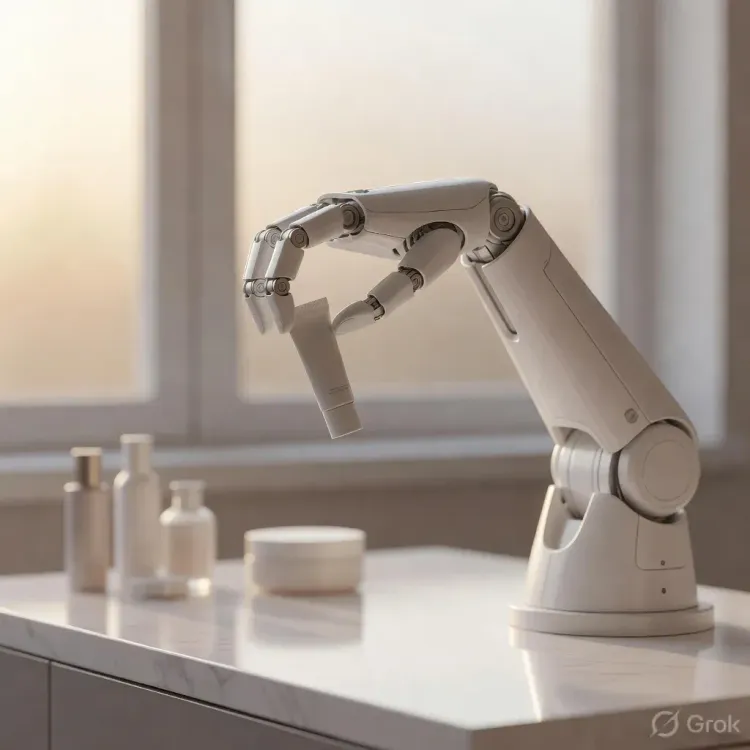
The device is a personalised robotic arm that uses vision-language models and voice recognition to identify cosmetics laid out on a vanity table, select the appropriate product based on the user's calendar, and apply it directly to their face — all while running through their morning schedule aloud. To protect sensitive personal data, the team integrated local redaction middleware, according to the investors.
The concept envisions a future where AI handles routine grooming tasks autonomously, freeing users from manual steps while keeping their daily routines contextually aware.
The team behind the win
The winning duo was an unlikely pairing: Luo Yuqing, a business information systems graduate from the City University of Hong Kong who reportedly had no formal coding background, and Zeng Yitao, a senior algorithm developer from the Southern University of Science and Technology in Shenzhen. Luo said she only began exploring AI out of personal curiosity roughly one year ago, making the Grand MVP her debut hackathon victory.
A first-day hardware glitch proved unexpectedly pivotal. 'When the robotic hand wrapped around my wrist on the first day, it felt like I was holding hands with someone I like,' Luo said — a moment she credited with reshaping her perception of robotics entirely.
Why it matters
The event, backed by stakeholders including alloop.ai, Brizan Ventures, and chip firm SpaceMiT, positions Hong Kong Science Park as an emerging hub for embodied AI — the fast-growing field where large language and vision models are paired with physical actuators. The format, combining hardware prototyping with software development under a single 48-hour deadline, is still rare in Asia.
Consumer robotics for personal care remains a nascent but heavily watched segment, with major tech companies and startups alike racing to find practical, non-industrial applications for robotic arms at the household level.
The competitive backdrop
More than 160 teams from across the globe entered the competition, reflecting growing international interest in applied AI challenges that go beyond pure software. The hackathon's physical format — requiring working hardware prototypes, not just code — raised the bar significantly compared with conventional software-only contests.
Sha Tin College hosted elements of the event, underscoring the organisers' intent to anchor the competition in the local academic ecosystem.
What's next
Whether Iron Bestie progresses toward a commercial product or remains a proof-of-concept will likely depend on further investment and miniaturisation of its robotic components. The involvement of Brizan Ventures and alloop.ai suggests at least some institutional interest in taking the technology forward. As embodied AI matures globally, competitions like this one are increasingly serving as early talent pipelines for the sector's next wave of startups.
Point of View
Hong Kong Science Park could carve out a niche in embodied AI that neither Shenzhen's manufacturing base nor Singapore's financial clout currently occupies.
NationPress
21 Sept 2026
Frequently Asked Questions
What is Iron Bestie and what does it do?
Iron Bestie is an AI-powered robotic make-up arm that uses vision-language models and voice recognition to identify cosmetics on a table, select the right product based on the user's calendar, and apply it to their face. It also reads out the user's morning schedule during the process, and uses local redaction middleware to keep personal data private.
Who won Hong Kong's first physical AI hackathon in 2026?
The Grand MVP award went to the Iron Bestie team: Luo Yuqing, a business information systems graduate from the City University of Hong Kong, and Zeng Yitao, a senior algorithm developer from the Southern University of Science and Technology in Shenzhen. They beat more than 160 global competitors in a 48-hour competition at Hong Kong Science Park on 6 August 2026.
Why is Hong Kong's physical AI hackathon significant?
It was billed as Hong Kong's first hackathon to require working physical hardware prototypes alongside software, raising the difficulty bar beyond conventional coding contests. The format reflects growing industry interest in embodied AI — pairing large AI models with real-world robotic actuators — and positions Hong Kong Science Park as a potential hub for the field.
Who backed or organised the Hong Kong AI hackathon?
The event's listed stakeholders included alloop.ai, Brizan Ventures, and chip firm SpaceMiT. Sha Tin College was also associated with the competition. The organisers attracted more than 160 teams from around the world for the 48-hour sprint.
What is embodied AI and why does it matter for consumer robotics?
Embodied AI refers to AI systems — typically large vision-language or multimodal models — that are integrated into physical robots capable of interacting with the real world. It matters for consumer robotics because it enables devices like Iron Bestie to perceive their environment, make context-aware decisions, and perform physical tasks, moving AI out of screens and into everyday physical spaces.