Guyana's Rodrigues-Birkett leads UN Secretary-General straw poll
Synopsis
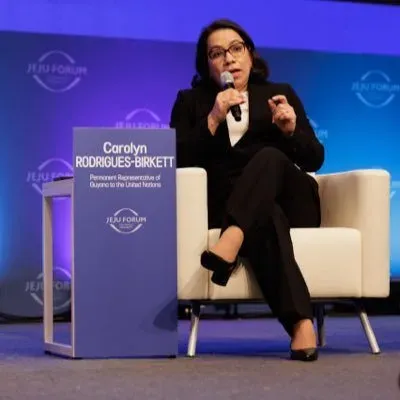
The race for the UN's top job just got more unpredictable. Guyana's Carolyn Rodrigues-Birkett has overtaken UNCTAD chief Rebecca Grynspan in the Security Council's second informal straw poll — but with no candidate hitting the nine-vote threshold and Russia hinting at new entrants, the contest to lead 193 nations is far from settled.
Key Takeaways
Carolyn Rodrigues-Birkett of Guyana topped the UN Security Council straw poll on 22 August with 8 positive votes, overtaking Rebecca Grynspan .
No candidate reached the 9 'encourage' votes required for election in the 15-member Council .
Grynspan's support dropped sharply — from 10 positive votes in July to 7 in this round, with negatives rising from 1 to 4 .
IAEA chief Rafael Grossi held third place with 7 positive and 6 negative votes.
Russia's envoy Vasily Nebenzia raised the possibility of new candidates entering if the current field remains deadlocked.
Permanent members' voting positions will only be colour-coded in later-stage polls, keeping their stances unknown for now.
Former Guyana Foreign Minister Carolyn Rodrigues-Birkett has emerged as the frontrunner for the post of UN Secretary-General after topping the second informal straw poll conducted by the UN Security Council on Friday, 22 August, according to unofficial tabulations published by advocacy group 1 for 8 Billion and UN-focused media outlet Pass Blue.
Rodrigues-Birkett, who had ranked second in the first informal poll held last month, edged past UNCTAD head Rebecca Grynspan, who had led that earlier round. The shift marks a significant reshuffling of the field with no clear consensus candidate yet in sight.
Key Poll Results
Rodrigues-Birkett secured eight positive or 'encourage' votes, three negative or 'discourage' votes, and four neutral votes in the 15-member Council, according to the leaked tabulations. Despite leading the field, she fell one short of the nine positive votes required for election — and critically, none of those nine must come from a veto-wielding permanent member voting against her.
Compared to last month's poll, she dropped one positive vote while picking up one additional negative, suggesting her support base is not yet consolidated.
Grynspan's Slide and the Shifting Field
The most dramatic movement was in Grynspan's tally. The former Vice-President of Costa Rica saw her 'encourage' votes fall sharply from ten in July to seven in this round, while 'discourage' votes climbed from one to four. The reversal signals that the race remains fluid and no candidate has yet locked in the support needed to proceed to the 193-member General Assembly, which by convention endorses the Council's recommendation.
International Atomic Energy Agency (IAEA) Director General Rafael Grossi of Argentina held third place with seven positive and six negative votes. Newcomer Ivonne A-Baki, a former Ecuadorian Ambassador to the United States and France who entered the race after last month's poll, received no positive votes and accumulated eight negative votes.
Other Candidates in the Race
The remaining candidates — former Chilean President and UN Human Rights High Commissioner Michelle Bachelet; former General Assembly President and Ecuador's ex-Foreign Minister Maria Fernanda Espinosa; former UN Under-Secretary-General and Uganda's ex-Foreign Minister Olara Otunnu; and former Senegal President Macky Sall — all trailed the frontrunners.
Russia Leaves Door Open for New Entrants
Adding to the uncertainty, Russia's Permanent Representative Vasily Nebenzia, whose country holds veto power on the Council, suggested on Thursday that a deadlock could open the field to new candidates. 'I am speculating now,' Nebenzia said, 'if there is a deadlock on any of the candidates we are seeing today, if nobody flies, then I think that we may see other candidates.'
Officially, the straw poll results are confidential. Denmark's Permanent Representative Christina Lassen, serving as this month's Council president, declined to release the figures — though they leaked regardless. The early-stage polls do not yet colour-code permanent members' votes, meaning it remains unclear where the five veto powers stand on each candidate.
With no candidate yet commanding the required threshold and a permanent member openly flagging the possibility of fresh entrants, the race to lead the United Nations remains wide open heading into the next round of consultations.
Point of View
But the more telling story is Grynspan's steep fall — losing three positive votes and gaining three negatives in a single round is a significant erosion for a candidate who was once the frontrunner. The fact that no candidate has crossed the nine-vote bar, combined with Russia publicly floating the idea of new entrants, suggests the permanent members are not yet aligned. In past UN Secretary-General races, early straw poll leaders have not always prevailed; the real contest begins when permanent members' votes are colour-coded and the veto calculus becomes visible. The current field's Latin American concentration also raises a structural question: with no Asian or African candidate in serious contention yet, regional bloc politics could yet reshape the race.
NationPress
6 Oct 2026
Frequently Asked Questions
Who is leading the race for UN Secretary-General?
Former Guyana Foreign Minister Carolyn Rodrigues-Birkett is currently leading after the second informal Security Council straw poll held on 22 August, receiving eight positive votes. However, she still needs nine votes — with none from a veto-wielding permanent member voting against her — to be recommended for election.
What is a UN Security Council straw poll?
A straw poll is an informal, confidential vote held by the 15-member Security Council to gauge support for candidates for the UN Secretary-General post. Votes are classified as 'encourage', 'discourage', or 'neutral', and a candidate needs at least nine positive votes — with no veto from a permanent member — to be formally recommended to the General Assembly.
Why did Rebecca Grynspan's support fall in this round?
Grynspan's 'encourage' votes dropped from ten in July to seven in the August poll, while 'discourage' votes rose from one to four. The reasons behind individual member votes are not publicly disclosed, but the shift indicates that support for the UNCTAD chief is eroding and the race remains fluid.
Could new candidates still enter the UN Secretary-General race?
Yes, according to Russia's Permanent Representative Vasily Nebenzia, who said on Thursday that if the current candidates remain deadlocked, new entrants could emerge. His remarks added to speculation that the field is not yet finalised.
What happens after the Security Council picks a candidate?
Once the Security Council recommends a candidate, the matter goes to the 193-member UN General Assembly, which by established convention endorses the Council's choice. The formal vote in the Council requires at least nine positive votes with no veto from any of the five permanent members — the United States, United Kingdom, France, Russia, and China.