Rebeca Grynspan leads UN chief race with 12 positive votes; Turkey's Sinirlioglu struggles
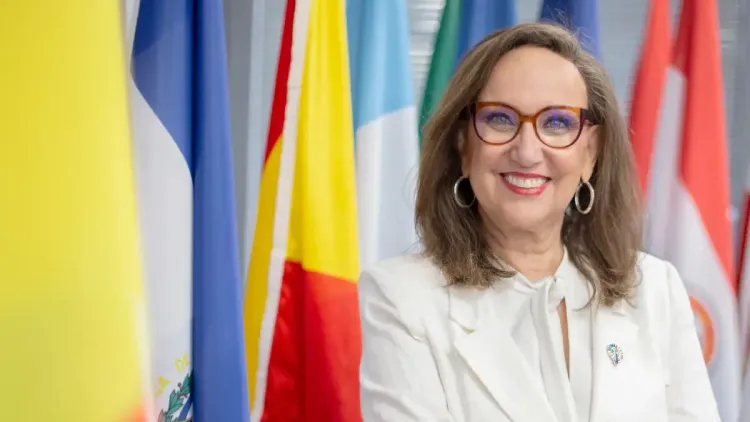
Synopsis
Costa Rica's Rebeca Grynspan has now led seven of eight UN Secretary-General straw polls, climbing to 12 positive votes — but two P5 vetoes recorded in an earlier colour-coded round mean her frontrunner status is no guarantee. Turkey's last-minute nominee Sinirlioglu, backed by Erdoğan, managed just three positive votes on debut, underscoring the costs of late entry into a race the Security Council must resolve before January.
Key Takeaways
Rebeca Grynspan (Costa Rica) leads the eighth Security Council straw poll with 12 positive and 3 negative votes, having led 7 of 8 rounds.
Feridun Sinirlioglu (Turkey), nominated by President Erdoğan over the weekend, debuted in sixth place with only 3 positive and 8 negative votes.
Rafael Grossi (Argentina/IAEA) holds second with 9 positive votes ; Carolyn Rodrigues-Birkett (Guyana) is third with 8 positive votes .
All five permanent members hold veto power; Grynspan received 2 P5 negative votes in the only colour-coded (sixth) poll.
The Security Council has fewer than 2 months to agree before the new chief takes over on 1 January 2027 .
No woman has ever led the UN in its 80-year history ; Latin America last held the post when Javier Pérez de Cuéllar finished his term in 1991 .
Rebeca Grynspan of Costa Rica strengthened her position in the race to succeed United Nations Secretary-General António Guterres, according to the latest Security Council straw poll conducted on Thursday, 6 November 2026. Grynspan, who heads the UN Conference on Trade and Development (UNCTAD), now holds 12 positive votes — up from 11 in the previous round — while trimming her negative count to three.
Key Developments in the Latest Straw Poll
Turkey's late entrant, Feridun Sinirlioglu — nominated over the weekend by President Recep Tayyip Erdoğan — fared poorly on his straw poll debut, finishing sixth among the eight candidates with only three positive votes and eight negative votes. Sinirlioglu, who currently serves as Secretary-General of the 57-member Organisation for Security and Cooperation in Europe (OSCE), entered the race after the United Arab Emirates nominated its own candidate, Lana Nusseibeh, Minister of State for Foreign Affairs.
The straw poll was expedited because Sinirlioglu had not yet participated in the informal candidate dialogue that the UN General Assembly convenes for all contenders. His appearance before that forum is scheduled for Friday, 7 November. The Assembly has insisted on this requirement as a condition of candidacy.
Full Standings After the Eighth Poll
Rafael Grossi, the Argentine director-general of the International Atomic Energy Agency (IAEA), retained second place with nine positive votes, four negative, and two neutral. Carolyn Rodrigues-Birkett, a former Foreign Minister of Guyana, held third with eight positive votes, five negative, and two neutral.
Lana Nusseibeh (UAE) stayed fourth, holding steady at seven positive, six negative, and two neutral — the same numbers from her debut poll last month. Olara Otunnu, a former UN Under-Secretary-General and Uganda's former Foreign Minister, came fifth. Feridun Sinirlioglu was sixth; María Fernanda Espinosa, a former President of the General Assembly and Ecuador's former Foreign Minister, was seventh; and Ivonne A-Baki, a former Ecuadorian ambassador to the United States, finished last.
The Veto Problem Grynspan Still Faces
Despite leading in seven of the eight straw polls held so far, Grynspan's path to the top job is not guaranteed. The five permanent members of the Security Council — the United States, United Kingdom, France, Russia, and China — each hold veto power, and all five must agree before a recommendation can be sent to the General Assembly for what is typically a formality. Ballot papers in this round were not colour-coded to identify the P5 votes, making it impossible to know precisely where the vetoes lie. Notably, the only colour-coded poll — the sixth — showed Grynspan receiving two negative votes from permanent members.
Regional and Gender Push Behind the Race
This contest carries historic weight. All nine individuals who have served as UN Secretary-General in the organisation's 80-year history have been men. At the General Assembly's high-level week in September 2026, leaders from several countries publicly backed electing a woman to lead the UN for the first time. Latin American and Caribbean nations have additionally argued that the next Secretary-General should come from their region — it has been 35 years since the region produced a UN chief, when Javier Pérez de Cuéllar ended his term in 1991. The top three candidates in the current standings are all from that region.
What Happens Next
The Security Council has fewer than two months to settle on a recommendation before the new Secretary-General must take office on 1 January 2027. The pace of polling is expected to intensify. If no consensus emerges among the P5, the leading candidates could face repeated rounds until a veto-proof name surfaces. The results of this eighth poll were not officially announced — per established ground rules — but were leaked to specialist outlets PassBlue and 1for8Billion, which cover the United Nations extensively.
Point of View
Which is happening in private among the P5. Two permanent-member vetoes in the sixth poll are the number that matters most — not her aggregate positive count. Sinirlioglu's dismal debut illustrates that late-entry candidacies at the Security Council level carry a structural disadvantage: the informal trust-building that precedes straw polls cannot be replicated overnight, regardless of the sponsor's geopolitical weight. The broader gender and regional arguments are politically potent but ultimately advisory — in a veto-driven system, one dissenting P5 member can override the preferences of the other 190 UN member states combined.
NationPress
6 Nov 2026
Frequently Asked Questions
Who is currently leading the race to become the next UN Secretary-General?
Rebeca Grynspan of Costa Rica is the frontrunner, having led seven of eight Security Council straw polls. She currently holds 12 positive and 3 negative votes in the latest round, conducted on 6 November 2026.
Who is Feridun Sinirlioglu and why did he enter the race late?
Feridun Sinirlioglu is Turkey's Secretary-General of the OSCE, nominated by President Recep Tayyip Erdoğan over the weekend of 1–2 November 2026. His late nomination meant he had not completed the General Assembly's mandatory candidate dialogue, forcing a rushed straw poll before his formal appearance on 7 November.
Can Rebeca Grynspan become UN Secretary-General despite P5 vetoes?
Not automatically. All five permanent Security Council members — the US, UK, France, Russia, and China — must agree before a recommendation goes to the General Assembly. Grynspan received two P5 negative votes in the only colour-coded poll (the sixth), meaning she still needs to overcome at least one veto to secure the post.
When must the new UN Secretary-General be chosen?
The Security Council has fewer than two months to reach consensus, as the incoming Secretary-General is due to take office on 1 January 2027. The pace of straw polling is expected to increase as the deadline nears.
Why is this UN leadership race considered historic?
All nine UN Secretaries-General in the organisation's 80-year history have been men. Many world leaders at the General Assembly's September 2026 high-level week called for the first woman to lead the UN, while Latin American and Caribbean countries have argued the region is overdue — it last produced a Secretary-General when Javier Pérez de Cuéllar's term ended in 1991.