Will Rubio Indicate That the U.S. Won’t Enforce Isolation Among Its Partners?
Synopsis
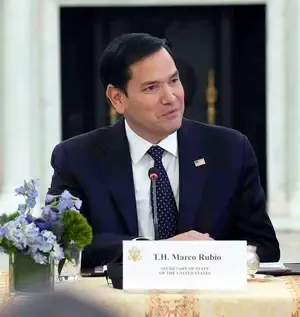
In a pivotal statement, Secretary of State Marco Rubio clarified that the U.S. will not demand its partners to isolate China. This marks a significant shift in Washington's foreign policy approach, emphasizing national interests over ideological conformity and suggesting a pragmatic engagement strategy.
Key Takeaways
U.S. will not demand ideological loyalty from allies.
Expectations for nations to pursue their own interests.
Engagement with China remains crucial for U.S.
Personal diplomacy is key in U.S.-Hungarian relations.
U.S. aims to diversify supply chains to avoid overdependence.
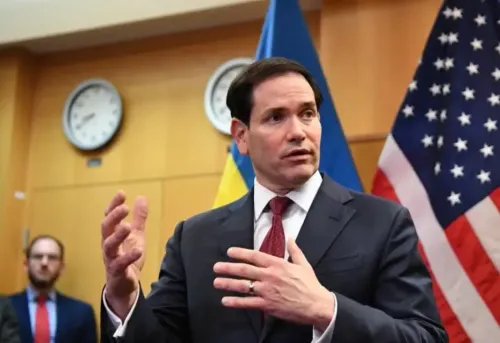
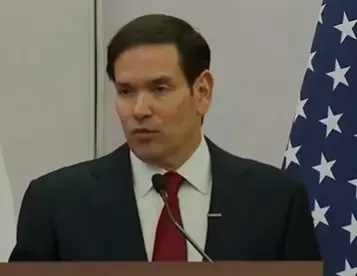
Washington, Feb 17 (NationPress) U.S. Secretary of State Marco Rubio emphasized that the United States will not impose ideological loyalty requirements on its allies. Speaking under the Trump administration, he stated that the U.S. anticipates that “every nation on Earth” will act according to its own national interests, and is “not urging any country to isolate themselves from anyone,” including China.
During his visit to Budapest, where he spoke alongside Hungarian Prime Minister Viktor Orban, Rubio characterized the Trump administration's foreign policy as realistic rather than prescriptive, even as the U.S. engages in strategic competition with Beijing.
“Our expectation is that every nation will act in their national interest,” he stated at a joint press briefing. “We’re not asking any country in the world to isolate themselves from anybody,” he reiterated to the press.
To highlight his point, he referred to the U.S.'s own relationship with Beijing. “It would be insane for the United States and China not to have relations and interact,” he remarked, noting that President Trump plans to visit China in April.
Rubio's comments came during a Budapest visit where the U.S. and Hungary formalized a partnership to enhance cooperation on Hungary’s civilian nuclear initiatives. However, the broader implications of the visit were significant in illustrating Washington's changing dynamics with allies that maintain strong economic or political connections to China.
Hungary, a member of both NATO and the European Union, has recently increased its investments from China while still securing agreements for Russian energy purchases. When asked why the U.S. was not tying deeper collaboration with Hungary to a reduction of its engagement with Beijing, Rubio dismissed the notion that alignment necessitates isolation.
“We recognize that every nation must navigate the realities of their geography, economy, history, and future challenges,” he explained.
Nonetheless, he coupled his openness to engagement with a cautionary economic perspective, which reflects a broader U.S. initiative to diversify supply chains.
“Relying on a single country or economy for 90 percent of anything — particularly critical supply chains — is detrimental to everyone,” he stated, labeling overdependence as a vulnerability rather than a geopolitical strength.
The Budapest event underscored the importance of personal diplomacy in the current U.S. strategy. Rubio frequently mentioned the “very, very close personal relationship” between President Trump and Orban as a pivotal factor behind mutual decisions, including energy-related waivers.
Orban warmly welcomed Rubio, calling the present moment a “golden age” in U.S.-Hungarian relations and expressing gratitude to President Trump.
Apart from discussing China, the two leaders also addressed the ongoing conflict in Ukraine. Rubio articulated a clear U.S. objective: “The United States’ interest is to see the war end, and we want to do what we can to facilitate that.” He asserted that the U.S. is in a unique position to mediate discussions and noted that recent technical talks among military officials had resumed.
“We’re not trying to impose a deal on anyone,” he asserted. “We simply want to assist them.”
On the subject of Iran, Rubio recognized the complexities of negotiations, indicating that any potential agreement would be challenging but reaffirming that the President “always prefers peaceful outcomes.”
The nuclear cooperation agreement signed recently adds another dimension to a relationship both Rubio and Orban characterized as exceptionally close. Rubio expressed hope that this would lead to “many” more agreements in the coming years.
However, it was his remarks concerning national interest and China that are likely to reverberate far beyond Budapest. By openly stating that the U.S. does not expect nations to sever ties with Beijing, even while cautioning against economic overreliance, the administration is crafting a doctrine that balances competition with realism — signaling to allies that alignment with the U.S. does not necessitate excluding the rest of the world.
Point of View
It is imperative to recognize that the evolving foreign policy articulated by Secretary Rubio reflects a pragmatic approach that prioritizes national interests. This strategy acknowledges the complex realities faced by nations and encourages cooperation without demanding ideological conformity.
NationPress
2 Oct 2026
Frequently Asked Questions
What did Secretary Rubio say about U.S. foreign policy?
He stated that the U.S. will not impose ideological loyalty tests on its partners and expects nations to pursue their own national interests.
How does this affect relations with China?
Rubio emphasized that the U.S. does not require countries to isolate China, indicating a willingness to engage with Beijing.
What are the implications for Hungary?
The U.S. is cooperating with Hungary on its civilian nuclear program despite Hungary's ties with China and Russia.
What is the broader significance of Rubio's statements?
The comments suggest a shift to a more pragmatic U.S. foreign policy that balances competition with realism.
What is the U.S. stance on the war in Ukraine?
Rubio stated that the U.S. aims to help end the war and facilitate discussions between involved parties.