Did Russia Propose a Venezuela-Ukraine Swap?
Synopsis
Russia's past signaling regarding a potential Venezuela-Ukraine swap emerges from Fiona Hill's 2019 testimony, reigniting discussions on international bargaining dynamics. Explore this intriguing geopolitical interplay and its implications for current U.S.-Russia relations in our detailed report.
Key Takeaways
Russia's signaling: Indicated a desire for a trade-off between Venezuela and Ukraine.
Fiona Hill's role: Offered insights during her 2019 congressional testimony.
Geopolitical implications: Highlights the complexities of U.S.-Russia relations.
Public discourse: The idea of a swap was circulated in public forums.
Strategic interests: Russia's interests in Venezuela are tied to its position in Ukraine.
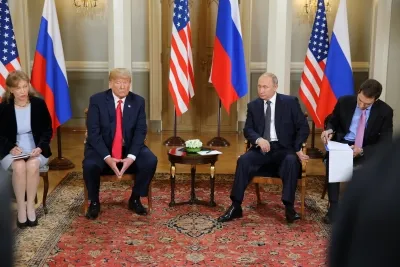
On January 6, Washington (NationPress) revealed that at one time, Russia indicated a readiness to grant the United States some flexibility regarding Venezuela in return for a more lenient stance on Ukraine. This information comes from a congressional testimony delivered seven years ago by Fiona Hill, a former high-ranking official at the National Security Council (NSC), which has resurfaced amid renewed discussions on great-power negotiations.
This scenario was highlighted in a report by the New York Times on Monday, referring back to Hill's testimony in 2019 when she was serving as the NSC’s senior director for Russian and European affairs during the inaugural Trump administration.
During her testimony, Hill recounted what she described as significant Russian communication—much of it made in public forums—indicating a connection between U.S. policies in Venezuela and Russia’s interests in Ukraine.
Hill stated, “The Russians at this particular juncture were signaling very strongly that they wanted to somehow make some very strange swap arrangement between Venezuela and Ukraine,” referring to early 2019 when tensions escalated between Washington and Caracas, coinciding with Russia's military support for Nicolas Maduro, the Venezuelan President.
As the United States intensified its efforts in Venezuela, invoking the Monroe Doctrine, Russia pointed to what it perceived as its own “backyard” in Ukraine. Hill summarized this dynamic by stating, “You have your Monroe Doctrine. You want us out of your backyard. Well, you know, we have our own version of this. You’re in our backyard in Ukraine.”
Hill noted that the idea of a trade-off was not presented through formal diplomatic channels but emerged through public statements and media articles. She remarked that the Russians “laid it out in articles,” many of which were in Russian, making the connection evident to U.S. officials monitoring Moscow's messaging.
During her unclassified visit to Moscow, Hill engaged with Russian counterparts and think tank representatives. She observed that discussions reinforced the notion that Russian officials were keen on linking Venezuela and Ukraine in their strategic considerations. “It was also apparent … that the Russian government was interested in having a discussion about Venezuela and Ukraine,” she commented.
Hill highlighted that the matter had been openly discussed to the extent that it prompted questions at a U.S. State Department press briefing about whether she had gone to Russia “to make a trade between Venezuela and Ukraine,” emphasizing that the idea was already in circulation.
The New York Times report indicated that Moscow's mixed reactions to recent American actions in Venezuela have revived memories of this earlier episode, which took place years before Russia's full-scale invasion of Ukraine.
At the time of Hill's testimony, Russia had deployed personnel and equipment to Venezuela as Washington intensified pressure on the Maduro administration. Hill personally dismissed the idea of such a trade during her interactions with Russian officials, framing the episode as part of a broader pattern in which Moscow sought to define global politics in terms of reciprocal spheres of influence, contrasting this approach with U.S. policy stances.
Hill clarified that her comments were based solely on unclassified information already available to the public: “I have confined all my answers to the things that have either been in the public discussion,” she stated during her testimony.
Point of View
I recognize the importance of understanding the complex dynamics of international relations. The resurfacing of Fiona Hill's testimony not only highlights Russia's strategic maneuvering but also serves as a reminder of the ongoing geopolitical challenges that the U.S. faces in its foreign policy strategies. Our nation must remain vigilant and informed.
NationPress
20 Sept 2026
Frequently Asked Questions
What did Fiona Hill's testimony reveal?
Fiona Hill's testimony indicated that Russia signaled a willingness to negotiate U.S. flexibility on Venezuela in exchange for a less stringent approach to Ukraine.
When did this proposal occur?
The proposal was discussed in early 2019 during heightened tensions between the U.S. and Venezuela.
What was the Monroe Doctrine?
The Monroe Doctrine is a U.S. policy that opposes European colonialism in the Americas, asserting that any intervention in the Americas by foreign powers is a potentially hostile act.