What Insights Does the Venezuela Debate in the US Provide on New Geopolitics?
Synopsis
The recent US Senate hearing on Venezuela unveils critical insights into how the US is reshaping its strategic approach, blending energy control with geopolitical maneuvering. This evolving narrative holds significant implications for India and the Global South, highlighting the intertwining of energy access and international diplomacy.
Key Takeaways
US Senate hearing on Venezuela reveals strategic shifts.
Energy control is intertwined with geopolitical maneuvers.
India faces similar challenges in energy diplomacy.
The US aims for stabilization and democratic transition in Venezuela.
China's influence complicates the geopolitical landscape.
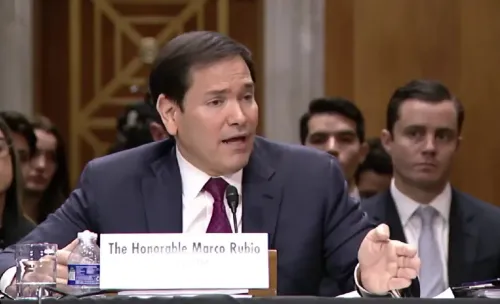
Washington, Jan 29 (NationPress) A heated US Senate hearing this week regarding Venezuela provided a significant insight into how Washington is merging energy dominance, China’s debt diplomacy, sanctions, and controlled military presence — a strategic combination that mirrors the challenges faced by India across the Global South and the Indo-Pacific.
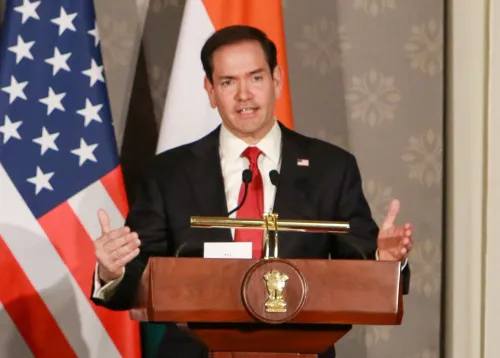
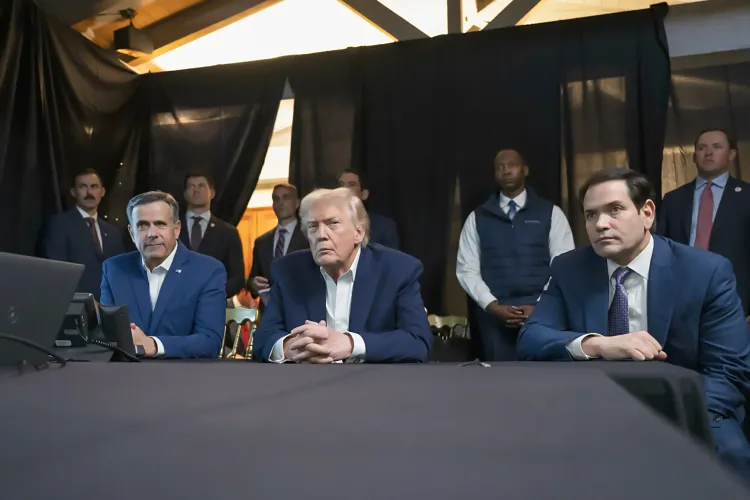
During the Senate Foreign Relations Committee session, US Secretary of State Marco Rubio presented Venezuela as a pivotal illustration of how great-power rivalry is now manifested through oil access, political shifts, and strategic messaging, rather than only through conventional military actions.
“In our hemisphere, we had a regime run by an indicted narcotrafficker that became a hub for virtually all global competitors and adversaries,” Rubio remarked, characterizing the Maduro government as a center for China, Russia, and Iran.
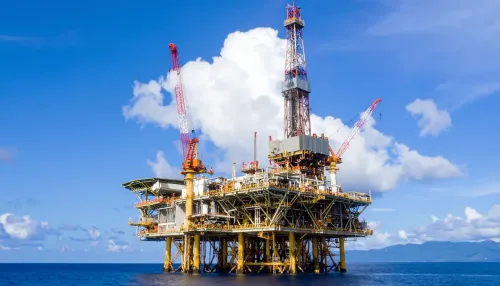
According to Rubio, China notably capitalized on Venezuela's oil resources to solidify its presence in the Western Hemisphere. “China was acquiring oil at a discount of approximately $20 per barrel, without even making cash payments,” he explained. “It was utilized for settling debts owed to them.”
“This oil belongs to the Venezuelan people, yet it was being exchanged with the Chinese as a barter,” Rubio added.
This portrayal resonates with officials in New Delhi, where concerns about China’s tactics of utilizing cheap energy, debt, and opaque agreements to enhance its influence have been raised — often undermining market fairness and sovereignty.
Rubio characterized the situation as “a significant strategic jeopardy for the United States, not distant, but within our own hemisphere,” stating that it was “unsustainable” and “needed to be addressed.”
Washington's current strategy emphasizes stringent control over Venezuelan oil supplies — a matter of direct importance to India, one of the largest global energy importers, which has navigated US sanctions on Iran and Russia to maintain fuel security.
Rubio highlighted that the US has enacted a “quarantine, not a blockade,” permitting sanctioned Venezuelan oil to be marketed only under strict conditions.
“We will permit you to market it at standard prices, not at the discount China enjoyed,” he stated. “The revenues will be deposited into a monitored account, ensuring that the funds are utilized for the benefit of the Venezuelan populace.”
He noted the immediate goal was to prevent economic collapse. “Although they were producing oil, they lacked outlets for it,” Rubio explained, noting that Venezuela was grappling with a “fiscal crisis” and desperately needed funds “to compensate police officers, sanitation workers, and manage government operations.”
Rubio underscored that this arrangement is temporary. “This will not be the permanent solution,” he remarked. “This is a short-term strategy.”
For India, this scenario illustrates how access to oil is increasingly dictated by geopolitical factors rather than market mechanisms alone — a trend New Delhi has highlighted in international discussions as sanctions, export restrictions, and strategic chokepoints redefine global energy distribution.
Rubio mentioned that Venezuela is already beginning to reduce reliance on adversaries. “They previously sourced 100% of their diluent from Russia,” he stated. “Now, they are obtaining all of it from the United States.”
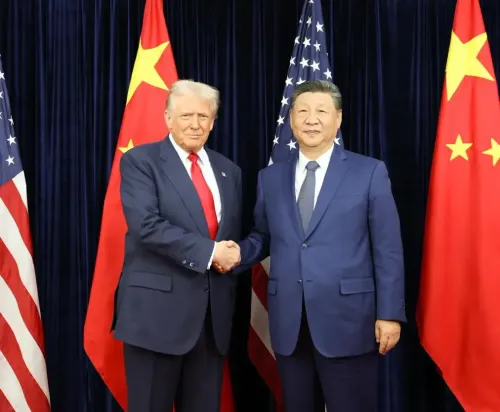
Beyond energy, Rubio portrayed the Venezuela strategy as a broader message to China — a narrative closely monitored in New Delhi amidst escalating US-China rivalry in the Indo-Pacific.
When asked if the operation could sway Beijing’s assessment regarding Taiwan, Rubio responded, “The situation with Taiwan is a legacy project of Xi,” but acknowledged that US actions were “certainly alarming to China, Russia, Iran, and any global adversary, given that the US is the only nation capable of executing this operation.”
For Indian analysts observing the US-China tensions surrounding Taiwan and the South China Sea, these comments underscore a broader US communication — that American influence will be felt wherever its interests are engaged.
Rubio also outlined a three-tier US plan for Venezuela — stabilization, recovery, and transition — which reflects a strategy focused on order rather than rapid political upheaval.
“The end goal is to attain a transitional phase leading to a friendly, stable, and prosperous Venezuela with a democratic framework where all societal elements are represented in free and fair elections,” he stated.
However, he tempered expectations of swift outcomes. “We’re not going to achieve this in three weeks,” Rubio cautioned. “It will require some time.”
He emphasized that stability is the foremost priority post-Maduro. “The concern was about Venezuela’s future. Will there be a civil war? Will factions turn against one another?” he asked, noting that “all of that has been averted.”
Rubio acknowledged the challenges of collaborating with imperfect interim authorities. “We are engaging with individuals implicated in actions that would be unacceptable in our system,” he stated. “However, we must work with those in control of government functions.”
India, which consistently prioritizes sovereignty, gradual reforms, and stability over externally imposed regime changes, often shares a similar perspective in conflict-affected regions.
Rubio noted early signs of reform, mentioning modifications to investment regulations. “They have enacted a new hydrocarbon law that effectively abolishes many of the restrictions from the Chavez era regarding private investment,” he said. “While it may not be sufficient, it represents a significant improvement from their situation three weeks ago.”
He also highlighted the release of detainees. “By some accounts, up to 2,000,” Rubio indicated, though he acknowledged that the pace of releases was “probably slower than I would prefer.”
Regarding the use of military force, Rubio aimed to reassure lawmakers. “We are neither positioned for nor do we intend to initiate any military actions in Venezuela,” he clarified.
“The only military presence in Venezuela will be our marine guards at an embassy,” he added, while asserting that the US President retains the authority to respond to “an imminent threat.”
For India, the Venezuela discourse amalgamates several familiar themes. It highlights how energy is utilized for leverage, how China expands its reach through debt and long-term agreements, and how sanctions and military power are increasingly employed as signals rather than direct moves towards conflict. Washington's approach to Venezuela can be perceived as less of a Latin American narrative and more of an early indicator of how competition among major powers is likely to unfold.
Point of View
It is crucial to understand the implications of these developments for global diplomacy and regional stability. This approach underscores the necessity for nations, particularly India, to adapt and strategize in an increasingly interconnected world.
NationPress
20 Sept 2026
Frequently Asked Questions
What are the implications of the US Senate hearing on Venezuela?
The hearing underscores the US's strategic focus on energy control and geopolitical maneuvering, which could influence global energy access and international relations.
How does this situation relate to India's interests?
India faces similar challenges in energy access and geopolitical competition, making this debate particularly relevant for its foreign policy and energy strategies.
What is the US's strategy for Venezuela moving forward?
The US aims for stabilization, recovery, and transition in Venezuela, focusing on a democratic framework and economic recovery.
What role does China play in Venezuela's current situation?
China has leveraged Venezuela's oil resources to expand its influence in the Western Hemisphere, complicating the geopolitical landscape.
Are military actions expected in Venezuela?
The US has stated it does not intend to engage in military action in Venezuela, focusing instead on diplomatic and financial strategies.