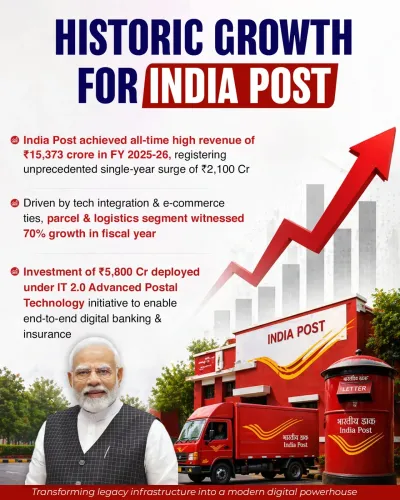
APT 2.0 platform transforms India Post into a modern logistics hub

Synopsis
India Post's APT 2.0 platform is quietly rewriting how the country's largest postal network operates — bringing AI, real-time intelligence, and data-driven decision-making to over 1.5 lakh branch offices. MoS Pemmasani's review signals the Centre's intent to convert India Post from a legacy institution into a competitive national logistics backbone.
Key Takeaways
Chandra Sekhar Pemmasani reviewed APT 2.0 on 12 May 2025 in New Delhi .
APT 2.0 integrates AI to process operational data, predict outcomes, and automate routine postal functions.
Platform equips branch offices with real-time intelligence for data-driven decisions at the field level.
Focused on improving service adoption and unlocking revenue in underserved rural and semi-urban markets .
Governance model shifting from a legacy system to an agile, technology-led institution , per the minister.
Platform includes a robust cybersecurity architecture to safeguard data integrity across the postal network.
Union Minister of State for Communications and Rural Development Dr. Chandra Sekhar Pemmasani on Tuesday, 12 May conducted a detailed review of APT 2.0, India Post's next-generation digital platform, underscoring its pivotal role in transforming India Post into a modern logistics and services hub. The review, held in New Delhi, was followed by an official statement from the Ministry of Communications outlining the platform's wide-ranging operational impact.
What APT 2.0 Delivers
According to the official statement, APT 2.0 has enabled faster service delivery, reduced manual intervention, improved decision-making, enhanced customer satisfaction, and ensured more reliable operations across the postal network. The platform equips branch offices with real-time intelligence, allowing them to analyse local demand, monitor performance, and take faster, data-driven decisions at the field level.
The integration of artificial intelligence (AI) allows India Post to process large volumes of operational data, predict outcomes, automate routine functions, and significantly enhance service delivery — a shift that officials describe as foundational to the institution's modernisation.
Business Impact and Rural Outreach
Minister Pemmasani emphasised the platform's strong business impact, particularly its ability to enable better customer targeting and engagement in underserved rural and semi-urban markets. APT 2.0 has reportedly helped improve service adoption at the branch office level and unlocked new revenue opportunities through timely, data-backed outreach.
By converting branch-level data into actionable intelligence, the platform is strengthening India Post's competitiveness in an evolving logistics landscape increasingly dominated by private players. This comes amid growing pressure on India Post to demonstrate commercial viability alongside its public service mandate.
Governance Shift: From Legacy to Agile
The minister noted a significant governance shift within the organisation — from a traditional legacy system to a more agile, corporate-style, technology-led institution. The government, he said, is closely monitoring the implementation to ensure the transition is both structured and sustainable.
Notably, this transformation aligns with the broader national push toward Digital India, with the government aiming to position India Post as a national logistics backbone — a role that leverages its unmatched last-mile reach across 1.5 lakh-plus post offices, particularly in rural India.
Cybersecurity and Data Integrity
Pemmasani also highlighted that the government's digital push ensures a robust, secure architecture that safeguards data integrity and strengthens cybersecurity. The goal, according to the statement, is to enable trusted, resilient, and future-ready digital public service delivery across the postal network.
As APT 2.0 continues its rollout, the next phase will likely test whether the platform's gains in efficiency and rural engagement translate into measurable revenue growth — and whether India Post can hold its own against private logistics operators in a rapidly consolidating market.
Point of View
Zomato, and Amazon. The AI integration claim deserves scrutiny: real-time intelligence at branch level is only as good as the connectivity infrastructure supporting it, and rural India's last-mile digital gaps remain significant. The shift to a 'corporate-style' governance model also raises a quiet tension — India Post's social mandate in remote areas and its commercial imperative do not always point in the same direction. Whether APT 2.0 resolves that tension or simply papers over it will be the real test of this transformation.
NationPress
25 Sept 2026
Frequently Asked Questions
What is APT 2.0 and what does it do for India Post?
APT 2.0 is India Post's next-generation digital platform that integrates AI to process large volumes of operational data, automate routine functions, and equip branch offices with real-time intelligence. It aims to improve service delivery, customer targeting, and operational efficiency across India Post's vast postal network.
Who reviewed the APT 2.0 platform and when?
Union Minister of State for Communications and Rural Development Dr. Chandra Sekhar Pemmasani conducted a detailed review of APT 2.0 on Tuesday, 12 May 2025, in New Delhi. The review was followed by an official statement from the Ministry of Communications.
How does APT 2.0 benefit rural and semi-urban areas?
APT 2.0 enables better customer targeting and engagement in underserved rural and semi-urban markets by converting branch-level data into actionable intelligence. It has reportedly improved service adoption at the branch office level and helped unlock new revenue opportunities through data-backed outreach.
What governance changes has APT 2.0 brought to India Post?
According to Minister Pemmasani, APT 2.0 has driven a shift from a traditional legacy system to a more agile, corporate-style, technology-led institution. The government is closely monitoring implementation to ensure the transition is structured and sustainable.
How does APT 2.0 address cybersecurity concerns?
The platform incorporates a robust, secure architecture designed to safeguard data integrity and strengthen cybersecurity across India Post's network. The government has described this as central to enabling trusted, resilient, and future-ready digital public service delivery.