South Korea's Assembly Speaker pushes constitutional reform, rules out Lee term extension
Synopsis
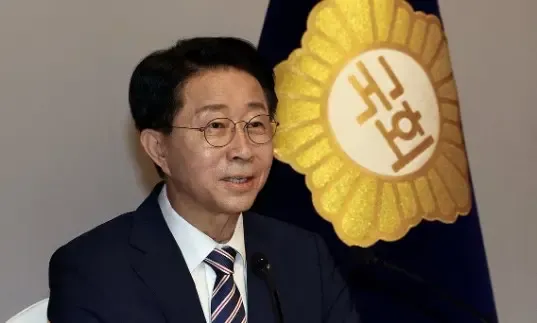
South Korea's National Assembly Speaker Cho Jeong-sik moved to put out a political fire on Wednesday, categorically ruling out any constitutional amendment that could extend President Lee Jae Myung's term and apologising for July remarks that had triggered the controversy. With a reform advisory committee in the works and 2027 flagged as the right window for deliberations, South Korea's constitutional debate is heating up — just without the presidential term question on the table.
Key Takeaways
Speaker Cho Jeong-sik reaffirmed his push for a constitutional revision on 11 November 2026 in Seoul .
He explicitly ruled out any amendment extending President Lee Jae Myung's term, citing Article 128 of the Constitution.
Cho apologised for July 2026 remarks that opposition lawmakers said implied openness to a Lee second term.
An advisory committee under the Speaker's office will be launched soon to set priorities for constitutional reform.
South Korea's Constitution currently caps presidents at a single five-year term and bars any extension from benefiting the sitting president who proposes it.
Cho plans diplomatic visits to the United States and China next year to advance South Korea's national interests.
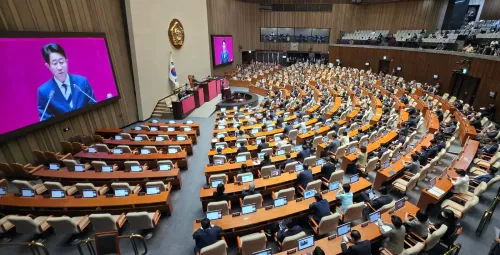
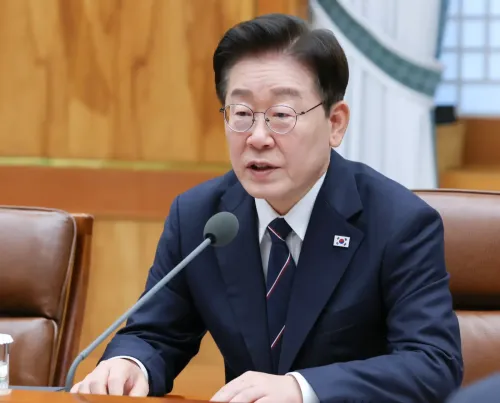
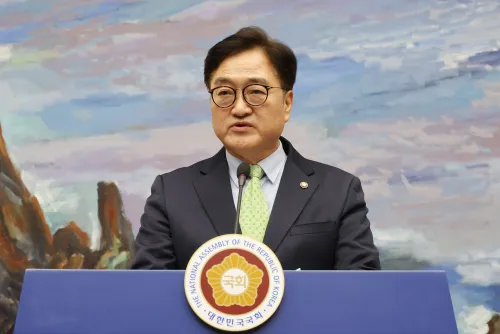
South Korea's National Assembly Speaker Cho Jeong-sik on Wednesday, 11 November 2026 reaffirmed his commitment to pursuing a constitutional revision, explicitly ruling out any amendment that would allow incumbent President Lee Jae Myung to seek a second term. The clarification came amid mounting opposition pressure over remarks Cho had made at a press conference in July, which critics said left open the door to a presidential term extension.
What Cho Said
Speaking at a discussion hosted by the Kwanhun Club, a prominent association of senior journalists in Seoul, Cho drew a clear constitutional line. 'As stipulated in Article 128 of the Constitution, the extension of a sitting president's term is not a subject of discussions for a constitutional revision,' he said, adding, 'This should no longer be used for political conflict.'
Cho also issued a public apology for the controversy his earlier remarks had sparked. 'As a politician, I would like to once again extend my sincere apologies to the public for inadvertently causing such misunderstanding and controversy,' he said.
Plans for a Constitutional Advisory Committee
The Speaker announced that he intends to establish an advisory committee under his office in the near term to chart the direction and priorities for a constitutional revision. He framed 2027 — a year with no scheduled nationwide elections in South Korea — as an opportune window for calm, deliberate discussions on reform. 'As no nationwide elections are scheduled for next year, it would be the right time to calmly hold discussions on constitutional reform,' Cho said.
The Constitutional Backdrop
South Korea's current Constitution limits presidents to a single, non-renewable five-year term. Crucially, it also contains a safeguard provision specifying that any amendment to extend the presidential term cannot apply to the president who is in office at the time the amendment is proposed — a clause designed precisely to prevent incumbents from using constitutional reform to prolong their own tenure.
Opposition lawmakers had seized on Cho's July remarks — in which he suggested that an incumbent president's eligibility for another term would ultimately be 'up to the people to decide' — as evidence that the revision process could be weaponised to benefit President Lee. Wednesday's statement was a direct attempt to close off that line of attack.
Diplomatic Outreach Planned
Beyond the constitutional debate, Cho also outlined a broader diplomatic agenda, pledging to visit major partner countries — including the United States and China — next year as part of efforts to advance South Korea's national interests. The visits would position the National Assembly as an active actor in Seoul's foreign policy alongside the executive branch.
With the advisory committee expected to launch shortly, constitutional reform is set to become one of the defining legislative debates in South Korea over the coming year.
Point of View
But it also reveals how quickly South Korea's constitutional reform conversation can be hijacked by partisan suspicion. The fact that a speaker must invoke a specific constitutional article to prove he is not helping the president extend his tenure speaks to how deeply distrust runs in Seoul's political culture. More telling is the choice of timing: flagging 2027 — an election-free year — as the reform window is tactically shrewd, but advisory committees have a habit of dissolving without output in politically charged environments. The real question is whether any cross-party consensus exists on what the revision should actually change, beyond what it must not change for President Lee.
NationPress
11 Nov 2026
Frequently Asked Questions
What constitutional revision is South Korea's National Assembly Speaker proposing?
Speaker Cho Jeong-sik is proposing a broad constitutional revision in South Korea, with an advisory committee to be set up under his office to define its direction and priorities. He has explicitly stated that extending the sitting president's term will not be part of any such revision, as barred under Article 128 of the Constitution.
Why did controversy arise over Cho Jeong-sik's earlier remarks?
At a press conference in July 2026, Cho said that an incumbent president's eligibility to seek another term would be 'up to the people to decide.' Opposition lawmakers interpreted this as leaving open the possibility of amending the Constitution to allow President Lee Jae Myung to run for a second term, prompting Cho to issue a public apology and a formal clarification on 11 November.
What does South Korea's Constitution currently say about presidential terms?
South Korea's Constitution limits the president to a single, non-renewable five-year term. Article 128 further stipulates that any amendment to extend the presidential term cannot apply to the president who is in office when the amendment is proposed, preventing incumbents from using reform to prolong their tenure.
When does Cho plan to launch the constitutional reform advisory committee?
Cho said the advisory committee under his office will be launched 'soon,' with substantive discussions on reform expected to take place in 2027, a year with no scheduled nationwide elections in South Korea, which he described as an appropriate time for calm deliberation.
What diplomatic plans did Speaker Cho announce?
Cho pledged to visit major countries, including the United States and China, in 2027 as part of efforts to advance South Korea's national interests. The visits signal the National Assembly's intent to play an active role in the country's foreign policy agenda.