Sacks Warns Against Using Regulatory Fear to Kill Open-Source AI
Synopsis
White House AI and Crypto Czar David Sacks on 19 July 2026 publicly rejected a strategy of using informal regulatory warnings to suppress Chinese open-source AI models, calling it manufactured doubt that corrodes the rule of law. He urged Silicon Valley to openly defend open competition against dominant closed AI labs seeking government help to eliminate their rivals.
Key Takeaways
White House AI and Crypto Czar David Sacks on 19 July 2026 condemned the use of informal 'soft-law' agency warnings to create fear around Chinese open-source AI models without solid justification.
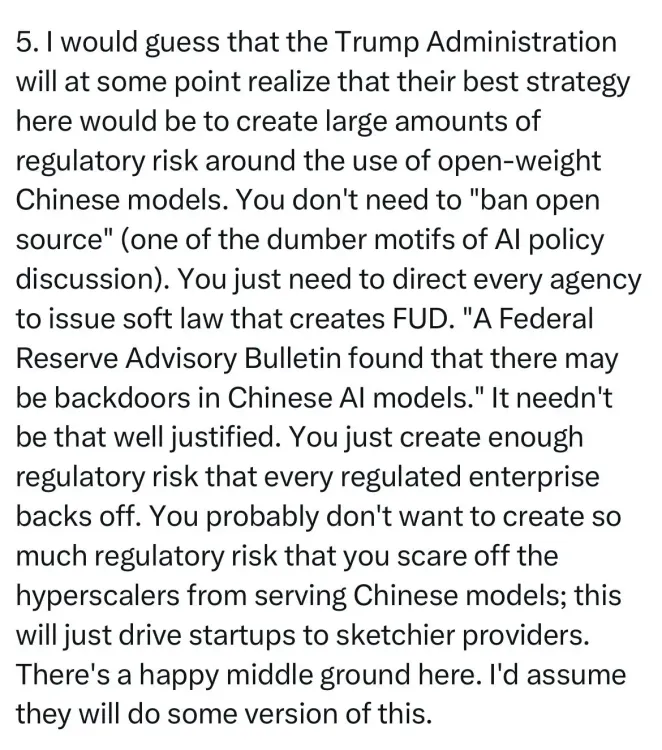
The strategy, attributed to commentator Dean Ball , would avoid an explicit ban and instead rely on regulatory FUD to push regulated enterprises away from Chinese models.
Sacks argued that 'implementing a surreptitious policy through manufactured doubt corrodes the rule of law and invites future abuse against anyone.' He described leading closed AI laboratories as already a 'duopoly in terms of AI model revenue' seeking government help to eliminate open-source competition.
Sacks called on the broader Silicon Valley community — which he said still values open competition — to publicly take a stand in the AI policy debate.
The statement is notable because Sacks himself is the Trump administration 's top AI and crypto adviser, making his public intervention a signal of internal policy tensions.
White House AI and Crypto Czar David Sacks on Sunday, 19 July 2026, issued a pointed rebuke of a strategy he described as weaponising regulatory uncertainty to suppress Chinese open-source AI models — warning that such an approach corrodes the rule of law and ultimately harms everyone. Sacks called on the broader Silicon Valley community to openly defend open competition against what he characterised as a push by dominant closed-model AI laboratories to use government machinery to eliminate their open-source rivals.
Context
Sacks was responding to an argument, attributed to commentator Dean Ball, that there is no need for an outright ban on Chinese open-source AI models. Instead, the argument goes, federal agencies could issue informal 'soft-law' warnings — guidance documents, advisories, and similar instruments — that generate enough fear, uncertainty, and doubt (FUD) among regulated enterprises to make them voluntarily avoid those models. Ball has since clarified he was predicting this outcome rather than endorsing it.
Sacks rejected both the strategy and its framing. Quoting Ball's phrase 'It needn't be that well justified,' he wrote: 'Regulatory decisions should always be well justified and grounded in facts, logic, and evidence, not the deliberate exploitation of fear and uncertainty.' He described implementing policy through 'manufactured doubt' as a threat to the rule of law that 'invites future abuse against anyone.'
Policy Backdrop
The debate sits at the intersection of two long-running tensions in US AI policy: promoting domestic innovation through open-source development versus imposing security-driven restrictions on foreign technology. The Biden administration's October 2023 executive order on Safe, Secure, and Trustworthy Artificial Intelligence directed federal agencies to develop AI standards and risk assessments, while the CHIPS and Science Act of 2022 authorised export controls aimed at maintaining US leadership in semiconductors and AI.
Successive administrations have preferred a layered toolkit — formal rules, export controls, and agency guidance — rather than outright bans on specific technologies, a pattern applied across semiconductor, software, and data sectors. The question now before the Trump administration, in which Sacks holds his AI and Crypto Czar role, is whether informal soft-law instruments can or should be used to achieve outcomes that explicit regulation has not yet sanctioned.
Stakeholders and Impact
Sacks identified the central fault line clearly: the leading closed AI laboratories, which he described as already constituting 'a duopoly in terms of AI model revenue,' have an interest in using government levers to suppress open-source competition — including models originating from China. Open-source developers, AI startups, and the enterprises that deploy their models stand on the other side of this divide.
For regulated industries — finance, healthcare, critical infrastructure — even informal agency guidance can carry the practical weight of a mandate. If agencies signal that Chinese open-source models carry unspecified risks without providing concrete evidence, compliance departments in those sectors are likely to steer clear regardless of any formal legal requirement. That outcome, Sacks argued, is precisely what the soft-law strategy is designed to produce.
What's Next
Sacks ended his post with a direct appeal: 'The leading closed labs... have laid their cards on the table. It is time for the rest of Silicon Valley — the vast majority that still values open competition — to do the same.' The statement amounts to a call for open-source advocates and smaller AI players to organise and make their position visible in the policy debate.
Congressional consideration of AI regulatory frameworks and any new executive orders or agency guidance from the Trump administration on model development and deployment will be the immediate arena to watch. Whether Sacks's intervention shifts the internal administration calculus — given his own role as the president's top AI and crypto adviser — makes this a moment of unusual public transparency about divisions within Washington DC's AI policy establishment.
Point of View
He is raising the evidentiary bar for any agency action targeting Chinese AI models, which will constrain how far the administration can go without explicit legislative backing. The appeal to 'the rest of Silicon Valley' suggests he is trying to mobilise a broader coalition before closed-lab lobbying consolidates its position in forthcoming Congressional AI legislation. For Indian AI startups and enterprises that use or build on open-source models, the outcome of this debate will directly shape which technologies remain accessible in global supply chains.
NationPress
20 Jul 2026
Frequently Asked Questions
Who is David Sacks and what is his role in the US government?
David Sacks is the White House AI and Crypto Czar in the Trump administration, responsible for advising on artificial intelligence and cryptocurrency policy. He is also co-founder of Craft Ventures and a co-host of the All-In Podcast.
What is 'soft-law' in AI regulation and why is Sacks opposed to it?
Soft-law refers to informal agency guidance, advisories, and warnings that are not legally binding but shape behaviour in regulated industries. Sacks opposes using it to suppress Chinese open-source AI models because it creates regulatory fear without factual justification, which he says corrodes the rule of law.
Why does Sacks call leading AI labs a 'duopoly'?
Sacks stated that the leading closed AI laboratories already dominate AI model revenue to the point of forming a duopoly, giving them a strong financial incentive to use government policy to eliminate open-source competitors rather than compete on merit.
What are Chinese open-source AI models and why are they controversial in the US?
Chinese open-source AI models are large language and multimodal models developed by Chinese companies and released publicly for others to use and modify. They are controversial in the US because of concerns about national security, data access, and the competitive advantage they may give Chinese technology firms.
How does this debate affect India and Indian AI companies?
Indian enterprises and AI startups that build on open-source models could be indirectly affected if US regulatory pressure causes global cloud providers and regulated partners to restrict access to Chinese open-source models, narrowing the ecosystem of freely available AI tools.