Is Securing U.S. Consent for Nuclear-Powered Subs a Major Achievement in Talks with Trump?
Click to start listening
Synopsis
In a pivotal moment for South Korea, President Lee Jae Myung has celebrated the achievement of gaining U.S. approval for nuclear-powered submarines during his talks with President Trump. This article delves into the implications of this agreement, the strategic considerations behind it, and Lee's stance on inter-Korean dialogue.
Key Takeaways
- Secured U.S. approval for nuclear-powered submarines is a pivotal achievement for South Korea.
- Domestic production of submarines is favored for military security and economic reasons.
- President Lee emphasizes the importance of dialogue with North Korea.
- South Korea's adherence to nonproliferation commitments remains a priority.
- Lee advocates for a mediating role in regional tensions between China and Japan.
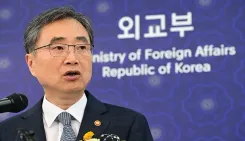
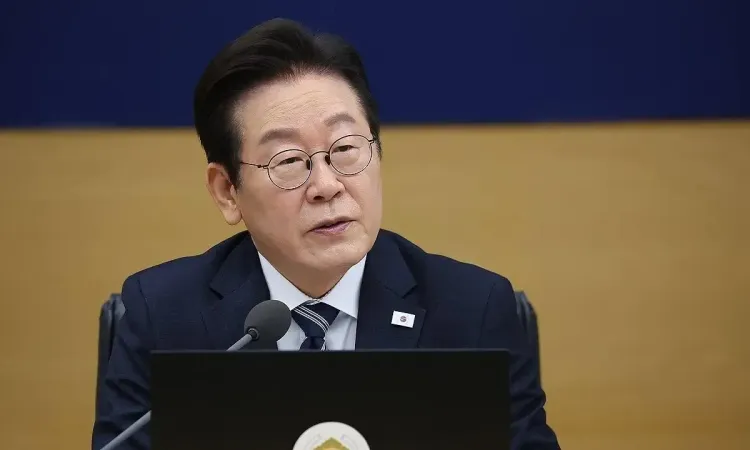
Seoul, Dec 3 (NationPress) President Lee Jae Myung of South Korea declared on Wednesday that securing U.S. consent for nuclear-powered submarines marks a significant accomplishment from his recent discussions with U.S. President Donald Trump.
During a press conference held with international media, Lee expressed optimism that the construction of a nuclear-powered submarine might occur in South Korea rather than in the United States, taking into account various economic and security considerations.
"This is a highly advantageous result for us, particularly in terms of strategic flexibility and autonomy," he commented, as reported by Yonhap News Agency.
"While President Trump has proposed constructing them at the Philadelphia shipyard, from our standpoint, it is realistically quite challenging," he added.
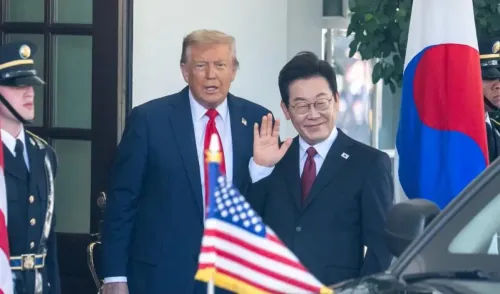
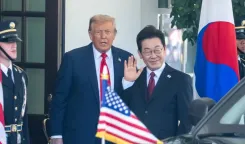
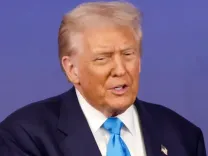
After meeting with Lee in Gyeongju during the APEC forum, Trump announced that he had granted approval for Seoul to develop nuclear-powered submarines, which will be manufactured at the shipyard operated by South Korea’s Hanwha Ocean.
"Producing them locally is preferable, considering military security and economic factors," Lee stated.
Lee firmly rejected worries that South Korea's initiative for nuclear-powered submarines would violate international nonproliferation agreements, emphasizing that South Korea fully adheres to its nonproliferation commitments.
"A nuclear submarine does not contain detonators or nuclear warheads," he clarified, noting that the reprocessing of spent fuel is not directly tied to nuclear proliferation.
"Denuclearization of the Korean Peninsula is a foundational principle both Koreas have agreed upon. Pursuing a nuclear buildup would be nonsensical. The U.S. would never endorse it, leading us to face severe economic sanctions and a fate similar to North Korea. Can we endure that?" he questioned.
Regarding the dialogue with North Korea, Lee remarked that stagnant inter-Korean relations should not obstruct efforts to revive discussions between Washington and Pyongyang, asserting that the U.S. "can play a significant role" in facilitating this.
"North Korea has outrightly dismissed our requests for talks, but there are numerous actions the U.S. can undertake," he noted. "North Korea regards the U.S. as the entity capable of providing security assurances for its regime."
Lee expressed his willingness to help establish conditions or offer "strategic leverage" to rejuvenate talks, including the possibility of reducing joint military exercises with the U.S.
"We will strive to create objective conditions for communication and cooperation at any moment. Adjusting the South Korea-U.S. joint military exercises is also part of that strategy," he stated.
As a liberal president, Lee has pledged to serve as a "pacemaker" to foster dialogue between Washington and Pyongyang, urging Trump to take on a "peacemaker" role by resuming discussions with North Korea's leader, Kim Jong-un.
When asked about the potential for apologizing to North Korea regarding alleged anti-Pyongyang leaflets distributed by former President Yoon Suk Yeol's administration, Lee mentioned he has contemplated this but has refrained due to fears it could incite ideological conflict at home.
"I have considered apologizing, but I have hesitated because I worry it might be used as a tool for pro-North labeling or provoke an ideological clash," he explained.
"I don’t know how you could read my mind and ask such a question. You must be able to read my thoughts," Lee said, declining to provide further details.
In a recent social media update, Lee claimed that "a war nearly broke out" due to the Yoon government attempting to invoke martial law as a pretext for conflict with the North, adding that the South's military dispatched anti-Pyongyang leaflets before the North retaliated.
Wednesday's press conference was part of the commemorations for the one-year anniversary of the attempted martial law imposition by Yoon on Dec. 3.
On the escalating tensions between China and Japan, Lee stated that South Korea could serve as a mediator whenever feasible, emphasizing that the nation does not intend to side with either party.
"Taking sides would only heighten the conflict. This principle applies to personal and international relations alike. Instead of choosing sides, it is preferable to seek coexistence," Lee remarked.
"Where possible, it is essential to minimize conflict and assume a mediating role," he added.
Regarding China, Lee emphasized that the two nations share an inseparable relationship based on geography, economy, history, and socio-cultural ties, expressing his desire to visit Beijing soon.
"Stable management of bilateral relations with China is crucial," he stated. "I hope to visit China shortly and conduct summit discussions with Chinese President Xi Jinping for extensive dialogue," he expressed.
"We should also explore security cooperation in Northeast Asia," he added.
Despite improved relations with Japan in recent years, historical issues stemming from Japan's colonial rule over Korea remain a deeply emotional topic for both nations, Lee noted.
"However, we should not abandon other areas for cooperation due to this issue. We can still pursue economic, security, cultural exchanges, and enhance ties between our peoples," he concluded.
When asked if Russia could assist in persuading North Korea to return to the negotiating table, Lee cautioned that its influence would be limited due to its ongoing aggression in Ukraine.
Point of View
The recent discussions between South Korea and the U.S. regarding nuclear-powered submarines represent a significant step towards strengthening South Korea's strategic autonomy. While concerns about nonproliferation must be addressed, the emphasis on domestic production aligns with broader security interests. It's crucial for South Korea to engage in constructive dialogue with North Korea, ensuring regional stability while navigating complex international relations.
NationPress
04/12/2025
Frequently Asked Questions
What was the main achievement of President Lee Jae Myung's talks with Donald Trump?
The primary achievement was securing U.S. approval for South Korea to develop nuclear-powered submarines.
Why does South Korea prefer to build submarines domestically?
Building submarines domestically is viewed as beneficial for military security and economic reasons.
How does President Lee view the potential for dialogue with North Korea?
President Lee believes that stalled inter-Korean relations should not hinder U.S.-North Korea talks and emphasizes the U.S.'s role in facilitating dialogue.
What are the implications of South Korea pursuing nuclear-powered submarines?
The pursuit of nuclear-powered submarines raises questions about nonproliferation commitments, but President Lee assures that South Korea remains committed to these obligations.
How does President Lee plan to mediate tensions between China and Japan?
President Lee aims to play a mediating role to reduce tensions, advocating for coexistence rather than taking sides.