Is Trump's Backing for Seoul's Nuclear Submarine Initiative a Sign of Cooperation Against Regional Threats?
Click to start listening
Synopsis
In a recent statement, a US diplomat highlighted President Trump's endorsement of South Korea's nuclear submarine project as a significant example of allied collaboration. This move aims to bolster defenses against regional threats, particularly from China, while reinforcing the longstanding alliance between the two nations.
Key Takeaways
- US supports South Korea's nuclear submarine initiative.
- Strengthening defense capabilities against regional threats.
- Alliance between the US and South Korea is stronger than ever.
- Commitment to North Korean denuclearization remains a priority.
- Efforts to improve visa processes for skilled South Korean workers.
Washington, Dec 4 (NationPress) A US diplomat has characterized President Donald Trump's endorsement of South Korea's initiative to construct nuclear-powered submarines as a definitive demonstration of collaboration aimed at strengthening the allies' joint capabilities to tackle regional threats.
Jonathan Fritz, the principal deputy assistant secretary of state for East Asian and Pacific affairs, made these statements during a forum on Wednesday (Washington time) amidst speculation that Trump's support for Seoul's pursuit of these strategic submarines is intended to mitigate challenges posed by an assertive China.
Emphasizing that the core elements of the Seoul-Washington alliance are more robust than ever, the diplomat noted that both nations are in total agreement regarding North Korea and reaffirmed America's unwavering commitment to deter threats against South Korea, as reported by Yonhap news agency.
“President Trump has also voiced US backing for the ROK to develop nuclear-powered, conventionally-armed submarines, collaborating with us to identify and tackle challenges and requirements,” he stated during the forum organized by the Center for Strategic and International Studies and the Korea Foundation. ROK refers to South Korea's official designation, the Republic of Korea.
“This is a notable instance of bilateral cooperation that enhances our collective abilities against regional threats,” he added.
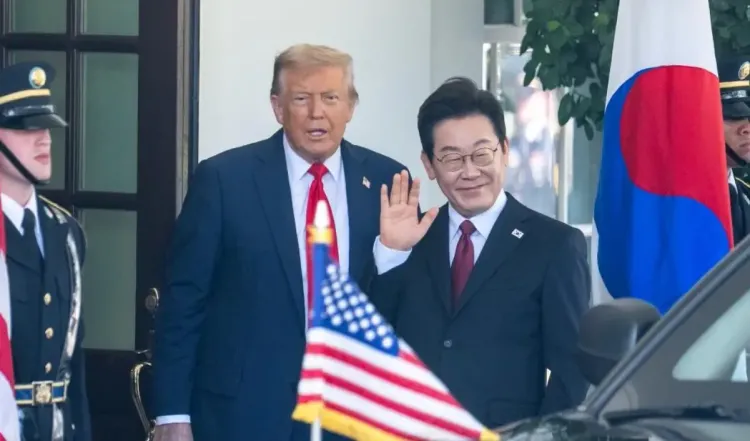
Following his second summit with South Korean President Lee Jae Myung in late October, Trump declared his agreement for Seoul to proceed with building the submarines. This endorsement coincided with Washington's calls for allies to boost their defense expenditures and capabilities amid efforts to counter the pacing threat from China.
In a recently published joint fact sheet detailing bilateral security and trade agreements, both Seoul and Washington highlighted their leaders' consensus on enhancing the US conventional deterrence posture against all regional threats to the alliance—language that seemingly reflects the US's request for Seoul to contribute to deterring Chinese threats.
Commenting on North Korea's policy, Fritz emphasized that Seoul and Washington remain aligned. “We continue to advocate for the complete denuclearization of the DPRK,” he remarked. DPRK is the official name of North Korea, the Democratic People's Republic of Korea.
“Both Presidents Trump and Lee endorse meaningful dialogue with the DPRK, urging it to adhere to its international obligations, which includes abandoning its weapons of mass destruction and ballistic missile initiatives.”
Furthermore, he noted the allies' maritime security cooperation within the Indo-Pacific, although he did not explicitly name China.
“We will also collaborate closely with the ROK and other partners throughout the Indo-Pacific to uphold the International Law of the Sea and maintain peace and stability, whether in the Taiwan Strait, the South China Sea, or elsewhere in the region,” he remarked.
Referring to the Asian ally as crucial to Trump's commitment to reindustrializing America, the official reiterated the necessity for ongoing South Korean investments in the US and for its personnel to operationalize those investments.
His comments followed efforts by Seoul and Washington to enhance the US visa system for skilled South Korean workers after a recent immigration crackdown at a Korean plant site in Georgia, which resulted in over 300 Korean workers being detained.
“President Trump has made it clear that we welcome Koreans to visit our country temporarily to train American workers in these high-precision roles,” he said. “We are committed to ensuring that qualified personnel can travel to the US to support the ROK's historic investments here in US manufacturing.”
He reported significant progress on the visa issue, including the establishment of the Korea Investment and Trade Desk at the US Embassy in Seoul to facilitate the specialized travel of Korean workers to the US.
Point of View
It is essential to recognize the growing significance of the US-South Korea alliance in today's geopolitical landscape. Trump's endorsement of South Korea's nuclear submarine development is a strategic move aimed at enhancing defense capabilities against regional threats, particularly from China. This cooperation highlights the commitment of both nations to maintain security and stability in the Indo-Pacific, reflecting a shared vision for a secure future.
NationPress
04/12/2025
Frequently Asked Questions
What prompted Trump's support for South Korea's nuclear submarines?
Trump's support is seen as a response to increasing threats from China and a reaffirmation of the strong US-South Korea alliance.
How will the submarines enhance regional security?
The submarines will bolster South Korea's defense capabilities, allowing for greater deterrence against potential aggressors in the region.
What is the significance of the US-South Korea alliance?
The alliance is crucial for maintaining peace and stability in the Indo-Pacific, countering threats from North Korea and China.
How does this affect North Korea's stance?
The development of nuclear submarines may pressure North Korea to engage in meaningful dialogue and adhere to international obligations.
What steps are being taken to enhance visa processes for South Korean workers?
Efforts are underway to improve the US visa system to facilitate skilled South Korean workers' travel for training in high-precision roles.