South Korea reaffirms US coordination after North Korea rocket launch delay row
Synopsis
South Korea's defence ministry was forced to defend its disclosure timeline after North Korea's 25 June weapons test — which Kim Jong-un personally oversaw — went unannounced for days. The episode has exposed a sensitive fault line in the Seoul-Washington intelligence-sharing arrangement, even as officials insist coordination was seamless throughout.
Key Takeaways
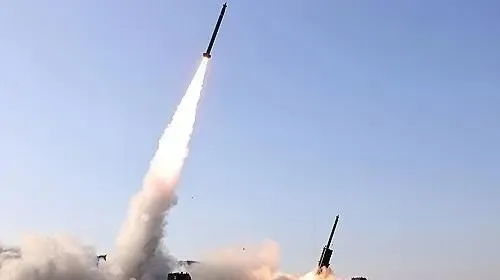
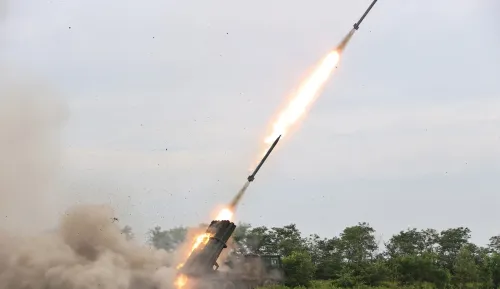
North Korea tested a new 240mm-calibre 24-tubular multiple rocket launcher , tactical ballistic missile warheads, and 155mm howitzer shells on 25 June , overseen by Kim Jong-un .
South Korea's Joint Chiefs of Staff (JCS) did not publicly disclose the launch on the day it occurred, drawing domestic criticism.
Lee Kyung-ho , deputy defence ministry spokesperson, confirmed both nations tracked the projectiles in real time between 7:27 a.m. and 8:20 a.m. on 25 June .
The JCS only publicly announces launches involving ballistic missiles that violate UN Security Council resolutions — the 25 June tests reportedly did not meet that bar.
A local media outlet raised the possibility that US restrictions on information-sharing may have limited Seoul's real-time tracking — a claim the defence ministry denied.
South Korea on Monday, 29 June said it is maintaining close coordination with the United States on North Korea's missile and weapons launches, pushing back against criticism over its belated public disclosure of the North's latest test-firing. The clarification came after questions emerged about whether Seoul had withheld information or failed to detect the launch in real time.
What North Korea Tested
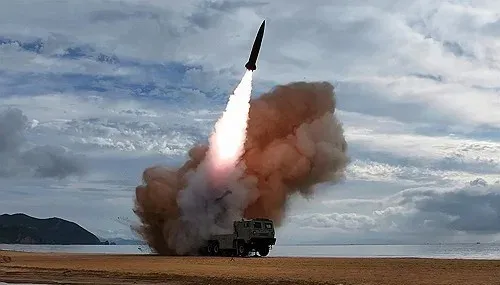
North Korea's state media confirmed on Friday that the country had conducted tests of a new multiple rocket launcher and other key weapons systems the previous day, 25 June, under the direct supervision of leader Kim Jong-un. The arsenal tested included an upgraded version of the 240mm-calibre 24-tubular multiple rocket launcher system, 'special mission' warheads for tactical ballistic missiles, and extended-range shells for a 155mm self-propelled howitzer, according to Pyongyang's state media.
The Disclosure Delay and the Questions It Raised
South Korea's Joint Chiefs of Staff (JCS) did not release details of the 25 June launch on the day it occurred, prompting scrutiny from domestic media and political observers. A local outlet raised the possibility that the US may have restricted information-sharing with South Korea on North Korea's military movements, potentially hampering Seoul's ability to track them in real time — a suggestion the defence ministry moved swiftly to counter.
What the Defence Ministry Said
'South Korea and the US detected and tracked in real time multiple projectiles launched by North Korea between 7:27 a.m. and 8:20 a.m. on 25 June, maintaining close coordination for all contingencies,' said Colonel Lee Kyung-ho, deputy defence ministry spokesperson, at a press briefing. He added that the projectiles have been classified as 'tactical weapons systems' and that detailed specifications would be finalised after a comprehensive analysis.
Col. Lee further stated: 'The bilateral information-sharing and coordination mechanism with the US remains seamless and our military maintains a 24-hour watertight readiness posture.' He urged against what he called political interpretations that could 'undermine the dedication of South Korean and US service members devoted to defending the Republic of Korea.'
Why the JCS Did Not Announce the Launch Earlier
According to reports citing Yonhap news agency, the JCS typically discloses North Korea launches only when they involve ballistic missiles that violate UN Security Council resolutions. The weapons tested on 25 June — rocket launchers, tactical warheads, and howitzer shells — reportedly did not meet that specific threshold, which explains the absence of an immediate public announcement. This distinction, however, was not communicated proactively, leaving room for speculation.
Broader Context and What Comes Next
The episode surfaces a recurring tension in the Seoul-Washington alliance: the gap between what each side knows and what is publicly disclosed, and when. North Korea has intensified its weapons testing cadence in recent years, and Kim Jong-un's personal oversight of these tests signals their strategic importance to Pyongyang. Analysts note that the inclusion of extended-range artillery and upgraded rocket systems suggests North Korea is broadening its conventional strike options alongside its nuclear programme. The JCS is expected to release a final technical assessment of the 25 June launches once analysis is complete.
Point of View
Especially when North Korea's state media beats the South's own defence establishment to the news cycle. The suggestion that Washington may have restricted intelligence-sharing with Seoul, however briefly floated, points to a deeper anxiety in the alliance: that the two sides do not always operate from the same information baseline. If that perception takes hold domestically in South Korea, it complicates the alliance's credibility at precisely the moment the Korean Peninsula requires it most.
NationPress
27 Sept 2026
Frequently Asked Questions
Why did South Korea not announce North Korea's 25 June missile launch immediately?
South Korea's Joint Chiefs of Staff typically discloses North Korean launches only when they involve ballistic missiles that violate UN Security Council resolutions. The 25 June tests — which included rocket launchers and howitzer shells — reportedly did not meet that specific threshold, so no immediate public announcement was made.
What weapons did North Korea test on 25 June?
North Korea tested an upgraded 240mm-calibre 24-tubular multiple rocket launcher system, 'special mission' warheads for tactical ballistic missiles, and extended-range shells for a 155mm self-propelled howitzer. The tests were personally overseen by leader Kim Jong-un, according to Pyongyang's state media.
Did the US limit intelligence-sharing with South Korea on the North Korean launch?
A South Korean media outlet raised this possibility, suggesting US restrictions may have hampered Seoul's real-time tracking. The South Korean defence ministry denied this, with Col. Lee Kyung-ho stating the bilateral information-sharing mechanism 'remains seamless' and that both nations tracked the projectiles in real time.
Who is Col. Lee Kyung-ho?
Col. Lee Kyung-ho is the deputy defence ministry spokesperson for South Korea. He addressed the disclosure controversy at a press briefing on 29 June, confirming joint US-South Korea detection of the North Korean projectiles and defending the military's readiness posture.
What happens next following North Korea's latest weapons test?
The South Korean JCS is expected to release a final technical assessment of the 25 June launches after a comprehensive analysis of the projectiles, which have been provisionally classified as 'tactical weapons systems.' Both Seoul and Washington say they remain in close coordination for all contingencies.