Did South Korea Propose a Legal Change to Acknowledge North Korea as a Separate Nation?

Synopsis
In a recent development, South Korea's unification ministry has denied claims of proposing a constitutional change to recognize North Korea as an independent nation. This article explores the implications of such a proposal, the current inter-Korean relations, and the military's updated guidelines amid ongoing tensions.
Key Takeaways
South Korea's unification ministry denies a report on constitutional changes.
The current Constitution does not recognize North Korea as an equal nation.
Updated military guidelines aim to prevent accidental clashes.
Inter-Korean relations remain complex and sensitive.
Importance of MDL markers in military operations is emphasized.
Seoul, Dec 22 (NationPress) The unification ministry of South Korea refuted a news article on Monday that suggested it had recommended a constitutional amendment to President Lee Jae Myung to officially acknowledge North Korea as a separate entity in efforts to revive dialogue with Pyongyang.
This response followed a local newspaper's report claiming that the ministry had proposed changing the Constitution to recognize North Korea as an independent nation during a private policy briefing to Lee last Friday.
Currently, the Constitution defines the entire Korean Peninsula as the sovereign territory of South Korea, thus not recognizing North Korea as an equal state, according to reports from Yonhap news agency.
Ministry spokesperson Yoon Min-ho labeled the report as “baseless and false” during a press briefing on Monday.
“The ministry did not propose any constitutional amendment during the policy discussion, nor have we ever contemplated such a move,” Yoon stated, voicing his “regret” over what he described as a “distorted report.”
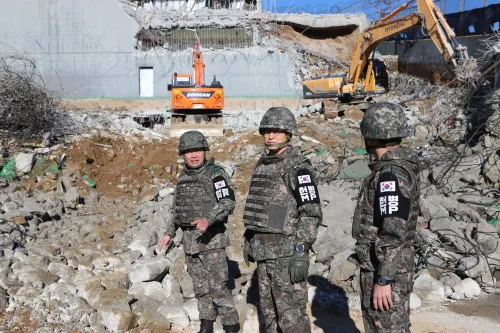
Moreover, officials indicated that the military has revised its internal guidelines regarding the inter-Korean land border to mitigate the risk of unintended clashes arising from North Korean incursions.
This adjustment follows multiple instances where North Korean troops have breached the Military Demarcation Line (MDL) within the Demilitarized Zone (DMZ) that separates the two Koreas, as they engaged in construction activities near the heavily fortified border since last year.
The Joint Chiefs of Staff (JCS) announced that troops have been instructed to focus on markers indicating the MDL when making operational decisions, while also comprehensively applying both the MDL on the South Korean military maps and a line connecting MDL markers established by the US-led United Nations Command (UNC).
This strategy effectively allows the military to utilize a line drawn further south in determining if North Korean troops have crossed the border.
Under the revised guidelines, even if North Korean forces cross the line connecting the MDL indicators, the South Korean military may opt not to respond if it assesses that it does not constitute an MDL breach according to its military map.
Nearly 1,300 markers were placed in 1953, a month after the armistice that concluded the Korean War, but only about one-sixth are currently identifiable. The UNC's maintenance efforts have been halted since 1973 when North Korean forces fired upon workers conducting the work.
The JCS distributed the update as an official order to subordinate units in September, as stated by spokesperson Lee Sung-jun during a regular press briefing.
Point of View
It's crucial to maintain a balanced perspective. The unification ministry's dismissal of the report indicates a cautious approach to handling sensitive inter-Korean relations. While dialogue is essential, the ministry's commitment to upholding the current constitutional framework reflects its stance on national sovereignty. The focus should remain on constructive engagement without compromising core principles.
NationPress
20 Sept 2026
Frequently Asked Questions
What did South Korea's unification ministry deny?
The unification ministry denied reports of proposing a constitutional revision to recognize North Korea as a separate nation.
What is the current constitutional stance on North Korea?
The South Korean Constitution defines the entire Korean Peninsula as the sovereign territory of South Korea, not recognizing North Korea as an equal state.
What measures has the military taken regarding North Korean incursions?
The military has updated guidelines to prevent accidental clashes with North Korean troops crossing the Military Demarcation Line.
How many markers were installed to define the MDL?
Approximately 1,300 markers were installed in 1953, but only about one-sixth are currently identifiable.
What has been the response from military officials?
Military officials have emphasized the importance of MDL markers in decision-making processes regarding border incidents.