South Korea protests Japan's Dokdo claim, demands immediate withdrawal
Synopsis
Japan's annual defence white paper renewed Tokyo's claim over Dokdo — and Seoul fired back through both foreign and defence ministry channels, summoning Japanese envoys and demanding immediate withdrawal. The episode lays bare a stubborn contradiction: Japan is simultaneously courting South Korea as a security partner against North Korea while relitigating a territorial dispute that Seoul considers closed.
Key Takeaways
South Korea's foreign ministry lodged a 'strong' protest on 4 August after Japan's defence white paper renewed its claim to Dokdo .
Japanese deputy chief of mission Kazuo Tsuchiya was summoned to the South Korean foreign ministry to receive the formal complaint.
Defence ministry official Kim Hak-jo separately summoned Japanese military attaché Takeshi Nagayoshi , marking a dual-channel diplomatic protest.
Spokesperson Park Doo-soon stated Japan's claim has 'no impact whatsoever' on South Korea's sovereignty over Dokdo .
The same Japanese white paper described South Korea as a key partner, highlighting a central contradiction in Tokyo's diplomatic posture.
South Korea maintains effective control of Dokdo through a permanent police detachment on the islets.
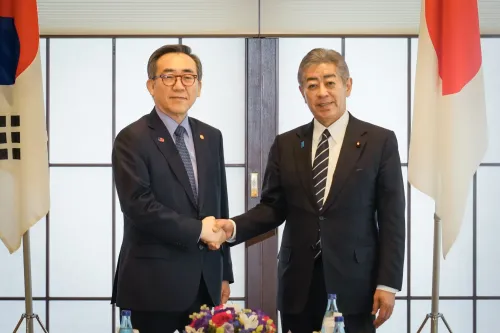
South Korea's foreign ministry on Tuesday, 4 August lodged a 'strong' protest against Japan after Tokyo renewed its territorial claim over the Dokdo islets in its latest annual defence white paper, demanding an immediate withdrawal of the claim. The ministry summoned Kazuo Tsuchiya, deputy chief of mission at the Japanese Embassy in Seoul, to receive the formal complaint.
Seoul's Official Position
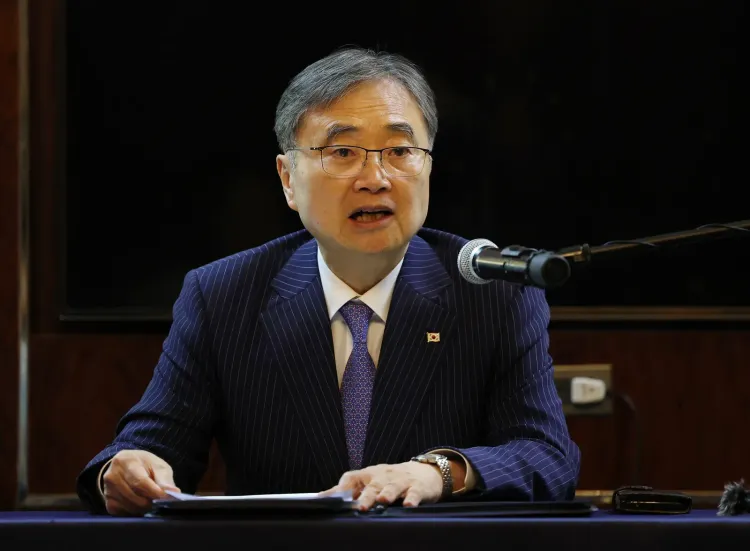
Foreign ministry spokesperson Park Doo-soon, speaking at a regular briefing, declared that the South Korean government 'strongly protests Japan's repeated, unjust territorial claim to Dokdo and calls for its immediate withdrawal.' He asserted that the islets are 'indisputably' South Korean territory under 'history, geography and international law.'
Park further stated: 'The government reaffirms that Japan's unjust claim has no impact whatsoever on our sovereignty over Dokdo and states that we will respond resolutely to any provocations by Japan regarding Dokdo.'
Defence Ministry Also Weighs In
Kim Hak-jo, director general for international policy at South Korea's defence ministry, separately summoned Takeshi Nagayoshi, a military attaché at the Japanese embassy, to lodge a parallel complaint and demand withdrawal of the claims. The dual-track diplomatic protest — through both foreign and defence channels — signals the seriousness with which Seoul is treating the renewed assertion.
Japan's White Paper and Its Contradictions
The Japanese Cabinet released its annual defence white paper earlier on Tuesday, renewing Tokyo's sovereignty claim over Dokdo — referred to as 'Takeshima' in Japanese official documents. Notably, the same white paper also emphasised the importance of bilateral relations with South Korea, describing Seoul as a partner and an important neighbour in confronting shared global challenges.
This comes amid Japan's active efforts to deepen security cooperation with South Korea, driven by North Korea's growing military and economic alignment with Russia and China, which poses an escalating threat to the broader region. Critics argue the simultaneous claim and partnership language reflects an unresolved tension at the heart of Tokyo's Korea policy.
A Long-Running Territorial Dispute
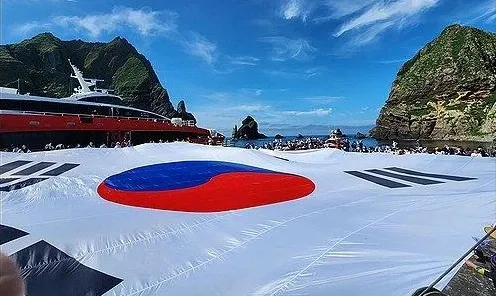
Dokdo — a cluster of small islets in the East Sea (Sea of Japan) — has been a recurring flashpoint between the two neighbours for decades. Japan continues to assert its claim through annual policy papers, public statements, and school textbooks, while South Korea maintains effective control, stationing a small police detachment on the islets.
This is not an isolated incident: Tokyo has made similar assertions in consecutive defence white papers, each triggering formal protests from Seoul. The pattern underscores how deeply the dispute is embedded in the bilateral relationship, even as both governments pursue closer strategic ties under regional security pressure.
With diplomatic temperatures rising over the white paper, the trajectory of Japan-South Korea security cooperation — critical to regional stability — will be closely watched in the weeks ahead.
Point of View
Through both foreign and defence ministries, is a calibrated escalation, but it changes little on the ground. What is underreported is the strategic cost: every annual white paper cycle erodes the bilateral trust that both governments need to operationalise their North Korea deterrence cooperation. Tokyo is effectively asking Seoul to compartmentalise history and security — a demand that South Korean domestic politics will not allow indefinitely.
NationPress
4 Aug 2026
Frequently Asked Questions
What is the Dokdo dispute between South Korea and Japan?
Dokdo is a cluster of small islets in the East Sea that South Korea administers and considers its sovereign territory under history, geography and international law. Japan disputes this, referring to the islets as 'Takeshima' and asserting its own claim annually through defence white papers, public statements and school textbooks.
Why did South Korea protest Japan's defence white paper on 4 August?
South Korea protested because Japan's latest annual defence white paper, released after a Cabinet meeting on 4 August, renewed Tokyo's territorial claim over Dokdo. Seoul summoned Japanese diplomatic and military representatives through both its foreign and defence ministries to demand an immediate withdrawal of the claim.
Who was summoned by South Korea over the Dokdo claim?
South Korea's foreign ministry summoned Kazuo Tsuchiya, deputy chief of mission at the Japanese Embassy in Seoul. Separately, the defence ministry summoned Takeshi Nagayoshi, a military attaché at the Japanese embassy, to lodge a parallel complaint.
Does Japan's Dokdo claim affect South Korea's actual control of the islets?
No. South Korea maintains effective control of Dokdo through a permanent police detachment stationed on the islets. Spokesperson Park Doo-soon stated that Japan's claim has 'no impact whatsoever' on South Korea's sovereignty over Dokdo.
How does the Dokdo dispute affect Japan-South Korea relations?
The dispute is a persistent irritant in an otherwise strategically important bilateral relationship. Notably, Japan's same defence white paper described South Korea as a key partner in addressing shared regional challenges — including North Korea's growing ties with Russia and China — even as it renewed the Dokdo claim, reflecting an unresolved tension at the core of Tokyo's Korea policy.