South Korea, Japan resume joint maritime drills after nine-year freeze
Synopsis
After a nine-year freeze triggered by a 2018 flyby incident, South Korea and Japan have resumed joint maritime search and rescue drills — deploying an Aegis destroyer and a landing ship southeast of Jeju Island. The revival, agreed at ministerial level and framed as strategic 'necessity', is the clearest military-operational signal yet of the two neighbours' ongoing defence reset.
Key Takeaways
South Korea and Japan held their first joint SAREX drill in nine years on 7 June , in international waters southeast of Jeju Island .
The drill involved South Korea's 4,900-tonne ROKS Cheon Ja Bong and Japan's 7,250-tonne Aegis-equipped Kongo destroyer .
The biennial SAREX programme, launched in 1999 , was suspended after its 10th round in 2017 following a diplomatic row over a December 2018 Japanese aircraft flyby incident.
Resumption was agreed at Defence Ministers' talks in January and confirmed at the Shangri-La Dialogue in Singapore .
Japanese Defence Minister Shinjiro Koizumi said the cooperation is driven by 'necessity', citing shared Indo-Pacific security challenges.
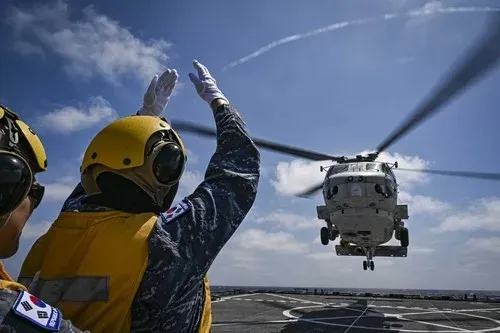
South Korea and Japan on Sunday, 7 June conducted their first joint maritime search and rescue exercise (SAREX) in nine years, the South Korean Navy confirmed. The drill, held in international waters southeast of Jeju Island, marks a significant reset in bilateral defence ties that had been strained for nearly a decade.
What the Exercise Involved
The drill was carried out jointly by the South Korean Navy and Japan's Maritime Self-Defence Force. South Korea deployed its 4,900-tonne ROKS Cheon Ja Bong landing ship, while Japan contributed the 7,250-tonne Aegis-equipped Kongo destroyer and a maritime patrol helicopter. The exercise trained both navies in coordinated response procedures for maritime incidents in waters near the Korean Peninsula.
Why the Drills Were Suspended
The biennial SAREX programme, launched in 1999, had been running every two years until its 10th round in 2017. It was suspended after a sharp diplomatic row in December 2018, when a Japanese maritime patrol aircraft made an unusually low-altitude flyby over a South Korean warship — an incident that deepened mutual suspicion and effectively froze defence-level exchanges between the two neighbours.
The Diplomatic Path to Resumption
The two countries agreed to revive the SAREX programme during Defence Ministers' talks in January. The schedule was formally announced at a subsequent bilateral ministerial meeting on the sidelines of the Asia Security Summit — commonly known as the Shangri-La Dialogue — held in Singapore last month.
Ahead of the Singapore talks, South Korea's Defence Minister Ahn Gyu-back described the expanding defence exchanges as 'ping-pong diplomacy', calling the development 'yet another milestone' in bilateral ties. Japanese Defence Minister Shinjiro Koizumi struck a more strategic note, saying such cooperation is driven not by goodwill alone but by 'necessity' in the face of shared regional security challenges.
The Broader Strategic Context
'To promote peace and stability in the Indo-Pacific region, it is important for Japan and South Korea to take a leading role, including through the US-Japan alliance, the US-ROK (Republic of Korea) alliance, and broader strategic cooperation to maintain and strengthen deterrence and response capabilities,' Koizumi said through an interpreter.
This comes amid growing concern over North Korea's missile programme and China's expanding naval footprint in the region. Notably, the resumption of the SAREX marks the first tangible military-operational outcome of the diplomatic thaw between Seoul and Tokyo that has been building since 2023. With both nations now signalling a return to structured defence engagement, the next scheduled SAREX round will be closely watched as a barometer of how durable this reset proves to be.
Point of View
Seoul and Tokyo have strong structural incentives to hold this reset together — but domestic political headwinds in both countries have derailed similar thaws before. The 'ping-pong diplomacy' framing is optimistic; the harder work of institutionalising these ties beyond ministerial goodwill has barely begun.
NationPress
21 Sept 2026
Frequently Asked Questions
What is the SAREX exercise between South Korea and Japan?
SAREX is a biennial joint maritime search and rescue exercise launched in 1999, designed to train the South Korean Navy and Japan's Maritime Self-Defence Force in coordinated responses to maritime incidents near the Korean Peninsula. Sunday's drill was the first since the programme was suspended after its 10th round in 2017.
Why were the South Korea-Japan maritime drills suspended?
The drills were suspended following a diplomatic dispute in December 2018, when a Japanese maritime patrol aircraft made an unusually low-altitude flyby over a South Korean warship, souring bilateral ties. The suspension lasted nearly nine years before the two sides agreed to resume.
Where was the 2025 SAREX drill conducted?
The exercise was held in international waters southeast of Jeju Island, involving the South Korean Navy's ROKS Cheon Ja Bong landing ship and Japan's Aegis-equipped Kongo destroyer, along with a Japanese maritime patrol helicopter.
How was the resumption of the drills agreed upon?
The two countries agreed to resume SAREX during Defence Ministers' talks in January 2025. The schedule was formally announced at bilateral ministerial talks on the sidelines of the Asia Security Summit (Shangri-La Dialogue) in Singapore last month.
What is the broader strategic significance of this exercise?
Both defence ministers framed the resumption in terms of Indo-Pacific security necessity rather than bilateral goodwill alone. It reflects a wider effort to strengthen trilateral deterrence alongside the US-Japan and US-ROK alliances amid shared concerns over North Korea and regional stability.